KI-Beratung Beta

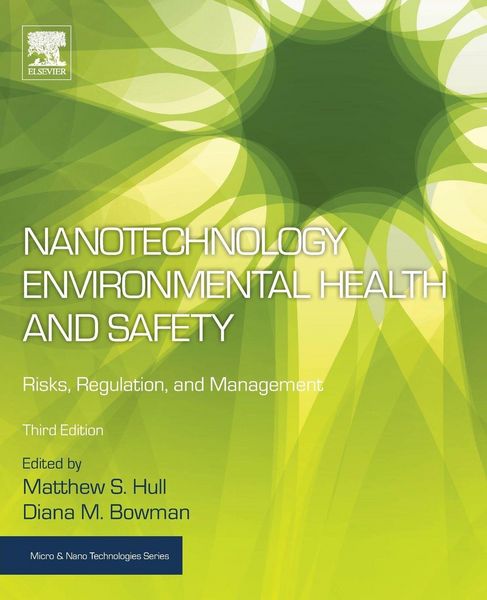
  • Produktbild: Nanotechnology Environmental Health and Safety
  • Produktbild: Nanotechnology Environmental Health and Safety

Nanotechnology Environmental Health and Safety Risks, Regulation, and Management

205,99 €

inkl. gesetzl. MwSt., Versandkostenfrei


Beschreibung

Produktdetails

Einband

Taschenbuch

Erscheinungsdatum

17.08.2018

Herausgeber

Matthew Scott Hull + weitere

Verlag

Elsevier Science & Technology

Seitenzahl

580

Maße (L/B/H)

23,5/19,1/3 cm

Gewicht

985 g

Auflage

3. Auflage

Sprache

Englisch

ISBN

978-0-12-813588-4

Beschreibung

Portrait

Matthew Hull has been an active part of the nanotechnology environmental health and safety (EHS) landscape for over two decades. In 2003, he developed the NanoSafeT framework, which provided an integrated approach for managing nanotechnology EHS risks. That framework led Hull to found NanoSafe, Inc., in 2007, and contributed pioneering programs in web-enabled nanotechnology EHS management systems, nanotechnology waste recovery and recycling processes, third-party test and verification services, and life-cycle ecotoxicological studies of nanomanufacturing. After 16 years as president/owner of NanoSafe, Inc., Hull successfully exited the company in 2023, through an acquisition by ITA International, LLC. Currently, Hull serves as Research Professor in Virginia Tech's Institute for Critical Technology and Applied Science (ICTAS) as well as Director for the Nanoscale Characterization and Fabrication Laboratory (NCFL) and the Materials Characterization Laboratory (MCL). He also serves as Associate Director for Innovation and Entrepreneurship for the NSF-funded US National Nanotechnology Coordinated Infrastructure (NNCI) and Virginia Tech's National Center for Earth and Environmental Nanotechnology (NanoEarth). He received his Ph.D. in Civil and Environmental Engineering from Virginia Tech in 2011 and an M.S. in Biology from Virginia Tech in 2002. He received his B.S. In Environmental Science from Ferrum College in 2000.

Dr. Diana Bowman is a Professor of Law in the Sandra Day O'Connor College of Law, where she serves as the Associate Dean for Applied Research and Partnerships and the School for the Future of Innovation and Society, at Arizona State University (ASU). Diana is a Co-Director of the Center for Smart Cities and Regions (CenSCR), a Faculty Innovation Fellow with ASU's University Technology Office and Andrew Carnegie Fellow (2018). Diana's research has primarily focused on the legal and policy issues associated with emerging technologies including, for example, nanotechnologies, CRISPR and autonomous vehicles. Diana's second pillar of work is within the sphere of public health law and policy, with a particular focus on road safety, assisted reproductive technologies and water safety.

Diana earned her Bachelor of Science (Physiology), a Bachelor of Law and a Doctor of Philosophy (Law) from Monash University (Australia). In August 2011 she was admitted to practice as a Barrister and Solicitor of the Supreme Court of Victoria (Australia). In December 2022 she graduated from the Thunderbird School of Global Management with a Masters of Global Leadership and Management (Executive Program).

Produktdetails

Einband

Taschenbuch

Erscheinungsdatum

17.08.2018

Herausgeber

Verlag

Elsevier Science & Technology

Seitenzahl

580

Maße (L/B/H)

23,5/19,1/3 cm

Gewicht

985 g

Auflage

3. Auflage

Sprache

Englisch

ISBN

978-0-12-813588-4

Herstelleradresse

Libri GmbH
Europaallee 1
36244 Bad Hersfeld
DE

Email: gpsr@libri.de

Noch keine Bewertungen vorhanden

Verfassen Sie die erste Bewertung zu diesem Artikel

Helfen Sie anderen Kundinnen und Kunden durch Ihre Meinung.

Kundinnen und Kunden meinen

Bewertungen (0)

Die Leseprobe wird geladen.
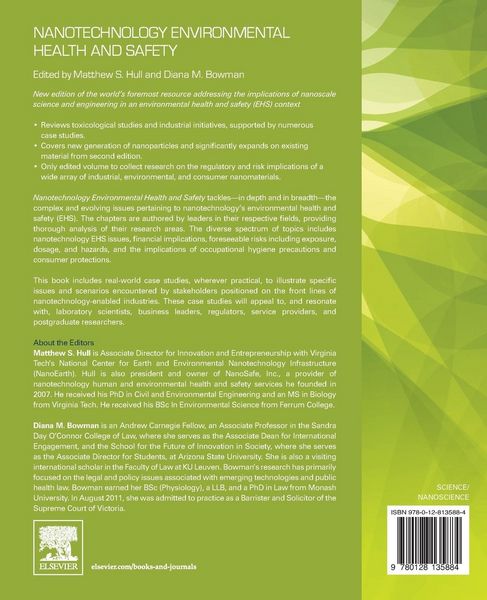
  • Produktbild: Nanotechnology Environmental Health and Safety
  • Produktbild: Nanotechnology Environmental Health and Safety
  • Part I: Precaution
    1. Nanotechnology Environmental Health and Safety - introduction
    2. Is there a need for any more environmental health and safety research on nanoparticles?
    3. Responsible Research and Innovation
    4. What are the warning signs that we should be looking forward?
    5. Emergency management of emerging technologies - nanotechnology
    6. The role of NGOs in shaping the Environmental Health and Safety nanotech agenda

    Part II: Progress
    7. Characterization of nanomaterials for nanoEHS studies
    8. Toxicological issues to consider when evaluating the safety of consumer products containing nanomaterials
    9. Long-term effects - assessing the chronic toxicity of engineered nanomaterials
    10. Workplace standards
    11. Nanomaterials ecotoxicology: a case study with nanosilver
    12. A Nanomaterial Registry
    13. Nanoinformatics: data driven materials design for health and environmental needs

    Part III: Perspectives
    14. A case study of a nanoscale-research facility safety through design and operation
    15. What should epidemioligists be looking for, or doing, to ensure worker safety?
    16. Commercialization of cellulose nanocrystal (NCCTM) production: A business case focusing on the importance of proactive EHS management
    17. Safe, rapid development of nanotechnologies
    18. Nanotechnology risk management: An insurance industry perspective
    19. Managing nanotechnology risks in small business
    20. Lowering insurance premiums - a how to guide for small nanotechnology businesses
    21. A nanotechnology legal framework
    22. The EPA/NSF funded centers for environmental implications of nanotechnology
    23. Two Steps Forward, One Step Back: Shaping the Nanotechnologies Landscape Through Regulatory Choice

    Part IV: Personal
    24. Consumer use of nanoparticles in sunscreens
    25. Cosmetics
    26. Cleaning products

    Part V: Prediction and Sustainability
    27. Exploring boundaries around the safe use of advanced materials: A Prospective Product-Based Case Studies approach
    28. What’s ahead - what can we expect from the nano-enabled materials and systems of the future
    29. Nanomaterial governance, planetary health and the sustainocene transition
    30. Sustainable nanotechnology: a regional perspective