Gutscheinbedingungen

**Gültig bis 06.07.2026 auf fremdsprachige Bücher online auf thalia.at, in der Thalia App ab einem Mindestbestellwert von 30€ und in allen Thalia Buchhandlungen in Österreich. In den Buchhandlungen nur gültig auf lagernde Ware. Einzelne Artikel können ausgeschlossen sein. Ausgenommen sind preisgebundene Artikel & eBooks. Pro Einkauf einmal einlösbar. Nur gültig gegen Vorlage oder im Onlineshop hinterlegter Bonuscard. Infos zur Einlösung in der Buchhandlung sind auf der Bonuscard-Vorteilspreisseite zu finden. Click & Collect nur bei Onlinevorabzahlung möglich. Keine Einlösung bei Scan & Go-Bezahlung. Keine Barauszahlung. Nicht kombinierbar mit anderen Aktionen und Gutscheinen. Gutschein wird auf max. 500€ Bestellwert angerechnet. Nicht gültig für Versandkosten und Services.

  • Produktbild: The Future of Museums
  • Produktbild: The Future of Museums

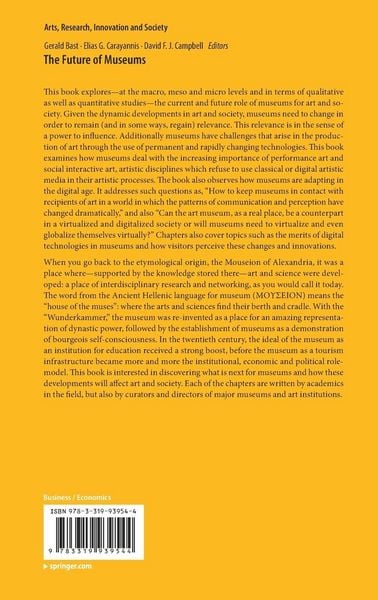
The Future of Museums

199,99 €

inkl. gesetzl. MwSt., Versandkostenfrei


Beschreibung

Produktdetails

Einband

Gebundene Ausgabe

Erscheinungsdatum

11.10.2018

Abbildungen

XII, 16 illus. in color., farbige Illustrationen

Herausgeber

Gerald Bast + weitere

Verlag

Springer

Seitenzahl

152

Maße (L/B/H)

24,1/16/1,5 cm

Gewicht

400 g

Auflage

1st ed. 2018

Sprache

Englisch

ISBN

978-3-319-93954-4

Beschreibung

Rezension

“The book will be of interest to all museum professionals and non-professionals alike. The book is easy to read and each chapter starts with an abstract providing an overview. … I can highly recommend this future orientated book for anyone involved in museums. … The book was easy to read and very relevant to understanding the changing nature of our society and how this influences leisure demands.” (Sabine Michaela Lehmann, Journal of Tourism Futures, Vol. 5 (3), 2019)

Portrait

Gerald Bast  studied law and economics at Johannes Kepler University Linz, worked between 1980 and 1999 at the Austrian Federal ministry for Higher Education and Research, responsible for university law and university reforms, been Rector of the University of Applied Arts Vienna since 2000 and was recently re-elected to remain in this position until 2023. As an author and editor, he has published on various subjects of university law and university management, cultural policy and the arts. He is member of the European Academy of the Arts and Sciences,Representative Board member of the European League of Institutes of the Arts, member of the Scientific Advisory Board of "Journal for university law, university management and higher education policy,” and a member of the advisory board of the European Forum Alpbach.

Elias G. Carayannis  is Full Professor of Science, Technology, Innovation and Entrepreneurship, as well as co-Founder and co-Director of the Global and Entrepreneurial Finance Research Institute (GEFRI) and Director of Research on Science, Technology, Innovation and Entrepreneurship, European Union Research Center, (EURC) at the School of Business of the George Washington University in Washington, DC. Dr. Carayannis‘ teaching and research activities focus on the areas of strategic Government-University-Industry R&D partnerships, technology road-mapping, technology transfer and commercialization, international science and technology policy, technological entrepreneurship and regional economic development.

David F.J. Campbell is a Quality Enhancement Expert and Quality Researcher at the University of Applied Arts in Vienna; a Lecturer and “Privat-Dozent” in Political Science at the University of Vienna; a Project Manager and Researcher at the Centre for Educational Management and Higher Education Development, Department for Continuing Education Research and Educational Management, at Danube University Krems; and a Fellow (Senior Scientist) at the Institute of Science Communication and Higher Education Research (WIHO), Faculty for Interdisciplinary Studies (iff), Alpen-Adria-University of Klagenfurt. He studied political science at the University of Vienna, completing his studies with a doctoral degree in 1996. In 2014, Campbell received a “Habilitation” (Doctor Habilitatus) from the University of Vienna with a Venia Docendi for Comparative Political Science. His articles on knowledge, innovation, knowledge economy and democracy (knowledge democracy and quality of democracy) have been published in several international journals.

Produktdetails

Einband

Gebundene Ausgabe

Erscheinungsdatum

11.10.2018

Abbildungen

XII, 16 illus. in color., farbige Illustrationen

Herausgeber

Verlag

Springer

Seitenzahl

152

Maße (L/B/H)

24,1/16/1,5 cm

Gewicht

400 g

Auflage

1st ed. 2018

Sprache

Englisch

ISBN

978-3-319-93954-4

Herstelleradresse

Springer-Verlag KG
Sachsenplatz 4-6
1201 Wien
AT

Email: GPSR Kontakt

Noch keine Bewertungen vorhanden

Verfassen Sie die erste Bewertung zu diesem Artikel

Helfen Sie anderen Kundinnen und Kunden durch Ihre Meinung.

Kundinnen und Kunden meinen

Bewertungen (0)

  • Produktbild: The Future of Museums
  • Produktbild: The Future of Museums
  • Below is a tentative Table of Contents and contributing authors:

    Chapter 1. Introduction: Gerald Bast, Elias G. Carayannis and David F. J. Campbell

    Chapter 2. The Future of Museums: Gerald Bast (gerald.bast@uni-ak.ac.at University of Applied Arts Vienna)

    Chapter 3.” Merits of digital technologies for the museum of the future” or “Potentials of digital technologies in the museum”: Judit Bényei (benyeiju@gmail.com ; benyei@mome.hu University of Art and Design Budapest, Hungary) & Zsófia Ruttkay (ruttkay@mome.hueUniversity of Art and Design Budapest, Hungary)

    Chapter 4. Entering the Flow: Museum between Archive and Gesamtkunstwerk: Boris Groys (groys@aol.com; New York University, U.S.A.; Karlsruhe University of Arts and Design, Germany)

    Chapter 5.Yoko Ono (e-mail address?; Museum of Contemporary Art, Brazil)

    Chapter 6. Greek Museums and Tourists’ Perceptions: An Empirical Research: Eleni Mavragani (e.mavragani@aegean.gr; Expert on Museums, Greece)

    Chapter 7. Imaginary Bauhaus Museum: Danica Dakic (danicadakic@yahoo.com; Bauhaus University Weimar, Germany) & Ulrike Bestgen (e-mail address?; Klassik Stiftung Weimar, Germany). 

    Chapter 8. Deciding the Museum: Joshua Decter (joshua.decter@gmail.com; Art Theorist and Curator, New York City, U.S.A.).” 

    Chapter 9. TBD: Nicolaus Schaffhausen (nicolaus.schafhausen@kunsthallewien.at;affiliation?)

    Chapter 10. Under the Spell of the User – The Future of Museums: Harald Kraemer (h.kraemer@cityu.edu.hk; Associate Professor, School of Creative Media, City University of Hong Kong, China)

    Chapter 11. TBD: Martin Roth (e-mail address?; Director of the Victoria and Albert Museum, London, UK)

    Chapter 12. ECM: Nora Sternfeld (nora.sternfeld@aalto.fi; Professor for Curating and Mediating Art, Department of Art, School of Arts, Design and Architecture,Aalto University, Finland) et al.

    Chapter 13. Conclusion: Elias G. Carayannis, Gerald Bast and David F. J. Campbell