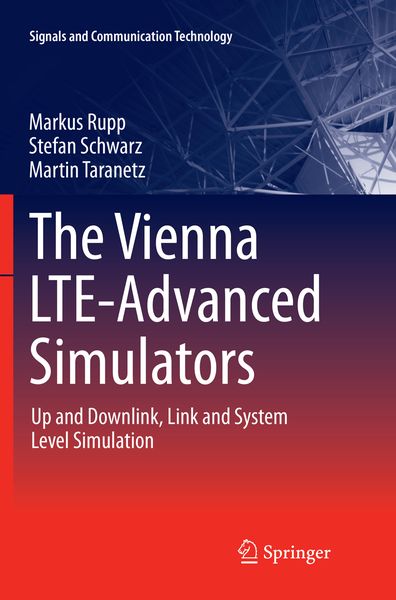
The Vienna LTE-Advanced Simulators Up and Downlink, Link and System Level Simulation
-
- Taschenbuch ausgewählt
- eBook
-
Sprache:Englisch
95,99 €
UVP
109,99 €
inkl. gesetzl. MwSt.,
Beschreibung
Produktdetails
Einband
Taschenbuch
Erscheinungsdatum
25.04.2018
Abbildungen
XXXIV, 357 p. 139 illus.
Verlag
Springer SingaporeSeitenzahl
357
Maße (B/H)
15,5/23,5 cm
Gewicht
593 g
Auflage
Softcover reprint of the original 1st ed. 2016
Sprache
Englisch
ISBN
978-981-10-9211-4
This book introduces
the Vienna Simulator Suite for 3rd-Generation Partnership Project
(3GPP)-compatible Long Term Evolution-Advanced (LTE-A) simulators and presents
applications to demonstrate their uses for describing, designing, and optimizing
wireless cellular LTE-A networks.
Part One addresses LTE
and LTE-A link level techniques. As there has been high demand for the downlink
(DL) simulator, it constitutes the central focus of the majority of the
chapters. This part of the book reports on relevant highlights, including
single-user (SU), multi-user (MU) and single-input-single-output (SISO) as well
as multiple-input-multiple-output (MIMO) transmissions. Furthermore, it
summarizes the optimal pilot pattern for high-speed communications as well as
different synchronization issues. One chapter is devoted to experiments that
show how the link level simulator can provide input to a testbed. This section
also uses measurements to present and validate fundamental results on
orthogonal frequency division multiplexing (OFDM) transmissions that are not
limited to LTE-A. One chapter exclusively deals with the newest tool, the
uplink (UL) link level simulator, and presents cutting-edge results.
In turn, Part Two
focuses on system-level simulations. From early on, system-level simulations have
been in high demand, as people are naturally seeking answers when scenarios
with numerous base stations and hundreds of users are investigated. This part
not only explains how mathematical abstraction can be employed to speed up
simulations by several hundred times without sacrificing precision, but also
illustrates new theories on how to abstract large urban heterogeneous networks
with indoor small cells. It also reports on advanced applications such as train
and car transmissions to demonstrate the tools’ capabilities.
Noch keine Bewertungen vorhanden
Verfassen Sie die erste Bewertung zu diesem Artikel
Helfen Sie anderen Kundinnen und Kunden durch Ihre Meinung.
Kurze Frage zu unserer Seite
Vielen Dank für Ihr Feedback
Wir nutzen Ihr Feedback, um unsere Produktseiten zu verbessern. Bitte haben Sie Verständnis, dass wir Ihnen keine Rückmeldung geben können. Falls Sie Kontakt mit uns aufnehmen möchten, können Sie sich aber gerne an unseren Kund*innenservice wenden.
zum Kundenservice