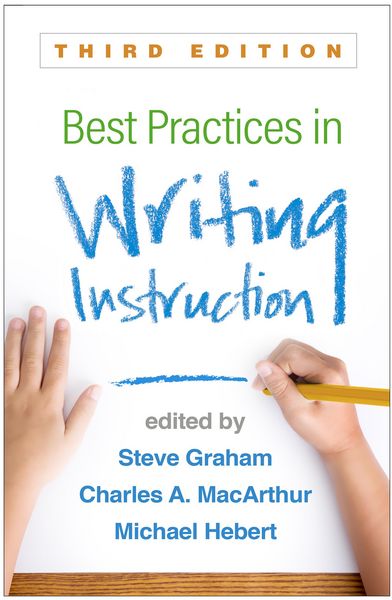
Best Practices in Writing Instruction
-
- Hardcover ausgewählt
- Taschenbuch
- eBook
-
Sprache:Englisch
89,99 €
inkl. gesetzl. MwSt.,
Beschreibung
Produktdetails
Einband
Gebundene Ausgabe
Erscheinungsdatum
26.12.2018
Herausgeber
Graham Steve + weitereVerlag
Taylor and FrancisSeitenzahl
416
Maße (L/B/H)
23,1/15,5/2,8 cm
Gewicht
780 g
Auflage
3. Auflage
Sprache
Englisch
ISBN
978-1-4625-3797-6
"This book thoughtfully answers the 'whys,' 'whats,' and 'how-tos' of effective writing instruction. Graduate students, general and special education teachers, and educational specialists will find the third edition packed with information to design and deliver a comprehensive writing curriculum. The book highlights evidence-based practices in the most important areas of writing instruction and assessment. New chapters on setting up the writing classroom and writing from sources fill in gaps from the second edition. Use this book in graduate literacy classes, school study groups, or individually to boost K–12 writing performance."--Natalie G. Olinghouse, PhD, Department of Educational Psychology, University of Connecticut "This is the best book available on how to teach writing effectively. It draws on current research to provide a comprehensive framework and set of tools for teaching writing. Every chapter in the third edition is filled with up-to-date, useful instructional practices. This text will be invaluable to both the research and practice communities."--Joanna P. Williams, PhD, Professor Emerita of Psychology and Education, Teachers College of Columbia University "Like its predecessors, the third edition is edited and written by scholar-practitioners who bring their vast research knowledge and rich experience working with students and schools to elevate the teaching of writing. Classroom teachers and teacher educators will appreciate the informative, readily applicable descriptions and recommendations offered in each chapter. The chapters on writing from source texts, writing to learn, digital writing tools, and assessment offer practical insights into some of the most complex aspects of K–12 writing instruction.”--Gary A. Troia, PhD, CCC-SLP, Department of Counseling, Educational Psychology, and Special Education, Michigan State University "Proficient writing is a competence that nowadays cannot be underestimated! Unfortunately, the teaching of writing still remains challenging for a majority of teachers throughout the world. This third edition provides necessary guidance and inspiration, and could not be more timely. Expert contributors report on the newest and most strongly supported instructional approaches for teaching writing from kindergarten through the secondary grades. The chapters are substantive, thorough, and research based, but at the same time accessible and practical. This volume is very well worth reading and translating into classroom practice."--Hilde Van Keer, PhD, Department of Educational Studies, Ghent University, Belgium "The third edition of Best Practices in Writing Instruction takes the guesswork out of writing instruction by providing a blueprint of proven strategies that can be used immediately. For instance, the authors include suggestions for teaching students to master each writing genre, which is essential in today’s classrooms. This book gives educators the knowledge to meet the needs of all students, including those who receive special education services. I recommend this book for undergraduate- and graduate-level teacher preparation courses, or as a resource for teachers who are interested in taking their instruction to the next level."--Stephen Ciullo, PhD, Special Education Program, Texas State University
Kundinnen und Kunden meinen
Verfassen Sie die erste Bewertung zu diesem Artikel
Helfen Sie anderen Kund*innen durch Ihre Meinung
Kurze Frage zu unserer Seite
Vielen Dank für Ihr Feedback
Wir nutzen Ihr Feedback, um unsere Produktseiten zu verbessern. Bitte haben Sie Verständnis, dass wir Ihnen keine Rückmeldung geben können. Falls Sie Kontakt mit uns aufnehmen möchten, können Sie sich aber gerne an unseren Kund*innenservice wenden.
zum Kundenservice