Gutscheinbedingungen

**Gültig bis 06.07.2026 auf fremdsprachige Bücher online auf thalia.at, in der Thalia App ab einem Mindestbestellwert von 30€ und in allen Thalia Buchhandlungen in Österreich. In den Buchhandlungen nur gültig auf lagernde Ware. Einzelne Artikel können ausgeschlossen sein. Ausgenommen sind preisgebundene Artikel & eBooks. Pro Einkauf einmal einlösbar. Nur gültig gegen Vorlage oder im Onlineshop hinterlegter Bonuscard. Infos zur Einlösung in der Buchhandlung sind auf der Bonuscard-Vorteilspreisseite zu finden. Click & Collect nur bei Onlinevorabzahlung möglich. Keine Einlösung bei Scan & Go-Bezahlung. Keine Barauszahlung. Nicht kombinierbar mit anderen Aktionen und Gutscheinen. Gutschein wird auf max. 500€ Bestellwert angerechnet. Nicht gültig für Versandkosten und Services.

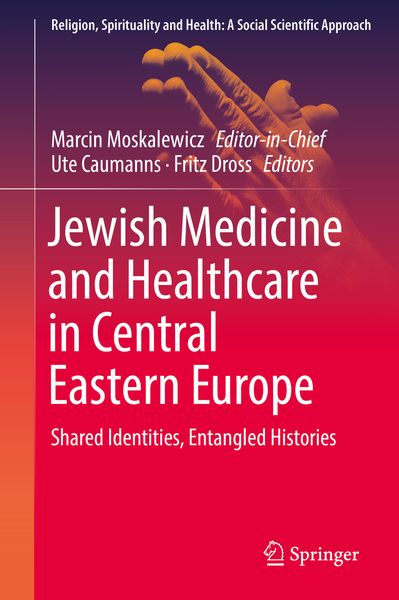
  • Produktbild: Jewish Medicine and Healthcare in Central Eastern Europe
  • Produktbild: Jewish Medicine and Healthcare in Central Eastern Europe
Band 3

Jewish Medicine and Healthcare in Central Eastern Europe Shared Identities, Entangled Histories

129,99 €

inkl. gesetzl. MwSt., Versandkostenfrei


Beschreibung

Produktdetails

Einband

Gebundene Ausgabe

Erscheinungsdatum

25.09.2018

Abbildungen

X, 6 illus., schwarz-weiss Illustrationen

Herausgeber

Marcin Moskalewicz + weitere

Verlag

Springer

Seitenzahl

277

Maße (L/B/H)

24,1/16/2,2 cm

Gewicht

600 g

Auflage

1st ed. 2019

Sprache

Englisch

ISBN

978-3-319-92479-3

Beschreibung

Portrait

Marcin Moskalewicz, born in Warsaw (Poland), studied history and philosophy of science at Adam Mickiewicz University in Poznan, University of California at Berkeley (2003) and Rijksuniversiteit Groningen (2005, 2007). In 2009 he defended Ph.D. in philosophy of history in the „European Doctorate“ framework (summa cum laude). Moskalewicz has been a Senior Fulbright Scholar at Texas A & M University (USA), a EURIAS Fellow at the Collegium Helveticum, University of Zurich/ETH Zurich (Switzerland) as well as a Marie Curie Fellow at the Faculty of Philosophy, University of Oxford. He works as an Assistant Professor at the Department of Social Sciences at Poznan University of Medical Sciences and holds a fellowship at The Oxford Research Centre in the Humanities (TORCH). Currently, his main research area is the philosophy of psychiatry.

Fritz Dross studied history and information science at the Heinrich-Heine-University in Düsseldorf (Germany). In 2002 he defended his PhD in modern history (Krankenhaus und lokale Politik, 1770-1850). In 2004 he became Assistant Professor at the Institute for the History of Medicine and Medical Ethics in Erlangen. In 2010 he completed his habilitation ( venia legendi ) with a work on late medieval and early modern urban leper care. He is currently Associate Professor at the Institute for the History of Medicine and Medical Ethics at the Friedrich-Alexander-Universität Erlangen-Nürnberg (Germany). He is current President of the German Society for the History of Hospitals (Deutsche Gesellschaft für Krankenhausgeschichte), and the German-Polish Society for the History of Medicine.

Produktdetails

Einband

Gebundene Ausgabe

Erscheinungsdatum

25.09.2018

Abbildungen

X, 6 illus., schwarz-weiss Illustrationen

Herausgeber

Verlag

Springer

Seitenzahl

277

Maße (L/B/H)

24,1/16/2,2 cm

Gewicht

600 g

Auflage

1st ed. 2019

Sprache

Englisch

ISBN

978-3-319-92479-3

Herstelleradresse

Springer-Verlag KG
Sachsenplatz 4-6
1201 Wien
AT

Email: GPSR Kontakt

Noch keine Bewertungen vorhanden

Verfassen Sie die erste Bewertung zu diesem Artikel

Helfen Sie anderen Kundinnen und Kunden durch Ihre Meinung.

Kundinnen und Kunden meinen

Bewertungen (0)

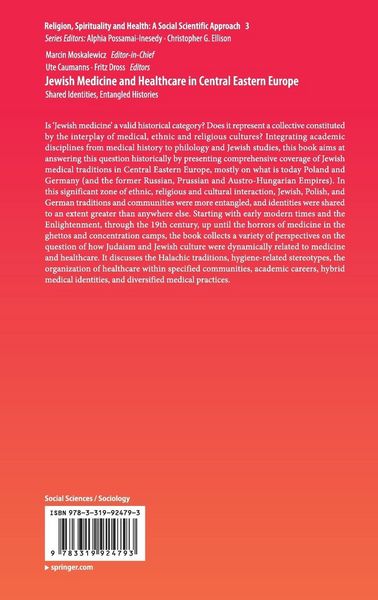
  • Produktbild: Jewish Medicine and Healthcare in Central Eastern Europe
  • Produktbild: Jewish Medicine and Healthcare in Central Eastern Europe
  • 1. Jewish – German – Polish: Histories and Traditions in Medical Culture (Marcin Moskalewicz).- Part I. Between Religious and Medical Authority: Early Modern Jewish Care for Body and Soul.- 2. Yiddish ‘Regimen Sanitatis Salernitanum’ from Early Modern Poland: A Humanistic Symbiosis of Latin Medicine and Jewish Thought (Ewa Geller).- 3. 'When the Rabbi Meets the Doctor': Differing Attitudes to Medical Diagnosis among Halakhic Authorities in Eastern and Central Europe in the 16th-19th Century (Eliezer Sariel).- 4. The Debate over Early Burial amongst Jews in the Duchy of Mecklenburg-Strelitz in the 1790s (Hans-Uwe Lammel).- Part II. Modern Jewish Healthcare: Community and the State.- 5. German Medicine, Folklore and Language in Popular Medical Practices of the Eastern European Jews (19th-20th century) (Marek Tuszewicki).- 6. Jewish Bodies and Jewish Doctors during the Cholera Years of the Polish Kingdom (Katharina Kreuder-Sonnen).- 7. Work of Jewish Medical Community and the Health Culture at School in the Second Republic of Poland (1918-1939) (Beata Szczepanska).- 8. A Survey of Jewish Healthcare in Poland after WWII (Ignacy Einhorn).- Part III. Shared Identities.- 9. German-Jewish Doctors as Members of the Colonial Health service in the Dutch East Indies in the First Half of the 19th Century (Philipp Teichfischer).- 10. Jewish Students from Silesia Studying at the Medical Faculty of Vienna University in the Years 1850-1938 According to the Records Regarding University Promotion and Requirements (Joanna Lusek).- 11. Between 'Here' and 'There': The Dual Identity of Dr. Izrael Milejkowski (Naomi Menuhin).- 12. A Doctor’s War Testimony: The Four Incarnations of “Dr. Twardy” (Monika Rice).- 13. „Ich bin ein Koszaliner”?   Struggles with Belongings in Borderlands. Leslie Baruch Brent’s Autobiography Sunday’s Child? A memoire (Miłosława Borzyszkowska-Szewczyk).- Part IV. Jewish Doctors in the Face of Terror and Extermination.- 14. Jewish Doctors: A place in Holocaust History (Ross Halpin).- 15. Fate of Jewish the Doctors – Members of the Jewish Chamber of Physicians in the Warsaw Ghetto (1940-1943) (Maria Ciesielska).- 16. Coping with the Impossible. The Developmental Roots of the Jewish Medical System in the Ghettos (Miriam Offer).