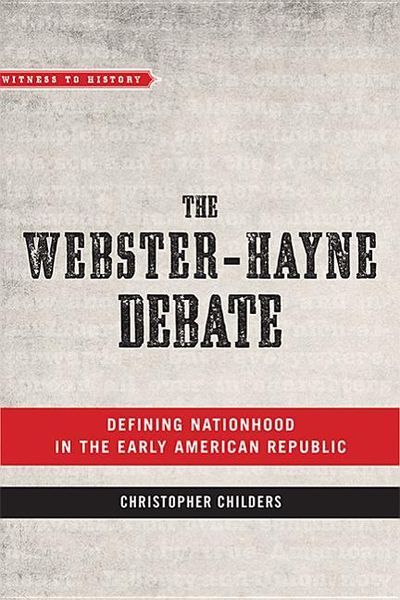
The Webster-Hayne Debate Defining Nationhood in the Early American Republic
-
- Hardcover ausgewählt
- Taschenbuch
- eBook
-
Sprache:Englisch
73,99 €
inkl. gesetzl. MwSt.,
Beschreibung
Produktdetails
Einband
Gebundene Ausgabe
Erscheinungsdatum
15.08.2018
Abbildungen
Raster,schwarz-weiss
Verlag
Johns Hopkins University PressSeitenzahl
184
Maße (L/B/H)
23,1/15,7/1,8 cm
Gewicht
386 g
Sprache
Englisch
ISBN
978-1-4214-2613-6
A crucial senatorial debate on the question of the states' relationship to the federal government.
Two generations after the founding, Americans still disagreed on the nature of the Union. Was it a confederation of sovereign states or a nation headed by a central government? To South Carolina Senator Robert Y. Hayne and others of his mindset, only the vigilant protection of states' rights could hold off an attack on the southern way of life, which was undergirded by slavery. Massachusetts Senator Daniel Webster, on the other hand, believed that the political and economic ascendancy of New England--and the nation--required a strong, activist national government.
In The Webster-Hayne Debate, Christopher Childers focuses on the sharp dispute that engaged Webster and Hayne in January 1830. During Senate discussion of western land policy, Childers explains, the senators' exchanges grew first earnest and then heated, finally landing on the question of union--its nature and its value in a federal republic. Childers argues that both Webster and Hayne, and the factions they represented, saw the West as key to the success of their political plans and sought to cultivate western support for their ideas.
A short, accessible account of the conflict and the related issues it addressed, The Webster-Hayne Debate captures an important moment in the early republic. Ideal for use in college classrooms or for readers interested in American history, this book examines a pivotal moment and a critical problem in the history of US politics. It also shows how Americans grappled with the issues of nationalism, sectionalism, and the meaning of union itself--issues that still resonate today.
Noch keine Bewertungen vorhanden
Verfassen Sie die erste Bewertung zu diesem Artikel
Helfen Sie anderen Kundinnen und Kunden durch Ihre Meinung.
Kurze Frage zu unserer Seite
Vielen Dank für Ihr Feedback
Wir nutzen Ihr Feedback, um unsere Produktseiten zu verbessern. Bitte haben Sie Verständnis, dass wir Ihnen keine Rückmeldung geben können. Falls Sie Kontakt mit uns aufnehmen möchten, können Sie sich aber gerne an unseren Kund*innenservice wenden.
zum Kundenservice