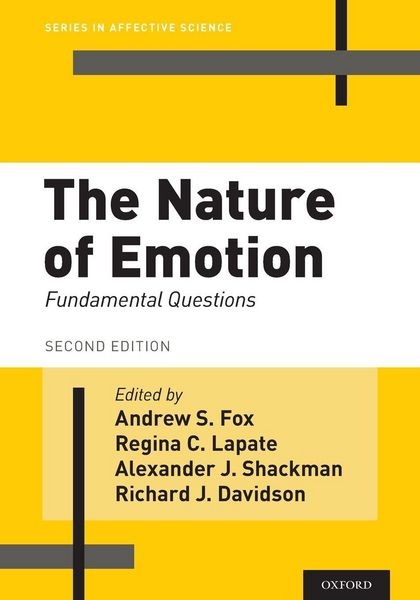
Produktbild: The Nature of Emotion

The Nature of Emotion Fundamental Questions

102,99 €

inkl. gesetzl. MwSt., Versandkostenfrei


Beschreibung

Produktdetails

Einband

Taschenbuch

Erscheinungsdatum

20.09.2018

Herausgeber

Andrew S. Fox + weitere

Verlag

Oxford Academic

Seitenzahl

634

Maße (L/B/H)

25,4/17,8/3,4 cm

Gewicht

1293 g

Sprache

Englisch

ISBN

978-0-19-061257-3

Beschreibung

Produktdetails

Einband

Taschenbuch

Erscheinungsdatum

20.09.2018

Herausgeber

Verlag

Oxford Academic

Seitenzahl

634

Maße (L/B/H)

25,4/17,8/3,4 cm

Gewicht

1293 g

Sprache

Englisch

ISBN

978-0-19-061257-3

Herstelleradresse

Libri GmbH
Europaallee 1
36244 Bad Hersfeld
DE

Email: gpsr@libri.de

Noch keine Bewertungen vorhanden

Verfassen Sie die erste Bewertung zu diesem Artikel

Helfen Sie anderen Kundinnen und Kunden durch Ihre Meinung.

Kundinnen und Kunden meinen

Bewertungen (0)

  • Produktbild: The Nature of Emotion
    • Acknowledgments

    • Contributors

    • Introduction

    • Preface to Paul Ekman's Essay

    • Richard J. Davidson

    • How emotions might work

    • Paul Ekman

    • Question 1. What is an emotion?

    • Emotions and feelings: William James and the present

    • Antonio Damasio and Hanna Damasio

    • Emotions are functional states that cause feelings and behavior

    • Ralph Adolphs

    • What is emotion? A natural science perspective

    • Peter J. Lang and Margaret M. Bradley

    • Affect is essential to emotion

    • Kent C. Berridge

    • Emotions: Causes and consequences

    • Gerald L. Clore

    • What are emotional states, and what are their functions?

    • Edmund T. Rolls

    • Active inference and emotion

    • Karl J. Friston, Mateus Joffily, Lisa Feldman Barrett and Anil K. Seth

    • Emotions are constructed with interoception and concepts within a predicting brain

    • Lisa Feldman Barrett

    • Afterword

    • Regina C. Lapate and Alexander J. Shackman

    • Question 2. How are emotions, mood and temperament related?

    • Distinguishing affective constructs: Structure, trait- vs. state-ness, and responses to affect

    • Kristin Naragon-Gainey

    • Inhibited temperament and intrinsic versus extrinsic influences on fear circuits

    • Jennifer Urbano Blackford and David H. Zald

    • Distinctions among moods and temperaments

    • Jerome Kagan

    • Distinctions between temperament and emotion: Examining reactivity, regulation, and social understanding

    • Lindsay C. Bowman and Nathan A. Fox

    • Afterword

    • Alexander J. Shackman, Regina C. Lapate and Andrew S. Fox

    • Question 3. What are the dimensions and bases for lasting individual differences in emotion?

    • Personality as lasting individual differences in emotions

    • Rebecca L. Shiner

    • The bases for preservation of emotional biases

    • Jerome Kagan

    • The psychological and neurobiological bases of dispositional negativity

    • Alexander J. Shackman, Melissa D. Stockbridge, Edward P. Lemay, Jr. and Andrew S. Fox

    • Reactivity, recovery, regulation: The three R's of emotional responding

    • Richard J. Davidson

    • Afterword

    • Alexander J. Shackman and Andrew S. Fox

    • Question 4. What is the added value of studying the brain for understanding emotion?

    • Studying the brain is necessary for understanding emotion

    • Tom Johnstone

    • Brain and emotion research: Contributions of patient and activation studies

    • Robert W. Levenson

    • Understanding emotion by unraveling complex structure-function mappings

    • Luiz Pessoa

    • Brain studies can advance psychological understanding

    • Kent C. Berridge

    • Afterword

    • Alexander J. Shackman and Regina C. Lapate

    • Question 5. How are emotions organized in the brain?

    • Discrete and dimensional contributions to emotion arise from multiple brain circuits

    • Ralph Adolphs

    • Brain limbic systems as flexible generators of emotion

    • Kent C. Berridge

    • At primal levels, via vast subcortical brain networks that mediate instinctual emotional reactions that help program higher-order emotional-cognitive abilities in higher regions of the brain and mind.

    • Jaak Panksepp

    • Brain architecture and principles of the organization of emotion in the brain

    • Luiz Pessoa

    • Variation and degeneracy in the brain basis of emotion.

    • Lisa Feldman Barrett

    • How are emotions organized in the brain?

    • Tor D. Wager, Anjali Krishnan and Emma Hitchcock

    • The brain is organized to emote

    • Andrew S. Fox

    • Neural circuit mechanisms for switching emotional tracks: From positive to negative and back again

    • Kay M. Tye

    • Afterword

    • Alexander J. Shackman and Andrew S. Fox

    • Question 6. When and in what ways are emotions adaptive and maladaptive?

    • The ambiguous issue of adaptive emotions

    • Jerome Kagan

    • Maladaptive emotions are inseparable from inaccurate appraisals

    • Phoebe C. Ellsworth

    • Emotions aren't maladaptive

    • Aaron S. Heller

    • Cultural neuroscience of emotion

    • Joan Y. Chiao

    • Positive emotions broaden and build: Consideration for how and when pleasant subjective experiences are adaptive and maladaptive

    • Barbara L. Fredrickson

    • The social nature of emotions: Context matters

    • Amy Lehrner and Rachel Yehuda

    • Afterword

    • Andrew S. Fox and Regina C. Lapate

    • Question 7. How are emotions regulated by context and cognition?

    • Emotion as an evolutionary adaptive pattern: The roles of context and cognition

    • D. Caroline Blanchard and Brandon L. Pearson

    • Individual differences in fear conditioning and extinction paradigms: Insights for emotion regulation

    • Marie-France Marin and Mohammed R. Milad

    • The role of context and cognition in the placebo effect

    • Lauren Y. Atlas

    • Emotional Intensity: It is the thought that counts

    • Gerald L. Clore and David A. Reinhard

    • Emotion regulation as a change of goals and priorities

    • Carien M. van Reekum and Tom Johnstone

    • Searching for implicit emotion regulation

    • Matthew D. Lieberman

    • Fighting fire with fire: Endogenous emotion generation as a means of emotion regulation

    • Haakon G. Engen and Tania Singer

    • Afterword

    • Alexander J. Shackman and Regina C. Lapate

    • Question 8. How do emotion and cognition interact?

    • The interplay of emotion and cognition

    • Hadas Okon-Singer, Daniel M. Stout, Melissa D. Stockbridge, Matthias Gamer, Andrew S. Fox and Alexander J. Shackman

    • The impact of affect depends on its object

    • Gerald L. Clore

    • Thoughts on cognition-emotion interactions and their role in the diagnosis and treatment of psychopathology

    • Keren Maoz and Yair Bar-Haim

    • Beyond cognition and emotion: Dispensing with a cherished psychological narrative

    • Alexandra Touroutoglou and Lisa Feldman Barrett

    • Can we advance our understanding of emotional behavior by reconceptualizing it as involving valuation?

    • Roshan Cools, Hanneke den Ouden, Verena Ly and Quentin Huys

    • Beyond the threat bias: Reciprocal links between emotion and cognition

    • Nick Berggren and Nazanin Derakshan

    • The cognitive-emotional brain

    • Luiz Pessoa

    • Emotional vs. rational systems, and decisions between them

    • Edmund T. Rolls

    • Afterword

    • Alexander J. Shackman and Regina C. Lapate

    • Question 9. How are emotions embodied in the social world?

    • Connections between emotions and the social world: Numerous and complex

    • Nancy Eisenberg and Maciel M. Hernández

    • Effects of emotion on interpersonal behavior: A motivational perspective

    • Edward P. Lemay, Jr.

    • Emotion in the social world

    • Carolyn Parkinson

    • The affective nature of social interactions

    • Dominic S. Fareri and Mauricio R. Delgado

    • On the significance of implicit emotional communication

    • Andrew S. Fox

    • Deconstructing social emotions: Empathy and compassion and their relation to prosocial behavior

    • Haakon G. Engen and Tania Singer

    • Afterword

    • Andrew S. Fox and Alexander J. Shackman

    • Question 10. How and why are emotions communicated?

    • Form of facial expression communication originates in sensory function

    • Daniel H. Lee and Adam K. Anderson

    • Expression of emotion: New principles for future inquiry

    • Dacher Keltner, Daniel T. Cordaro, Jessica Tracy, and Disa Sauter

    • The (more or less accurate) communication of emotions serves social problem solving

    • Ursula Hess

    • Making sense of the senses in emotion communication

    • Wen Li, Lucas R. Novak, and Yuqi You

    • Movement and manipulation: the how and why of emotion communication

    • Lasana T. Harris

    • Concepts are key to the "communication" of emotion

    • Maria Gendron and Lisa Feldman Barrett

    • The web of emotion understanding in human infants

    • Betty M. Repacholi and Andrew N. Meltzoff

    • The dynamic-interactive model approach to the perception of facial emotion

    • Jonathan B. Freeman

    • Afterword

    • Regina C. Lapate and Andrew S. Fox

    • Question 11. How are emotions physically embodied?

    • How and why emotions are embodied

    • Adrienne Wood, Jared Martin and Paula Niedenthal

    • Emotion in body and brain: Context-dependent action and reaction

    • Margaret M. Bradley and Peter J. Lang

    • The importance of the mind for understanding how emotions are embodied

    • Naomi I. Eisenberger

    • How are emotions physically embodied?

    • Rosalind W. Picard

    • Pain as an embodied emotion

    • Tim V. Salomons

    • How are emotions organized and physically embodied?

    • Bruce S. McEwen

    • The complex tapestry of emotion: immune and microbial contributions

    • Melissa A. Rosenkranz

    • Afterword

    • Andrew S. Fox and Alexander J. Shackman

    • Question 12. What is the role of conscious awareness in emotion?

    • Emotions are more than their subjective feelings

    • Kent C. Berridge

    • Reactive emotional processing in the absence of conscious awareness

    • Joshua M. Carlson

    • What is the role of unconscious emotions and of conscious awareness in emotion?

    • Beatrice de Gelder and Marco Tamietto

    • Self-regulating our emotional states when we are conscious of them and when we are not

    • Leanne Williams

    • Regulatory benefits of conscious awareness: Insights from the emotion misattribution paradigm and a role for lateral prefrontal cortex

    • Regina C. Lapate

    • Afterword

    • Regina C. Lapate and Andrew S. Fox

    • Question 13. How are emotions integrated into choice?

    • How can affect influence choice?

    • Brian Knutson and Mirre Stallen

    • Emotions through the lens of economic theory

    • Agnieszka Tymula and Paul Glimcher

    • Emotions as computational signals of goal error

    • Luke J. Chang and Eshin Jolly

    • Affect is the foundation of value

    • Catherine Hartley and Peter Sokol-Hessner

    • Emotion, value, and choice

    • Jolie Wormwood and Lisa Feldman Barrett

    • Emotions can bias decision-making processes by promoting specific behavioral tendencies

    • Jan B. Engelmann and Todd A. Hare

    • Emotions are important for advantageous decision-making: A neuropsychological perspective

    • Justin Reber and Daniel Tranel

    • From emotion to motion: Making choices based on current states and biological needs

    • Elisabeth A. Murray

    • Afterword

    • Andrew S. Fox and Regina C. Lapate

    • Question 14. What develops in emotional development?

    • The recognition of emotion during the first years of life

    • Julia Cataldo and Charles A. Nelson

    • Everything develops during emotional development

    • Hill H. Goldsmith

    • Stability and change in emotion-relevant personality traits in childhood and adolescence

    • Rebecca L. Shiner

    • Normative trajectories and sources of psychopathology risk in adolescence

    • Leah H. Somerville and Katie A. McLaughlin

    • What happens in emotional development? Adolescent emotionality

    • Eveline A. Crone and Jennifer H. Pfeifer

    • Goals change with age and benefit emotional experience

    • Candice Hogan, Tamara Sims and Laura L. Carstensen

    • Ideal ends in emotional development

    • Carol D. Ryff

    • Afterword

    • Regina C. Lapate and Alexander J. Shackman

    • Epilogue-The nature of emotion: A research agenda for the 21st century

    • Andrew S. Fox, Regina C. Lapate, Richard J. Davidson and Alexander J. Shackman

    • References

    • Index