KI-Beratung Beta

Gutscheinbedingungen

**Gültig bis 18.11.2026 auf englischsprachige Klassiker (klassiker-32728) online auf thalia.at und in der Thalia App. Einzelne Artikel können ausgeschlossen sein. Ausgenommen sind preisgebundene Artikel & eBooks. Pro Einkauf einmal einlösbar. Click & Collect nur bei Onlinevorabzahlung möglich. Keine Barauszahlung. Nicht kombinierbar mit anderen Aktionen und Gutscheinen. Gutschein wird auf max. 500€ Bestellwert angerechnet. Nicht gültig für Geschenkkarten, Versandkosten und Services.

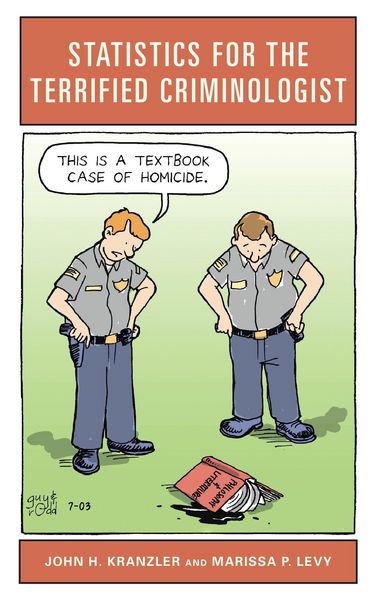
Produktbild: Statistics for the Terrified Criminologist

Statistics for the Terrified Criminologist

76,99 €

inkl. gesetzl. MwSt., Versandkostenfrei


Beschreibung

Statistics for the Terrified Criminologist is a user-friendly introduction to elementary statistics, intended primarily for the reluctant, math-anxious/avoidant criminology student. Written in a personal and informal style, with healthy doses of humor and encouragement, the aim of this book is to help...

Beschreibung

Statistics for the Terrified Criminologist is a user-friendly introduction to elementary statistics, intended primarily for the reluctant, math-anxious/avoidant criminology student. Written in a personal and informal style, with healthy doses of humor and encouragement, the aim of this book is to help readers make the leap from apprehension to comprehension of elementary statistics. Statisticsfor the Terrified Criminologist includes step-by-step instructions on how to run basic statistical tests in SPSS (Statistical Package for the Social Sciences) and is intended to serve as a comprehensive text for criminology courses in statistics and research methods; as a refresher for criminology students who have already taken a statistics course; and as a primer for new students of elementary statistics. Millions of people have math anxiety; yet this fact is rarely taken into consideration in textbooks on statistics. This book also presents self-help strategies (based on the cognitive behavioral techniques of rational emotive therapy) that help people manage their math anxiety so they can relax and build confidence while learning statistics. Statistics for theTerrified Criminologist makes statistics accessible to people by helping them manage their anxiety and presenting them with other essential materials for learning statistics before jumping into statistics.

Produktdetails

Einband

Taschenbuch

Erscheinungsdatum

10.12.2018

Abbildungen

27 b/w illustrations;110 b/w photos; 37 tables; 16 textboxes

Verlag Rowman & Littlefield

Produktdetails

Einband

Taschenbuch

Erscheinungsdatum

10.12.2018

Abbildungen

27 b/w illustrations;110 b/w photos; 37 tables; 16 textboxes

Verlag Rowman & Littlefield
Seitenzahl

248

Maße (L/B/H)

22,6/15,2/1 cm

Gewicht

299 g

Sprache

Englisch

ISBN

978-1-5381-0869-7

Herstelleradresse

Libri GmbH
Europaallee 1
36244 Bad Hersfeld
DE

Email: gpsr@libri.de

Noch keine Bewertungen vorhanden

Verfassen Sie die erste Bewertung zu diesem Artikel

Helfen Sie anderen Kundinnen und Kunden durch Ihre Meinung.

Kundinnen und Kunden meinen

Bewertungen (0)

Weitere Artikel finden Sie in

Die Leseprobe wird geladen.
  • Produktbild: Statistics for the Terrified Criminologist
  • Preface
    Acknowledgments

    Section I

    Essentials for Statistics

    1 Effective Strategies for Studying Statistics
    Self-assessment
    Assumptions about the Reader
    Effective Strategies for Studying Statistics

    2 Overcoming Math Anxiety
    What Causes Math Anxiety?
    Overview of Rational Emotive Therapy
    Irrational Beliefs
    How to Deal with Math Anxiety

    3 How to Use SPSS
    What is SPSS?
    Starting SPSS
    Basic Steps in SPSS Data Analysis
    Entering Data
    Selecting an Analysis
    Running an Analysis and Examining Results
    Finding Help in SPSS

    Section II
    Describing Univariate Data

    4 Frequency Distributions
    What are statistics?
    Variables
    Levels of Measurement
    Frequency Distributions
    Grouped Frequency Distributions
    Graphing Data
    Frequency Polygon
    Histogram
    Cumulative Frequency Polygon
    Normal Curve
    Skewed and Multimodal Distributions
    Problems
    Answers to Problems

    5 Descriptive Statistics
    What are statistics?
    Measures of Central Tendency
    Selecting a Measure of Central Tendency
    Measures of variability
    Problems
    Answers to Problems

    6 The Normal Curve
    What is the Normal Curve?
    The Normal Curve as a Model
    Proportions of Scores Under the Normal Curve
    Problems
    Answers to Problems

    7 Percentiles and Standard Scores
    Percentiles
    Standard Scores (Z score)
    Other Standard Scores
    T Scores
    Converting Standard Scores to Percentiles
    A Word of Warning
    Problems
    Answers to Problems

    Section III
    Inferential Statistics

    8 Introduction to Inferential Statistics
    Probability
    The Sampling Experiment
    Sample Values (Statistics) and Population Values (Parameters)
    The Null Hypothesis

    Type I and Type II Errors
    Statistical Significance and Type I Error
    Effect Size and Power
    Problems
    Answers to Problems

    9 The t Test
    The t Test for Independent Samples
    Assumptions for Using the t Test for Independent Samples
    Formula for the t Test for Independent Samples
    The Critical Value of t: tcrit
    Effect Size for the t Test for Independent Samples
    The t Test for Dependent (Matched/Paired) Samples
    Directional Versus Nondirectional Tests
    Problems
    Answers to Problems

    10 Analysis of Variance (ANOVA)
    Analysis of Variance
    Assumptions for using ANOVA
    Conducting an ANOVA in SPSS
    Strength of Association
    Post hoc Analysis
    The Scheffé Method of Post-Hoc Analysis
    Problems

    Answers to Problems

    11 Nonparametric Statistics: Chi-square
    Nonparametric Statistical Tests
    The One-way Test of Chi-square ()
    The Two-way Test of Chi-square ()
    Effect Size for Chi-Square Tests of Independence
    A Bit More
    Problems
    Answers to Problems

    Section IV
    Correlation Coefficients and Linear Regression

    12 Correlation Coefficients
    Correlation Coefficients
    Pearson Product-Moment Correlation Coefficient
    Interpreting Correlation Coefficients
    Sources of Misleading Correlation Coefficients
    Creating a Scatterplot
    Other Methods of Correlation
    Spearman Rank Correlation Coefficient
    Problems
    Answers to Problems

    13 Linear Regression

    Regression Equations
    Standard Error of the Estimate
    Problems
    Answers to Problems

    14 Postscript
    Congratulations!
    Review of Book

    Appendices
    A Basic Math Review
    B Proportions of Area Under the Standard Normal Curve
    C Critical Values of t
    D Glossary of Formulas
    Index