Gutscheinbedingungen

**Gültig von 22.06.2026 ab 19 Uhr bis 23.06.2026 24 Uhr auf Spielzeug, Schreibwaren, Filme, Geschenke & Trends, Musik, tolino eReader & Zubehör, Hörbücher und Hörbuch-Downloads (außer Abo), nicht preisgebundene Bücher und Kalender online auf thalia.at und in der Thalia App. Einzelne Artikel können ausgeschlossen sein. Aufgrund der Buchpreisbindung sind deutschsprachige Bücher und eBooks ausgenommen. Zusätzlich ausgenommen sind preisgebundene Artikel, Abos & Flatrates, eBooks, Games, Geschenkkarten/-boxen, Shelfies, Software, Zeitschriften sowie einzelne Artikel von tonies®. Pro Einkauf einmal einlösbar. Click & Collect nur bei Onlinevorabzahlung möglich. Keine Barauszahlung. Nicht kombinierbar mit anderen Aktionen und Gutscheinen. Gutschein wird auf max. 500€ Bestellwert angerechnet. Nicht gültig für Versandkosten und Services.

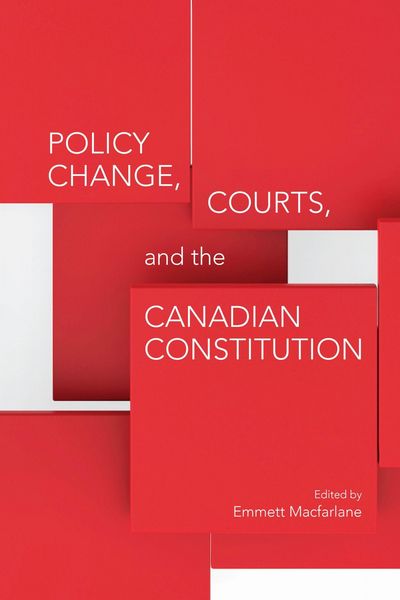
  • Produktbild: Policy Change, Courts, and the Canadian Constitution
  • Produktbild: Policy Change, Courts, and the Canadian Constitution

Policy Change, Courts, and the Canadian Constitution

38,99 €

inkl. gesetzl. MwSt., Versandkostenfrei


Beschreibung

Produktdetails

Einband

Taschenbuch

Erscheinungsdatum

24.11.2018

Herausgeber

Emmett Macfarlane

Verlag

University of Toronto Press

Seitenzahl

464

Maße (L/B/H)

22,6/15,2/3 cm

Gewicht

702 g

Sprache

Englisch

ISBN

978-1-4875-2315-2

Beschreibung

Rezension

"Why, when, and how courts make policy is not only grist for law faculties and practitioners. Public policy effects change in Canada - and occasionally that change is truly uncharted...The questions posed in this book are fundamental."

- Michael Bryant (Literary Review of Canada, Vol 27, no. 2)

"The case studies in this text are fascinating and provide insight into how changes in public policy have (or have not) come into effect."

- Julie Hetherington-Field, Norton Rose Fulbright Canada (Canadian Law Library Review)

Produktdetails

Einband

Taschenbuch

Erscheinungsdatum

24.11.2018

Herausgeber

Emmett Macfarlane

Verlag

University of Toronto Press

Seitenzahl

464

Maße (L/B/H)

22,6/15,2/3 cm

Gewicht

702 g

Sprache

Englisch

ISBN

978-1-4875-2315-2

Herstelleradresse

Libri GmbH
Europaallee 1
36244 Bad Hersfeld
DE

Email: gpsr@libri.de

Kundinnen und Kunden meinen

0 Bewertungen

Informationen zu Bewertungen

Zur Abgabe einer Bewertung ist eine Anmeldung im Konto notwendig. Die Authentizität der Bewertungen wird von uns nicht überprüft. Wir behalten uns vor, Bewertungstexte, die unseren Richtlinien widersprechen, entsprechend zu kürzen oder zu löschen.

Die Bewertungen sind nach Format, Anzahl Sterne und Datum sortiert.

Verfassen Sie die erste Bewertung zu diesem Artikel

Helfen Sie anderen Kund*innen durch Ihre Meinung

Kundinnen und Kunden meinen

0 Bewertungen filtern

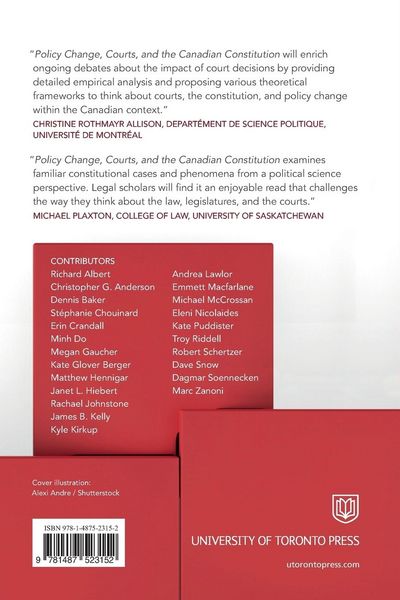
  • Produktbild: Policy Change, Courts, and the Canadian Constitution
  • Produktbild: Policy Change, Courts, and the Canadian Constitution
  •  

    Introduction: Judicial Policy Impact in Canada
    Emmett Macfarlane (University of Waterloo)


    PART I - Approaches and Theories of Policy Change


    Chapter 1: Lessons from Public Policy Theories: Ask About Policy Change First, Courts Second
    Minh Do (University of Toronto)


    Chapter 2: Closing a Door but Opening a Policy Window: Legislating Assisted Dying in Canada
    Dave Snow (University of Guelph) and Kate Puddister (University of Guelph)


    Chapter 3: The Supreme Court of Canada, Judicial Remedies, and Punctuated Equilibrium
    Marc Zanoni (University of Guelph)


    PART II - Institutional Contexts


    Chapter 4: The Charter, Policy, and Political Judgment
    Janet Hiebert (Queen’s University)


    Chapter 5: Collaborative Federalism and the Role of the Supreme Court of Canada
    Robert Schertzer (University of Toronto)


    Chapter 6: The Impact of Constitutional References on Institutional Reform
    Kate Glover (Western University)


    Chapter 7: The Desuetude of the Notwithstanding Clause - And How to Revive It
    Richard Albert (University of Texas at Austin)


    PART III - Policy Issues


    Chapter 8: The Charter Beat: The Impact of Rights Decisions on Canadian Policing
    Troy Riddell (University of Guelph) and Dennis Baker (University of Guelph)


    Chapter 9: Protecting Against Cruel and Unusual Punishment: Section 12 of the Charter and Mandatory Minimum Sentences
    Kate Puddister (University of Guelph)


    Chapter 10: Third Party Policy and Electoral Participation after Harper v. Canada: A Triumph of Egalitarianism?
    Erin Crandall (Acadia University) and Andrea Lawlor (Western University)


    Chapter 11: Section 23 of the Charter and Official-Language Minority Instruction in Canada: The Judiciary’s Impact and Limits in Education Policymaking
    Stéphanie Chouinard (Royal Military College of Canada)


    Chapter 12: The Charter of the French Language and the Supreme Court of Canada: Assessing Whether Constitutional Design Can Influence Policy Outcomes
    James B. Kelly (Concordia University)


    Chapter 13: When is a Citizen No Longer a Citizen? Analyzing Constructions of Citizenship in Canada’s Judicial and Legislative Forums
    Megan Gaucher (Carleton University)


    Chapter 14: Taking the Harper Government’s Refugee Policy to Court
    Chris Anderson (Wilfrid Laurier University) and Dagmar Soennecken (York University)


    Chapter 15: Carter Conflicts: The Supreme Court of Canada’s Impact on Medical Assistance in Dying Policy
    Eleni Nicolaides (University of Guelph) and Matthew Hennigar (Brock University)


    Chapter 16: Canadian Abortion Policy and the Limitations of Litigation
    Rachael Johnstone (Queen’s University)


    Chapter 17: Contrasting Visions of Indigenous Rights, Recognition, and Territory: Assessing Crown Policy in the Context of Reconciliation and Historic Obligations
    Michael McCrossan (University of New Brunswick)


    Chapter 18: After Marriage Equality: Courting Queer and Trans Rights
    Kyle Kirkup (University of Ottawa)


    Conclusion: Policy Influence and Its Limits: Assessing the Power of Courts and the Constitution
    Emmett Macfarlane (University of Waterloo)