KI-Beratung Beta

Gutscheinbedingungen

**Gültig am 27.11.2026 auf Spielzeug, Schreibwaren, Filme, Geschenke & Trends, Musik, tolino eReader & Zubehör, Hörbücher und Hörbuch-Downloads, nicht preisgebundene Bücher und Kalender online auf thalia.at und in der Thalia App. Einzelne Artikel können ausgeschlossen sein. Aufgrund der Buchpreisbindung sind deutschsprachige Bücher und eBooks ausgenommen. Zusätzlich ausgenommen sind Abos & Flatrates, Games, Geschenkkarten/-boxen, Shelfies, Software, Zeitschriften sowie einzelne Artikel von tonies®. Pro Einkauf einmal einlösbar. Click & Collect nur bei Onlinevorabzahlung möglich. Keine Barauszahlung. Nicht kombinierbar mit anderen Aktionen und Gutscheinen. Gutschein wird auf max. 500€ Bestellwert angerechnet. Nicht gültig für Versandkosten und Services.

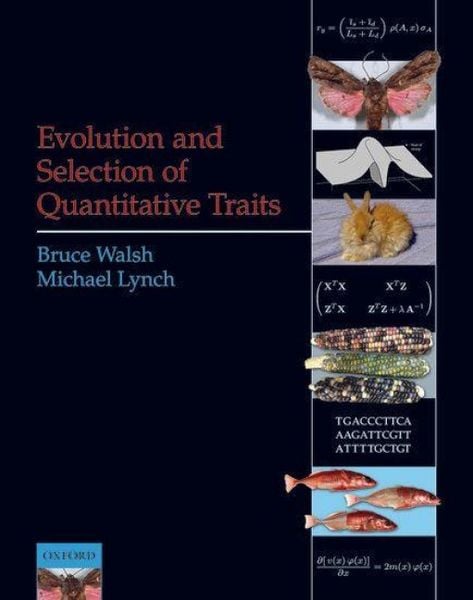
Produktbild: Evolution and Selection of Quantitative Traits

Evolution and Selection of Quantitative Traits

229,99 €

inkl. gesetzl. MwSt., Versandkostenfrei


Beschreibung

Quantitative traits-be they morphological or physiological characters, aspects of behavior, or genome-level features such as the amount of RNA or protein expression for a specific gene-usually show considerable variation within and among populations. Quantitative genetics, also referred to as the genetics...

Beschreibung

Quantitative traits-be they morphological or physiological characters, aspects of behavior, or genome-level features such as the amount of RNA or protein expression for a specific gene-usually show considerable variation within and among populations. Quantitative genetics, also referred to as the genetics of complex traits, is the study of such characters and is based on mathematical models of evolution in which many genes influence the trait and in which non-genetic factors may also be important.
Evolution and Selection of Quantitative Traits presents a holistic treatment of the subject, showing the interplay between theory and data with extensive discussions on statistical issues relating to the estimation of the biologically relevant parameters for these models. Quantitative genetics is viewed as the bridge between complex mathematical models of trait evolution and real-world data, and the authors have clearly framed their treatment as such. This is the second volume in a planned trilogy that summarizes the modern field of quantitative genetics, informed by empirical observations from wide-ranging fields (agriculture, evolution, ecology, and human biology) as well as population genetics, statistical theory, mathematical modeling, genetics, and genomics. Whilst volume 1 (1998) dealt with the genetics of such traits, the main focus of volume 2 is on their evolution, with a special emphasis on detecting selection (ranging from the use of genomic and historical data through to ecological field data) and examining its consequences.

Rezension

...the authors have done an admirable job at integrating the newest results to provide an unusually current and comprehensive guide. It is hard to imagine that anyone publishing in this area could make the case that they have added to what is known without consulting this wonderful book. Jarrod Hadfield, Biological Sciences, University of Edinburgh, The Quarterly Review of Biology

Produktdetails

Einband

Gebundene Ausgabe

Erscheinungsdatum

30.08.2018

Verlag Oxford University Press
Seitenzahl

1496

Produktdetails

Einband

Gebundene Ausgabe

Erscheinungsdatum

30.08.2018

Verlag Oxford University Press
Seitenzahl

1496

Maße (L/B/H)

28,4/22,4/6,6 cm

Gewicht

3869 g

Sprache

Englisch

ISBN

978-0-19-883087-0

Herstelleradresse

Libri GmbH
Europaallee 1
36244 Bad Hersfeld
DE

Email: gpsr@libri.de

Noch keine Bewertungen vorhanden

Verfassen Sie die erste Bewertung zu diesem Artikel

Helfen Sie anderen Kundinnen und Kunden durch Ihre Meinung.

Kundinnen und Kunden meinen

Bewertungen (0)

  • Produktbild: Evolution and Selection of Quantitative Traits
    • Preface
    • I
    • Introduction
    • 1: Changes in quantitative traits over time
    • II
    • Evolution at one and two loci
    • 2: Neutral evolution in one- and two-locus systems
    • 3: The genetic effective size of a population
    • 4: The nonadaptive forces of evolution
    • 5: The population genetics of selection
    • 6: Theorems of natural selection: Results of Price, Fisher, and Robertson
    • 7: Interaction of selection, mutation, and drift
    • 8: Hitchhiking and selective sweeps
    • 9: Using molecular data to detect selection: Signatures from recent single events
    • 10: Using molecular data to detect selection: Signatures from multiple historical events
    • III
    • Drift and quantitative traits
    • 11: Changes in genetic variance induced by drift
    • 12: The neutral divergence of quantitative traits
    • IV
    • Short-term response on a single character
    • 13: Short-term changes in the mean: 1. The breeder's equation
    • 14: Short-term changes in the mean: 2. Truncation and threshold selection
    • 15: Short-term changes in the mean: 3. Permanent versus transient response
    • 16: Short-term changes in the variance: 1. Changes in the additive variance
    • 17: Short-term changes in the variance: 2. Changes in environmental variance
    • 18: Analysis of short-term selection experiments: 1. Least-squares approaches
    • 19: Analysis of short-term selection experiments: 2. Mixed-model and bayesian approaches
    • 20: Selection response in natural populations
    • V
    • Selection in structured populations
    • 21: Family-based selection
    • 22: Associative effects: Competition, social interactions, group and kin selection
    • 23: Selection under inbreeding
    • VI
    • Population-genetic models of trait response
    • 24: The infinitesimal model and its extensions
    • 25: Long-term response: 1. Deterministic aspects
    • 26: Long-term response: 2. Finite population size and mutation
    • 27: Long-term response: 3. Adaptive walks
    • 28: Maintenance of quantitative genetic variation
    • VII
    • Measuring selection on traits
    • 29: Individual fitness and the measurement of univariate selecton
    • 30: Measuring multivariate selection
    • VIII
    • Appendices
    • A1: Diffusion theory
    • A2: Introduction to Bayesian Analysis
    • A3: Markov Chain Monte Carlo and Gibbs sampling
    • A4: Multiple comparisons: Bonferroni corrections, false-discovery rates, and meta-analysis
    • A5: The geometry of vectors and matrices: Eigenvalues and eigenvectors
    • A6: Derivatives of vectors and vector-valued functions
    • Literature Cited
    • Author Index
    • Organism and Trait Index
    • Subject Index