Gutscheinbedingungen

**Gültig am 28.09.2026 auf fremdsprachige Bücher online auf thalia.at und in der Thalia App. Einzelne Artikel können ausgeschlossen sein. Ausgenommen sind preisgebundene Artikel & eBooks. Pro Einkauf einmal einlösbar. Click & Collect nur bei Onlinevorabzahlung möglich. Keine Barauszahlung. Nicht kombinierbar mit anderen Aktionen und Gutscheinen. Gutschein wird auf max. 500€ Bestellwert angerechnet. Nicht gültig für Geschenkkarten, Versandkosten und Services.

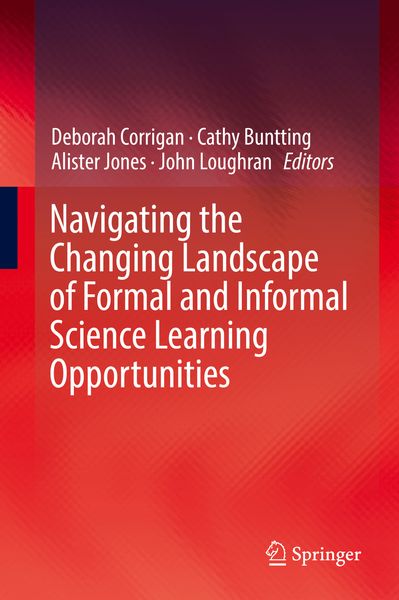
  • Produktbild: Navigating the Changing Landscape of Formal and Informal Science Learning Opportunities
  • Produktbild: Navigating the Changing Landscape of Formal and Informal Science Learning Opportunities

Navigating the Changing Landscape of Formal and Informal Science Learning Opportunities

51,99 €

inkl. gesetzl. MwSt., Versandkostenfrei


Beschreibung

Produktdetails

Einband

Gebundene Ausgabe

Erscheinungsdatum

09.07.2018

Abbildungen

XVII, 210 p. 16 illus.

Herausgeber

Deborah Corrigan + weitere

Verlag

Springer

Seitenzahl

210

Maße (L/B/H)

24,1/16/1,8 cm

Gewicht

512 g

Sprache

Englisch

ISBN

978-3-319-89760-8

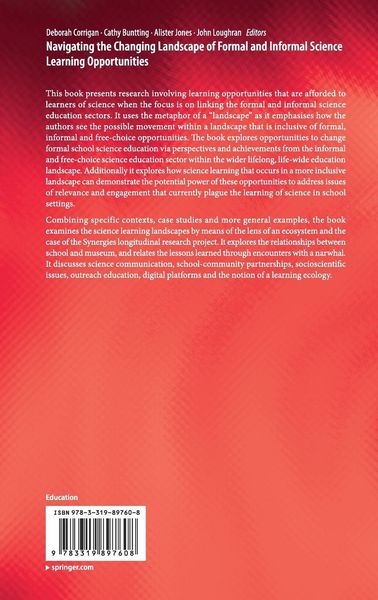
Beschreibung

Portrait


Cathy Buntting
is a Senior Research Fellow at the University of Waikato, New Zealand. She has a Masters degree in biochemistry and a PhD in science education, and is Director of the Science Learning Hub, a significant online portal linking the science and education sectors. Recent research projects have included the development of students’ futures thinking and the role of ICTs in transforming science learning and teaching.  


Deborah Corrigan
is a Professor in science education and Deputy Dean of the Faculty of Education at Monash University. After working as a chemistry and biology teacher, she worked at Monash University in chemistry and science education, particularly in teacher preparation. Her research interests include industry and technology links with science, curriculum design, science and STEM education policy and the values that underpin science education. However, her main research interest remains improving the quality of chemistry and science education so that it is relevant to students.

Alister Jones
 is a Research Professor and Senior Deputy Vice-Chancellor of the University of Waikato, New Zealand. He is Director of the New Zealand Science and Biotechnology Learning Hubs, as well as the Director for a number of companies.  He has been consulted on educational development in New Zealand, Australia, the UK, USA, Hong Kong, Chile and Thailand. His research interests span technology and science education, teacher education, curriculum, assessment and educational leadership.

John Loughran
is the Foundation Chair in Curriculum & Pedagogy and Dean of the Faculty of Education, Monash University. John was a science teacher for ten years before moving into teacher education. His research interests include the fields of teacher education and science education. John was the co-founding editor of Studying Teacher Education and is an Executive Editor for Teachers and Teaching: Theory and Practice and on the International Editorial Advisory Board for a number journals including Teacher Education Quarterly, Journal of Reflective Practice and the Asia Pacific Forum for Science Teaching and Learning.

Produktdetails

Einband

Gebundene Ausgabe

Erscheinungsdatum

09.07.2018

Abbildungen

XVII, 210 p. 16 illus.

Herausgeber

Verlag

Springer

Seitenzahl

210

Maße (L/B/H)

24,1/16/1,8 cm

Gewicht

512 g

Sprache

Englisch

ISBN

978-3-319-89760-8

Herstelleradresse

Springer-Verlag KG
Sachsenplatz 4-6
1201 Wien
AT

Email: ProductSafety@springernature.com

Noch keine Bewertungen vorhanden

Verfassen Sie die erste Bewertung zu diesem Artikel

Helfen Sie anderen Kundinnen und Kunden durch Ihre Meinung.

Kundinnen und Kunden meinen

Bewertungen (0)

  • Produktbild: Navigating the Changing Landscape of Formal and Informal Science Learning Opportunities
  • Produktbild: Navigating the Changing Landscape of Formal and Informal Science Learning Opportunities

  • Navigating the changing landscape of formal and informal science learning opportunities, Deborah Corrigan, Cathy Buntting, Alister Jones & John Loughran.- Viewing Science Learning Through an Ecosystem Lens: A story in two parts, John H. Falk and Lynn D. Dierking.- Pregnant Pauses: Science Mueseums, Schools and a controversial exhibition, Erminia Pedretti & Ana Maria Navas-Iannini.- Encounters with a narwhal: revitalising science education’s capacity to affect and be affected, Steve Alsop & Justin Dillon.- Communicating science, Sue Stocklmayer.- Reinvigorating primary school science through school-community partnerships, Kathy Smith, Angela Fitzgerald, Suzanne Deefholts, Sue Jackson, Nicole Sadler, Alan Smith & Simon Lindsay.- Natural disasters as unique socioscientific events: Curricular responses to the New Zealand earthquakes, Léonie Rennie, John Wallace & Grady Venville.- The challenges and opportunities for embracing complex socio-scientific issues as important in learning science: the Murray-Darling River Basin as an example, Peter Fensham   Jasper Montana.- Outreach Education: Enhancing the possibilities for every student to learn science, Debra Panizzon, Greg Lancaster & Deborah Corrigan.- Using a digital platform to mediate intentional and incidental science learning, Cathy Buntting, Alister Jones & Bronwen Cowie.- “Meet the Scientist”: How pre-service teachers constructed knowledge and identities, Gillian Kidman & Karen Marangio.- Trial-and-error, Googling and talk: Engineering students taking initiative out of class, Elaine Khoo & Bronwen Cowie.- Index.