Gutscheinbedingungen

**Gültig bis 15.06.2026 auf Spiele & Spielzeug online auf thalia.at, in der Thalia App ab einem Mindestbestellwert von 30€ und in allen Thalia Buchhandlungen in Österreich. In den Buchhandlungen nur gültig auf lagernde Ware. Einzelne Artikel können ausgeschlossen sein. Ausgenommen sind preisgebundene Artikel sowie online auf thalia.at und in der Thalia App einzelne Artikel von tonies®. Pro Einkauf einmal einlösbar. Nur gültig gegen Vorlage oder im Onlineshop hinterlegter Bonuscard. Infos zur Einlösung in der Buchhandlung sind auf der Bonuscard-Vorteilspreisseite zu finden. Click & Collect nur bei Onlinevorabzahlung möglich. Keine Einlösung bei Scan & Go-Bezahlung. Keine Barauszahlung. Nicht kombinierbar mit anderen Aktionen und Gutscheinen. Gutschein wird auf max. 500€ Bestellwert angerechnet. Nicht gültig für Geschenkkarten, Versandkosten und Services.

  • Produktbild: Social Dynamics in Swiss Society
  • Produktbild: Social Dynamics in Swiss Society
Band 9

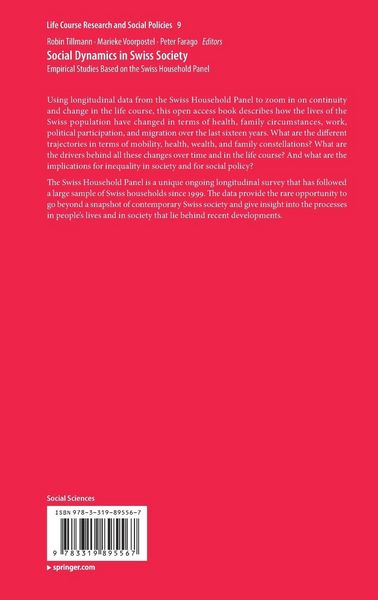
Social Dynamics in Swiss Society Empirical Studies Based on the Swiss Household Panel

51,99 €

inkl. gesetzl. MwSt., Versandkostenfrei


Beschreibung

Produktdetails

Einband

Gebundene Ausgabe

Erscheinungsdatum

25.06.2018

Abbildungen

XXI, 21 illus., schwarz-weiss Illustrationen

Herausgeber

Robin Tillmann + weitere

Verlag

Springer

Seitenzahl

253

Maße (L/B/H)

24,1/16/2,1 cm

Gewicht

578 g

Auflage

1st ed. 2018

Sprache

Englisch

ISBN

978-3-319-89556-7

Beschreibung

Portrait

Dr Robin Tillmann is the head of the Swiss Household Panel at the Swiss Centre of Expertise in the Social Sciences FORS. He has more than 20 years of experience in empirical social research. His research interests include social stratification, social inequality and social change, precariousness and poverty, and quality of life. He is co-editor of the special issue “Persistent Social Inequalities” of the Swiss Journal of Sociology (2012). He contributed to the Encyclopedia of Quality of Life and Well-Being Research (Springer, 2014) and to the book Poor Europe. The problem of poverty in chosen European countries (Wydawnictwo Uniwersytetu Śląskiego, 2015).   

Dr Marieke Voorpostel is a senior researcher for the Swiss Household Panel at the Swiss Centre of Expertise in the Social Sciences FORS. She received her PhD in sociology from Utrecht University in 2007. Her research focuses primarily on kinship, family diversity, the interplay between the family and the community, and survey methodology. She has published her research in various European and American scientific journals. She has also contributed to handbooks on aging and the family. 


Produktdetails

Einband

Gebundene Ausgabe

Erscheinungsdatum

25.06.2018

Abbildungen

XXI, 21 illus., schwarz-weiss Illustrationen

Herausgeber

Verlag

Springer

Seitenzahl

253

Maße (L/B/H)

24,1/16/2,1 cm

Gewicht

578 g

Auflage

1st ed. 2018

Sprache

Englisch

ISBN

978-3-319-89556-7

Herstelleradresse

Springer-Verlag GmbH
Tiergartenstr. 17
69121 Heidelberg
DE

Email: ProductSafety@springernature.com

Kundinnen und Kunden meinen

0 Bewertungen

Informationen zu Bewertungen

Zur Abgabe einer Bewertung ist eine Anmeldung im Konto notwendig. Die Authentizität der Bewertungen wird von uns nicht überprüft. Wir behalten uns vor, Bewertungstexte, die unseren Richtlinien widersprechen, entsprechend zu kürzen oder zu löschen.

Die Bewertungen sind nach Format, Anzahl Sterne und Datum sortiert.

Verfassen Sie die erste Bewertung zu diesem Artikel

Helfen Sie anderen Kund*innen durch Ihre Meinung

Kundinnen und Kunden meinen

0 Bewertungen filtern

  • Produktbild: Social Dynamics in Swiss Society
  • Produktbild: Social Dynamics in Swiss Society
  • Introduction.- Part 1 Family, health & quality of life.- Chapter 1.1 “Health and Inequality: Impact of the Deterioration of a Household Member’s Health on Household Mobility”, Monica Budowski & Maurizia Masia, University of Fribourg, Robin Tillmann, FORS.- Chapter 1.2 “Life-Course Smoking Behavior in Switzerland in the 20th Century”, Dean R. Lillard, Ohio State University, DIW-Berlin.- Chapter 1.3 “Obesity and subjective well-being in Switzerland”, Mario Lucchini, Università degli Studi di Milano-Bicocca, University of Applied Sciences and Arts of Southern Switzerland, Sara Della Bella, University of Applied Sciences and Arts of Southern Switzerland.- Chapter 1.4 “Exploring the cohabitation gap in relationship dissolution and mental wellbeing: A cross-national longitudinal analysis of transitions from cohabitation and marriage in Switzerland and Australia”, Belinda Hewitt, The University of Queensland, Marieke Voorpostel, FORS, Gavin Turrell, Queensland University of Technology.-Chapter 1.5 “The transition to marriage: a step in the gendered division of housework shaping subjective well-being”, Valérie-Anne Ryser, FORS, Jean-Marie Le Goff, University of Lausanne, NCCR LIVES.- Chapter 1.6 “Family trajectory and life satisfaction: the Swiss case”, Boris Wernli & Sara Zella, FORS.- Part 2 Resources, work & living conditions.- Chapter 2.1 “Analyzing Trends in Deprivation and Poverty”, Pascale Gazareth & Katia Iglesias, University of Neuchâtel, Eric Crettaz, University of Applied Sciences of Western Switzerland.- Chapter 2.2 “Trajectories of Vulnerability: A Sequence-Analytical Approach”, Felix Bühlmann, University of Lausanne, NCCR LIVES.- Chapter 2.3 “From School to Work: Old or New Routes to Employment”, Rolf Becker, David Glauser & Christoph Zangger, University of Bern.- Chapter 2.4 “The true richness: savings and children among Swiss, German and Australian families”, Laura Ravazzini, University of Neuchâtel, Ursina Kuhn, FORS.- Chapter 2.5 “Home ownership andwealth inequality in Germany and Switzerland”, Markus Grabka, DIW-Berlin, Ursina Kuhn, FORS.- Chapter 2.6 “Voluntary turnover: a means of reducing perceived job insecurity? A longitudinal analysis in Switzerland”, Florence Lebert, FORS.- Part 3 Politics, attitudes & migration.- Chapter 3.1 “Partisan Support in Context”, Jennifer Fitzgerald & Christopher Jorde, University of Colorado, Boulder.- Chapter 3.2 “Does it stand a chance? The decrease in support for joining the European Union in Switzerland”, Oriane Sarrasin, University of Lausanne, Bram Lancee, Utrecht University, Theresa Kuhn, University of Amsterdam.- Chapter 3.3 “Perceived Unemployment Risk and Preferences for Social Protection”, Nicolas Pekari & Flurina Schmid, FORS, Jan Rosset, University of Mannheim.- Chapter 3.4 “Where Do They End Up? Biographical Consequences of Political Activism”, Gian-Andrea Monsch, FORS, Florence Passy, University of Lausanne.- Chapter 3.5 “Is There a Swiss Immigrant Epidemiological Paradox? Findings from the Swiss Household Panel”, Gina Potarca, University of Lausanne, Laura Bernardi, University of Lausanne, NCCR LIVES. 3.6 “First and Second Child Among Immigrants and Their Descendants in Switzerland: Results and difficulties to find results in Switzerland”, Andrés Guarin, Laura Bernardi, University of Lausanne, NCCR LIVES, Flurina Schmid, FORS