Gutscheinbedingungen

**Gültig bis 28.07.2026 auf Spielzeug, Schreibwaren, Filme, Geschenke & Trends, Musik, tolino eReader & Zubehör, Hörbücher und Hörbuch-Downloads (außer Abo), nicht preisgebundene Bücher und Kalender in der Thalia App. Einzelne Artikel können ausgeschlossen sein. Aufgrund der Buchpreisbindung sind deutschsprachige Bücher und eBooks ausgenommen. Zusätzlich ausgenommen sind preisgebundene Artikel, Abos & Flatrates, eBooks, Games, Geschenkkarten/-boxen, Shelfies, Software, Zeitschriften sowie einzelne Artikel von tonies®. Pro Einkauf einmal einlösbar. Click & Collect nur bei Onlinevorabzahlung möglich. Keine Barauszahlung. Nicht kombinierbar mit anderen Aktionen und Gutscheinen. Gutschein wird auf max. 500€ Bestellwert angerechnet. Nicht gültig für Versandkosten und Services.

Produktbild: Step Wise Protocols for Somatic Embryogenesis of Important Woody Plants
Band 84

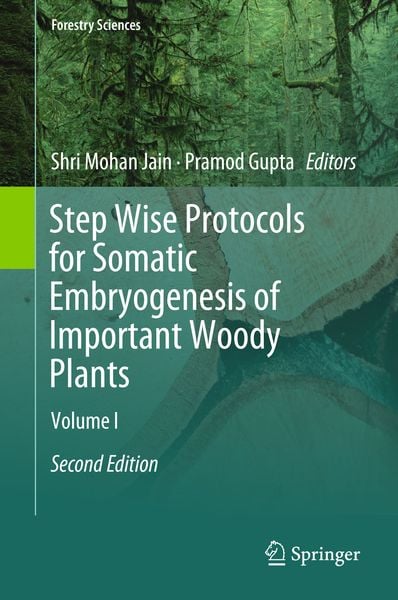
Step Wise Protocols for Somatic Embryogenesis of Important Woody Plants Volume I

Aus der Reihe Forestry Sciences

99,99 €

inkl. gesetzl. MwSt., Versandkostenfrei


Beschreibung

Produktdetails

Einband

Gebundene Ausgabe

Erscheinungsdatum

22.06.2018

Abbildungen

XV, 96 illus., 92 illus. in color., farbige Illustrationen, schwarz-weiss Illustrationen

Herausgeber

Shri Mohan Jain + weitere

Verlag

Springer

Seitenzahl

323

Maße (L/B/H)

24,1/16/2,3 cm

Gewicht

738 g

Auflage

Second Edition 2018

Sprache

Englisch

ISBN

978-3-319-89482-9

Beschreibung

Portrait

Prof. Dr. Shri Mohan Jain is an Indian-born plant biotechnology scientist. He worked several years for the International Atomic Energy Agency in Vienna. He has done research on genetically modified food, mutation breeding, ornamental plants, date palm, and tropical fruits, such as banana.

Prof. Jain completed his bachelor's degree at the Chaudhary Charan Singh Haryana Agricultural University in Hisar, Haryana, India (1966–1970). After that he continued his studies to receive a Master of Science from the Genetics department at the G.B. Pant University of Agriculture and Technology in Pantnagar, Nainital, India (1970–1972). In 1972 he started his studies in Master of Philosophy in Jawaharlal Nehru University in New Delhi, India and finally completed his studies with a PhD from the same university in 1978.

Pramod Gupta has been involved in the science of tree cloning since he chose forestry as his career at the ageof 20. He has a PhD and 30-years of work experience with one of the global leaders in forestry, Weyerhaeuser. Pramod Gupta developed the first cloning lab for Weyerhaeuser, built a scientific team, consulted with forest managers world-wide, studied optimal growing conditions, presented scientific papers, and earned multiple patents. 

Produktdetails

Einband

Gebundene Ausgabe

Erscheinungsdatum

22.06.2018

Abbildungen

XV, 96 illus., 92 illus. in color., farbige Illustrationen, schwarz-weiss Illustrationen

Herausgeber

Verlag

Springer

Seitenzahl

323

Maße (L/B/H)

24,1/16/2,3 cm

Gewicht

738 g

Auflage

Second Edition 2018

Sprache

Englisch

ISBN

978-3-319-89482-9

Herstelleradresse

Springer-Verlag KG
Sachsenplatz 4-6
1201 Wien
AT

Email: GPSR Kontakt

Noch keine Bewertungen vorhanden

Verfassen Sie die erste Bewertung zu diesem Artikel

Helfen Sie anderen Kundinnen und Kunden durch Ihre Meinung.

Kundinnen und Kunden meinen

Bewertungen (0)

  • Produktbild: Step Wise Protocols for Somatic Embryogenesis of Important Woody Plants
  • Section A: 1. Slash pine (Pinus elliottii Engelm.), R.J. Newton, et al. 2. Somatic embryogenesis and genetic transformation in Pinus radiate, C. Walters, J.I. Find. 3. Douglas–fir (Pseudotsuga menziesii), P.K. Gupta, D. Holmstrom. 4. Omorika spruce (Picea omorika), S. Mihaljevic, S. Jelaska. 5. Somatic embryogenesis in Picea glauca, E.C. Young, T.A. Thorpe. 6. Protocol of somatic embryogenesis: Black spruce (Picea mariana (Mills.)B.S.P.), F.M. Tremblay, et al. 7. Sitka spruce (Picea sitchensis), D. Thompson, F. Harrington. 8. Protocol of somatic embryogenesis of Pinus nigra Arn, T. Salajova, et al. 9. Loblolly pine (Pinus taeda), W. Tang, R.J. Newton. 10. Somatic embryogenesis in maritime pine (Pinus pinaster Ait.) L. Harvengt. 11. Somatic embryogenesis in Pinus patula, C.S. Ford, et al. 12. Somatic embryogenesis in Norway spruce, M. Vagner, et al. Section B: 13. Cashew (Anacardium occidentale L.), R.S. Nadgauda, S.S. Gogate. 14. Somatic embryogenesis protocol: coffee (Coffea arabica L. and C. canephora P.), H. Etienne. 15. Protocols for somatic embryogenesis and plantlet formation from three explants in tea (Camellia sinensis (l.) o. kuntze), A. Akula, C. Akula. 16. Protocol of somatic embryogenesis from Citrus spp. anther culture, M.A. Germana. 17. Integration system for propagation of Theobroma cacao L., S.N. Maximova, et al. 18. Mango (Mangifera indica L.), H. Ara, et al. 19. Somatic embryogenesis in jackfruit (Artocarpus heterophyllus Lam.), S.K. Roy, R.K. Debnath. 20. Somatic embryogenesis in Indian olive (Elaeocarpus robustus L.), S.K. Roy, P. Sinha. 21. Rescue of endangered palms by in vitro methods: the case of ‘bottle palm’, V. Sarasan, et al. 22. Somatic embryogenesis in American grapes (Vitis x labruscana L.H. Bailey), S. Motoike, et al. 23. Pistachio, Pistachio vera L., A. Onay. 24. Grape (Vitis vinifera L.), D.K. Das, et al. 25. Date palm, Phoenix dactylifera L., J.M. Al-Khayri. 26. Somatic embryogenesis protocol: Citrus, F. Carimi.27. Olive (Olea europaea), M. Mencuccini, et al. Section C: 28. Protocol of somatic embryogenesis: Dalbergia sissoo Roxb. (Sissoo), A.K. Singh, S. Chand. 29. Protocol of somatic embryogenesis: Pedunculate oak (Quercus robur L.) and sessile oak (Quercus petraea /Matt./Liebl.), V. Chalupa. 30. Protocol of somatic embryogenesis: tamarillo (Cyphomandra betacea (Cav.) Sendtn.), J.M. Canhoto, et al. 31. Protocol of somatic embryogenesis: European chestnut (Castanea sativa Mill.), U. Sauer, E. Wilhelm. 32. Protocol of somatic embryogenesis in Acacia arabica (Lamk.) Willd., G.R. Rout, R.M. Nanda. 33. Protocol for hazelnut somatic embryogenesis, B. Berros, et al. 34. Protocol of somatic embryogenesis: Ocotea catharinensis Mez. (Lauraceae), A.M. Viana, et al.