KI-Beratung Beta

Gutscheinbedingungen

**Gültig bis 30.11.2026 auf Spielzeug, Schreibwaren, Filme, Geschenke & Trends, Musik, tolino eReader & Zubehör, Hörbücher und Hörbuch-Downloads, nicht preisgebundene Bücher und Kalender online auf thalia.at und in der Thalia App. Einzelne Artikel können ausgeschlossen sein. Aufgrund der Buchpreisbindung sind deutschsprachige Bücher und eBooks ausgenommen. Zusätzlich ausgenommen sind Abos & Flatrates, Games, Geschenkkarten/-boxen, Shelfies, Software, Zeitschriften sowie einzelne Artikel von tonies®. Pro Einkauf einmal einlösbar. Nur gültig mit im Onlineshop hinterlegter Bonuscard. Click & Collect nur bei Onlinevorabzahlung möglich. Keine Barauszahlung. Nicht kombinierbar mit anderen Aktionen und Gutscheinen. Gutschein wird auf max. 500€ Bestellwert angerechnet. Nicht gültig für Versandkosten und Services.

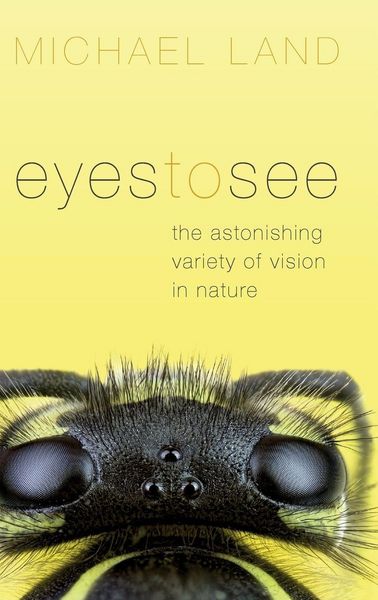
  • Produktbild: Eyes to See
  • Produktbild: Eyes to See

Eyes to See The Astonishing Variety of Vision in Nature

27,99 €

inkl. gesetzl. MwSt., zzgl. Versandkosten


  • Kostenlose Lieferung ab 30 € Einkaufswert
  • Versandkostenfrei für Bonuscard-Kund*innen

Beschreibung

Vision is the sense by which we and other animals obtain most of our information about the world around us. Darwin appreciated that at first sight it seems absurd that the human eye could have evolved by natural selection. But we now know far more about vision, the many times it has independently evolved...

Beschreibung

Vision is the sense by which we and other animals obtain most of our information about the world around us. Darwin appreciated that at first sight it seems absurd that the human eye could have evolved by natural selection. But we now know far more about vision, the many times it has independently evolved in nature, and the astonishing variety of ways to see. The human eye, with a lens forming an image on a sensitive retina, represents just one. Scallops, shrimps, and lobsters all use mirrors in different ways. Jumping spiders scan with their front-facing eyes to check whether the object in front is an insect to eat, another spider to mate with, or a predator to avoid. Mantis shrimps can even measure the polarization of light.
Animal eyes are amazing structures, often involving precision optics and impressive information processing, mainly using wet protein - not the substance an engineer would choose for such tasks. In Eyes to See, Michael Land, one of the leading world experts on vision, explores the varied ways in which sight has evolved and is used in the natural world, and describes some of the ingenious experiments researchers have used to uncover its secrets. He also discusses human vision, including his experiments on how our eye movements help us to do everyday tasks, as well as skilled ones such as sight-reading music or driving. He ends by considering the fascinating problem of how the constantly shifting images from our eyes are converted in the brain into the steady and integrated conscious view of the world we experience.

Rezension

[A] captivating book. GrrlScientist, Twelve Of The Best Books About Biology Of 2018, Forbes

Produktdetails

Einband

Gebundene Ausgabe

Erscheinungsdatum

22.01.2019

Abbildungen

94 black and white images and 8pp colour plate section

Verlag Oxford University Press

Produktdetails

Einband

Gebundene Ausgabe

Erscheinungsdatum

22.01.2019

Abbildungen

94 black and white images and 8pp colour plate section

Verlag Oxford University Press
Seitenzahl

214

Maße (L/B/H)

24/16,1/1,6 cm

Gewicht

440 g

Sprache

Englisch

ISBN

978-0-19-874771-0

Herstelleradresse

Libri GmbH
Europaallee 1
36244 Bad Hersfeld
DE

Email: gpsr@libri.de

Noch keine Bewertungen vorhanden

Verfassen Sie die erste Bewertung zu diesem Artikel

Helfen Sie anderen Kundinnen und Kunden durch Ihre Meinung.

Kundinnen und Kunden meinen

Bewertungen (0)

Weitere Artikel finden Sie in

Die Leseprobe wird geladen.
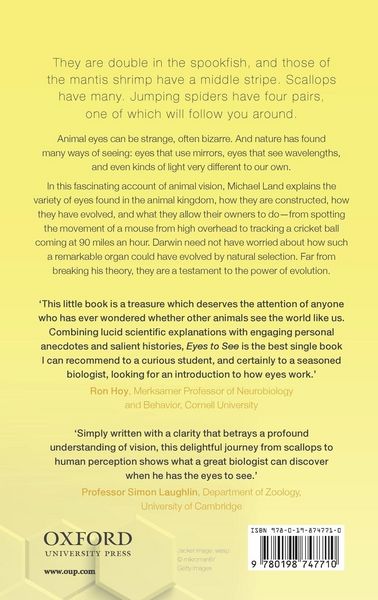
  • Produktbild: Eyes to See
  • Produktbild: Eyes to See
    • 1: Early Eyes
    • 2: Compound eyes and insect vision.
    • 3: Vision in the Ocean
    • 4: Establishing Identity
    • 5: Where do people look?
    • 6: The world out there and the world in your head
    • 7: Conclusions
    • Endnotes
    • Index