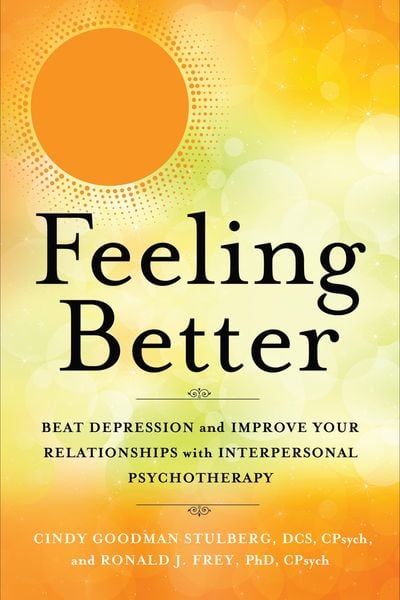
Produktbild: Feeling Better

Feeling Better Beat Depression and Improve Your Relationships with Interpersonal Psychotherapy

16,99 €

inkl. gesetzl. MwSt., zzgl. Versandkosten


  • Kostenlose Lieferung ab 30 € Einkaufswert
  • Versandkostenfrei für Bonuscard-Kund*innen

Beschreibung

Produktdetails

Einband

Taschenbuch

Erscheinungsdatum

15.11.2018

Verlag

New World Library

Seitenzahl

304

Maße (L/B/H)

22,7/16,8/0,7 cm

Gewicht

212 g

Sprache

Englisch

ISBN

978-1-60868-568-4

Beschreibung

Produktdetails

Einband

Taschenbuch

Erscheinungsdatum

15.11.2018

Verlag

New World Library

Seitenzahl

304

Maße (L/B/H)

22,7/16,8/0,7 cm

Gewicht

212 g

Sprache

Englisch

ISBN

978-1-60868-568-4

Herstelleradresse

Libri GmbH
Europaallee 1
36244 Bad Hersfeld
DE

Email: GPSR Kontakt

Noch keine Bewertungen vorhanden

Verfassen Sie die erste Bewertung zu diesem Artikel

Helfen Sie anderen Kundinnen und Kunden durch Ihre Meinung.

Kundinnen und Kunden meinen

Bewertungen (0)

Die Leseprobe wird geladen.
  • Produktbild: Feeling Better
  • Introduction: Get ready to feel better

    True confession: I'm one of those people who skips introductions. I'm busy. Just get me to the good stuff. This is your journey, so skip to Week 1 if you like. But if you're interested in knowing more about us, the approach that we use, and the four main characters we'll follow over the next 12 weeks, read on.

    Week 1: What if you had a broken leg instead?

    We spend our first week together discovering what depression is-and what it isn't. (You might be surprised!) You'll learn why you may need to take a temporary break from some of your activities and how to talk to the important people in your life about what you're going through.

    Week 2: Draw your social circle

    This week we play detective, investigating the kind of relationships you have and identifying what you wish was different about them. These relationships (and how you handle them) hold the key to your mood. This week's work will help open the door to a new world of possibilities with the people in your life.

    Week 3: Name that feeling

    This week we help you make connections between your feelings and the interactions you have with others. With practice, you'll become better at naming your feelings, understanding where they come from, and choosing how you want to handle them-with the end result of feeling better.

    Week 4: Choose your own adventure

    This week, we help you figure out which one of four problem areas you were experiencing around the time you started to feel down or depressed. Choosing a problem area will help you focus your efforts over the next few weeks and give you specific steps to take to feel better. Added bonus: the skills you learn can be applied to any future problem!

    Week 5: Goal get 'em

    This week, we help you set goals related to your problem area that you can work on for the rest of the book. By making these goals SMART (specific, measurable, achievable, relevant, and timely), and focusing your efforts on achieving them, you'll build your confidence and prove that you have the power to make yourself feel better.

    Week 6: Mirror, mirror

    This week is all about reflection. We start with a quick recap of everything you've accomplished since Week 1. Then we help you take a closer look at a recent incident that bothered you. By examining what happened and exploring your feelings in a constructive way, you'll be learning a skill that we'll build on in the weeks to come.

    Week 7: Who can you share that with?

    This week we help you share your feelings about your problem area and goals with someone in your circle. You'll get advice on who to talk to, suggestions for starting the conversation, and tips for getting the most out of the encounter so you can experience first-hand the mood-boosting power of interpersonal connection.

    Week 8: Out with the old and in with the new

    This week we help you change things up. We coach you through the steps: choosing what to change, deciding what you want to do instead, coping with the fear of the unknown, trying out your new approach, checking in on your emotions afterwards, and sharing your experience with your "who." You can make yourself feel better-and this week proves it.

    Week 9: What did you expect?

    Our expectations influence our feelings. This week we'll help you reflect on your own expectations and imagine what another person's expectations might be. Then, if it feels right, we'll coach you through having a discussion to clarify expectations with someone in your life. With your new understanding you can decide what you want to do to feel better.

    Week 10: The rehearsal

    Practice doesn't make perfect, but it can help us feel more prepared. This week we give you some strategies for practicing an important conversation or interaction so, come show time, you can choose an approach you've rehearsed and be ready for what might happen.

    Week 11: Just do it

    You've done what you can to prepare, and now it's show time. This week, we help you set realistic expectations for the interpersonal event that's going to get you to your goal, give you some examples for inspiration, and cheer you on from the sidelines. You've got this!

    Week 12: Do your happy dance

    It's our last week together, and time to celebrate what you've accomplished. We'll help you reflect on what you've learned, recall who you can rely on, and plan for future moments that may be stressful for you. If you tried anything new over the last 12 weeks, you'll be feeling better-and that's worth getting out your dancing shoes (and inviting someone to dance)!