KI-Beratung Beta

Gutscheinbedingungen

**Gültig am 27.11.2026 auf Spielzeug, Schreibwaren, Filme, Geschenke & Trends, Musik, tolino eReader & Zubehör, Hörbücher und Hörbuch-Downloads, nicht preisgebundene Bücher und Kalender online auf thalia.at und in der Thalia App. Einzelne Artikel können ausgeschlossen sein. Aufgrund der Buchpreisbindung sind deutschsprachige Bücher und eBooks ausgenommen. Zusätzlich ausgenommen sind Abos & Flatrates, Games, Geschenkkarten/-boxen, Shelfies, Software, Zeitschriften sowie einzelne Artikel von tonies®. Pro Einkauf einmal einlösbar. Click & Collect nur bei Onlinevorabzahlung möglich. Keine Barauszahlung. Nicht kombinierbar mit anderen Aktionen und Gutscheinen. Gutschein wird auf max. 500€ Bestellwert angerechnet. Nicht gültig für Versandkosten und Services.

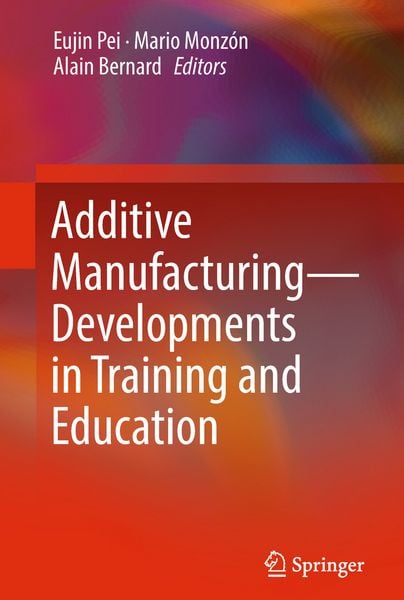
Produktbild: Additive Manufacturing – Developments in Training and Education

Additive Manufacturing – Developments in Training and Education

62,99 €

inkl. gesetzl. MwSt., Versandkostenfrei


Beschreibung

This book provides an overview of training and teaching methods, as well as education strategies, for Additive Manufacturing (AM) and its application in different business sectors. It presents real-world applications and case studies to demonstrate the key practical and theoretical fundamentals of AM...

Beschreibung

This book provides an overview of training and teaching methods, as well as education strategies, for Additive Manufacturing (AM) and its application in different business sectors. It presents real-world applications and case studies to demonstrate the key practical and theoretical fundamentals of AM training, written by international experts from the field.

Additive Manufacturing is a rapidly developing technology, and having a well-trained workforce is essential. Accordingly, readers are introduced to new training approaches and recent breakthroughs that can facilitate and accelerate the design, application and implementation of AM.

The book’s contributors discuss many topics to provide readers a fundamental grasp of AM, including:

·         collaboration among educational bodies, and between industry and governments;

·         strategies for implementing AM training;

·         new teaching methods;

·         training programs that provide alternative employment choices;

·         the need for certification by professional bodies; and

·         promoting awareness of AM in society.

 This book offers an excellent source of information for researchers and industrial engineers who are interested in expanding their AM expertise, and learning how to implement it. It will also be of interest to readers who want to learn about the practicalities of adopting training and teaching for AM.

Portrait


Dr Eujin Pei is the Programme Director for the Product Design and Product Design Engineering courses at Brunel University London. He is a Chartered Engineer (CEng) and a Chartered Technological Product Designer (CTPD) with the Institution of Engineering Designers. He worked as a Product Designer possessing considerable expertise in leading and managing industrial collaborative projects. He is the Convenor for the International Organization for Standardization (ISO) TC261/WG4 committee that is responsible for Data Transfer and Design Standards for Additive Manufacturing, and Chair of the British Standards Institute AMT/8 committee for Additive Manufacturing. He is the Managing Editor for the Progress in Additive Manufacturing Journal, and Associate Editor for the Assembly Automation Journal and the Journal of Intelligent Manufacturing. He is also an editorial board member of the Rapid Prototyping Journal.


Professor Mario D. Monzón Verona is a Doctor in Industrial Engineering and full Professor in Mechanical Engineering department of Las Palmas de Gran Canaria University. He has been working in the academic field of Manufacturing processes since 1989. He is in charge of the research group “Advanced and Integrated manufacturing” which main research activities are focused on polymer processing, additive manufacturing/rapid tooling (electroforming), natural fibres applied to composites and technical textiles, biomaterials for additive manufacturing and micro-manufacturing.


Professor Alain Bernard graduated in 1982, PhD in 1989, was associate-Professor, from 1990 to 1996 in Centrale Paris. From Sept. 1996 to Oct. 2001, he was Professor in CRAN, Nancy I, in the “Integrated Design and Manufacturing” team. Since 0ct. 2001, he has been Professor at Centrale Nantes and Dean for Research from 2007 to 2012. He is a researcher in LS2N laboratory (UMR CNRS 6004) leading the “Systems Engineering –Products-Processes-Performances-” team. His research topics are KM, PLM, information system modeling, interoperability, enterprise modeling, systems performance assessment, virtual engineering and additive manufacturing. He supervised 30 PhD students and has published more than 250 papers in refereed international journals, books and conferences. He is the vice-President of AFPR (French Association on Rapid prototyping and Additive Manufacturing), vice-chairman of WG5.1 of IFIP (Global Product Development for the whole product lifecycle) and member of the CIRP Council. He is also scientific adviser on Engineering Sciences at the French Ministry for Higher Education and Research.

Produktdetails

Einband

Taschenbuch

Erscheinungsdatum

11.07.2018

Abbildungen

XX, 229 p. 109 illus., 85 illus. in color.

Herausgeber Eujin Pei + weitere

Produktdetails

Einband

Taschenbuch

Erscheinungsdatum

11.07.2018

Abbildungen

XX, 229 p. 109 illus., 85 illus. in color.

Herausgeber
Verlag Springer
Seitenzahl

229

Maße (L/B/H)

23,5/15,5/1,4 cm

Gewicht

388 g

Sprache

Englisch

ISBN

978-3-319-76083-4

Herstelleradresse

Springer-Verlag KG
Sachsenplatz 4-6
1201 Wien
AT

Email: ProductSafety@springernature.com

Noch keine Bewertungen vorhanden

Verfassen Sie die erste Bewertung zu diesem Artikel

Helfen Sie anderen Kundinnen und Kunden durch Ihre Meinung.

Kundinnen und Kunden meinen

Bewertungen (0)

  • Produktbild: Additive Manufacturing – Developments in Training and Education
  • Introduction to Additive Manufacturing and Related Applications.- The Growing Need for Training and Education for AM.- "What's in a word?" –The use and background for terms and definitions in additive manufacturing.- Professional Training of AM at the European Level.- Case Studies of Using Additive Manufacturing for Prototyping in Design.- Knowledge transfer and standards needs in Additive Manufacturing.- What you need to take into account during your design for Additive Manufacturing.- Continuing education and part-time training on Additive Manufacturing for people in employment.- Additive Manufacturing through Problem Based Learning.- Additive Manufacturing: Instrumental Systems in Research, Education and Service.- Introducing state-of-the-art AM research in Education.- XIII: Measuring the cost of Additive Manufacturing.- Training and Teaching Strategies for Medical Applications of Additive Manufacturing Systems.- IPRs and 3D Printing.- AM validation methods, technology transfer based on case studies.- FoFAM and AM-Motion Initiatives: A strategic framework for additive manufacturing deployment in Europe.