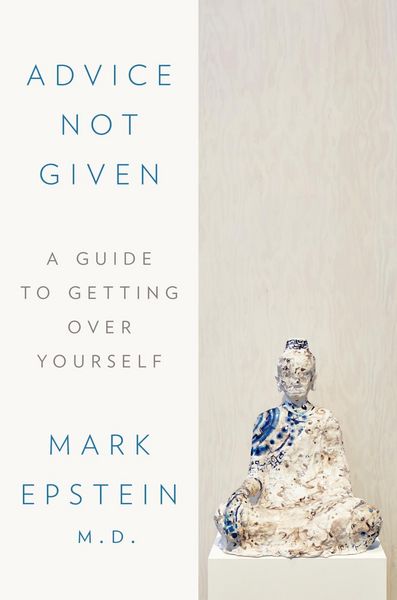
Advice Not Given A Guide to Getting Over Yourself
-
- Taschenbuch
- eBook ausgewählt
-
Form:Einzelkauf Download
-
Sprache:Englisch
11,90 €
inkl. gesetzl. MwSt.Beschreibung
Produktdetails
Format
ePUB 3
Kopierschutz
Ja
Family Sharing
Ja
Text-to-Speech
Ja
Erscheinungsdatum
16.01.2018
Verlag
Penguin Publishing GroupSeitenzahl
224 (Printausgabe)
Dateigröße
695 KB
Sprache
Englisch
EAN
9780399564338
"Most people will never find a great psychiatrist or a great Buddhist teacher, but Mark Epstein is both, and the wisdom he imparts in Advice Not Given is an act of generosity and compassion. The book is a tonic for the ailments of our time."-Ann Patchett, New York Times bestselling author of Commonwealth
Our ego, and its accompanying sense of nagging self-doubt as we work to be bigger, better, smarter, and more in control, is one affliction we all share. And while our ego claims to have our best interests at heart, in its never-ending pursuit of attention and power, it sabotages the very goals it sets to achieve. In Advice Not Given, renowned psychiatrist and author Dr. Mark Epstein reveals how Buddhism and Western psychotherapy, two traditions that developed in entirely different times and places and, until recently, had nothing to do with each other, both identify the ego as the limiting factor in our well-being, and both come to the same conclusion: When we give the ego free rein, we suffer; but when it learns to let go, we are free.
With great insight, and in a deeply personal style, Epstein offers readers a how-to guide that refuses a quick fix, grounded in two traditions devoted to maximizing the human potential for living a better life. Using the Eightfold Path, eight areas of self-reflection that Buddhists believe necessary for enlightenment, as his scaffolding, Epstein looks back productively on his own experience and that of his patients. While the ideas of the Eightfold Path are as old as Buddhism itself, when informed by the sensibility of Western psychotherapy, they become something more: a road map for spiritual and psychological growth, a way of dealing with the intractable problem of the ego. Breaking down the wall between East and West, Epstein brings a Buddhist sensibility to therapy and a therapist's practicality to Buddhism. Speaking clearly and directly, he offers a rethinking of mindfulness that encourages people to be more watchful of their ego, an idea with a strong foothold in Buddhism but now for the first time applied in the context of psychotherapy.
Our ego is at once our biggest obstacle and our greatest hope. We can be at its mercy or we can learn to mold it. Completely unique and practical, Epstein's advice can be used by all--each in his or her own way--and will provide wise counsel in a confusing world. After all, as he says, "Our egos can use all the help they can get."
Our ego, and its accompanying sense of nagging self-doubt as we work to be bigger, better, smarter, and more in control, is one affliction we all share. And while our ego claims to have our best interests at heart, in its never-ending pursuit of attention and power, it sabotages the very goals it sets to achieve. In Advice Not Given, renowned psychiatrist and author Dr. Mark Epstein reveals how Buddhism and Western psychotherapy, two traditions that developed in entirely different times and places and, until recently, had nothing to do with each other, both identify the ego as the limiting factor in our well-being, and both come to the same conclusion: When we give the ego free rein, we suffer; but when it learns to let go, we are free.
With great insight, and in a deeply personal style, Epstein offers readers a how-to guide that refuses a quick fix, grounded in two traditions devoted to maximizing the human potential for living a better life. Using the Eightfold Path, eight areas of self-reflection that Buddhists believe necessary for enlightenment, as his scaffolding, Epstein looks back productively on his own experience and that of his patients. While the ideas of the Eightfold Path are as old as Buddhism itself, when informed by the sensibility of Western psychotherapy, they become something more: a road map for spiritual and psychological growth, a way of dealing with the intractable problem of the ego. Breaking down the wall between East and West, Epstein brings a Buddhist sensibility to therapy and a therapist's practicality to Buddhism. Speaking clearly and directly, he offers a rethinking of mindfulness that encourages people to be more watchful of their ego, an idea with a strong foothold in Buddhism but now for the first time applied in the context of psychotherapy.
Our ego is at once our biggest obstacle and our greatest hope. We can be at its mercy or we can learn to mold it. Completely unique and practical, Epstein's advice can be used by all--each in his or her own way--and will provide wise counsel in a confusing world. After all, as he says, "Our egos can use all the help they can get."
Noch keine Bewertungen vorhanden
Verfassen Sie die erste Bewertung zu diesem Artikel
Helfen Sie anderen Kundinnen und Kunden durch Ihre Meinung.
Kurze Frage zu unserer Seite
Vielen Dank für Ihr Feedback
Wir nutzen Ihr Feedback, um unsere Produktseiten zu verbessern. Bitte haben Sie Verständnis, dass wir Ihnen keine Rückmeldung geben können. Falls Sie Kontakt mit uns aufnehmen möchten, können Sie sich aber gerne an unseren Kund*innenservice wenden.
zum Kundenservice