Gutscheinbedingungen

**Gültig nur für Bestellungen an die Wunsch-Poststation bis 10.06.2026 auf Spielzeug, Schreibwaren, Filme, Geschenke & Trends, Musik, tolino eReader & Zubehör, Hörbücher und Hörbuch-Downloads (außer Abo), nicht preisgebundene Bücher und Kalender online auf thalia.at und in der Thalia App. Einzelne Artikel können ausgeschlossen sein. Aufgrund der Buchpreisbindung sind deutschsprachige Bücher und eBooks ausgenommen. Zusätzlich ausgenommen sind preisgebundene Artikel, Abos & Flatrates, eBooks, Games, Geschenkkarten/-boxen, Shelfies, Software, Zeitschriften sowie einzelne Artikel von tonies®. Pro Einkauf einmal einlösbar. Kein Click & Collect möglich. Keine Barauszahlung. Nicht kombinierbar mit anderen Aktionen und Gutscheinen. Gutschein wird auf max. 500€ Bestellwert angerechnet. Nicht gültig für Versandkosten und Services.

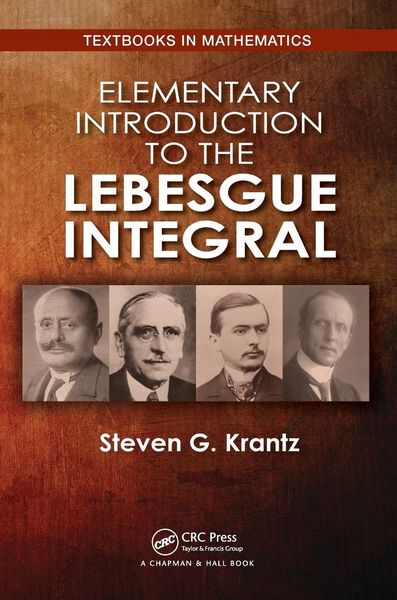
  • Produktbild: Elementary Introduction to the Lebesgue Integral
  • Produktbild: Elementary Introduction to the Lebesgue Integral

Elementary Introduction to the Lebesgue Integral

78,99 €

inkl. gesetzl. MwSt., Versandkostenfrei


Beschreibung

Produktdetails

Einband

Taschenbuch

Erscheinungsdatum

18.04.2018

Abbildungen

schwarz-weiss Illustrationen, Tabellen, schwarz-weiss

Verlag

Taylor & Francis

Seitenzahl

196

Maße (L/B/H)

23,3/15,4/1,2 cm

Gewicht

316 g

Sprache

Englisch

ISBN

978-1-138-48276-0

Beschreibung

Rezension

The book is an excellent example how with a clear and understanding exposition of the Lebesgue integral theory the author can achieve two purposes. First we have a useful text on the Lebesgue theory that is accessible to the normal undergraduate students and the second one is that the text will be a valuable tool for all mathematicians.

To make this book accessible for all readers, the author presents the text as a synthesis of the ideas therein and the concrete technical realisation which allows the readers to receive a good and proper understanding of the exposed mater. This is important because the Lebesgue integral theory traditionally creates more missunderstanding when compared to more widely used integrals like the Riemann integral for example. The author also includes in the textbook abundant examples and exercises which help to explain the topic. It is well known that in the first half of the twentieth century, the Lebesgue integral has been a mainstay of mathematical analysis because of its important properties with respect to the possibility of limits transition under the sign of the integral. The author writes It is a fundamental fact that the majority of important theoretical problems in mathematical analysis reduces to an identity of type limits transition under the sign of the integral".

The book contains a preface and 16 chapters and it is self-contained for the reader's convenience independently from their quali cation. The preface is an excellent explanation of the signi cance of the Lebesgue integral theory. From my point of view the book can conditionally divided into three parts. Chapters 1{5 together form the introduction in the theme and the reader will obtain a good and proper understanding for the ideas and the base of the Lebesgue integral theory starting from what is a measure" to the Lebesgue spaces inclusively. The middle part, Chapters 6{12, deals with the measure theory starting from the concept of outer measure and the question what is a measurable set" via the themes concerning the decomposition theorems, two versions of the Riesz representation theorem and the importance for the practical creation of different types of measures. Finally, in the middle part are considered several important instances of measurable sets, approximation by open and closed sets as well as different methods of convergence. The last part, Chapters 13{15, is devoted to the more complicated themes as measure on a product space, additivity of the outer measure (presents the striking fact that the outer measure is additive over the union of two disjoint sets provided that only one of them is measurable) and in Chapter 15 themes about nonmeasurable sets and non-Borel sets are considered. Some interesting examples are also generated. In the last Chapter 15, some elegant applications of Lebesgue measure theory to basic harmonic analysis are provided. Two advantages of the book must be noted { the rst one is that the more abstract and di cult themes as abstract measure spaces and product measures are discussed in a very concrete manner which allows the author to keep the exposition as simple as possible. The second one is that the book includes many useful examples, gures, and exercises as well as features a table of notation and glossary to readers help. In conclusion, from my point of view the presented book is a useful tool for all mathematicians and I nd it regrettable that this book was not written when I was a student.

Andrey Zahariev (Plovdiv)

Produktdetails

Einband

Taschenbuch

Erscheinungsdatum

18.04.2018

Abbildungen

schwarz-weiss Illustrationen, Tabellen, schwarz-weiss

Verlag

Taylor & Francis

Seitenzahl

196

Maße (L/B/H)

23,3/15,4/1,2 cm

Gewicht

316 g

Sprache

Englisch

ISBN

978-1-138-48276-0

Herstelleradresse

Libri GmbH
Europaallee 1
36244 Bad Hersfeld
DE

Email: gpsr@libri.de

Kundinnen und Kunden meinen

0 Bewertungen

Informationen zu Bewertungen

Zur Abgabe einer Bewertung ist eine Anmeldung im Konto notwendig. Die Authentizität der Bewertungen wird von uns nicht überprüft. Wir behalten uns vor, Bewertungstexte, die unseren Richtlinien widersprechen, entsprechend zu kürzen oder zu löschen.

Die Bewertungen sind nach Format, Anzahl Sterne und Datum sortiert.

Verfassen Sie die erste Bewertung zu diesem Artikel

Helfen Sie anderen Kund*innen durch Ihre Meinung

Kundinnen und Kunden meinen

0 Bewertungen filtern

Die Leseprobe wird geladen.
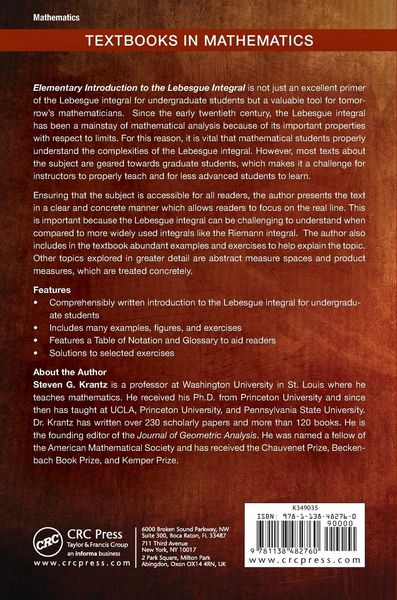
  • Produktbild: Elementary Introduction to the Lebesgue Integral
  • Produktbild: Elementary Introduction to the Lebesgue Integral
  • Introductory Thoughts.The Purpose of Measures.The Lebesgue Integral.Integrable Functions.The Lebesgue Spaces. The Concept of Outer Measure.What is a Measurable Set? Decomposition Theorems.Creation of Measures. Instances of Measurable Sets. Approximation by Open and Closed Sets. Different Methods of Convergence. Measure on a Product Space. Additivity for Outer Measure. Nonmeasurable and Non-Borel Sets