Gutscheinbedingungen

**Gültig von 22.06.2026 ab 19 Uhr bis 23.06.2026 24 Uhr auf Spielzeug, Schreibwaren, Filme, Geschenke & Trends, Musik, tolino eReader & Zubehör, Hörbücher und Hörbuch-Downloads (außer Abo), nicht preisgebundene Bücher und Kalender online auf thalia.at und in der Thalia App. Einzelne Artikel können ausgeschlossen sein. Aufgrund der Buchpreisbindung sind deutschsprachige Bücher und eBooks ausgenommen. Zusätzlich ausgenommen sind preisgebundene Artikel, Abos & Flatrates, eBooks, Games, Geschenkkarten/-boxen, Shelfies, Software, Zeitschriften sowie einzelne Artikel von tonies®. Pro Einkauf einmal einlösbar. Click & Collect nur bei Onlinevorabzahlung möglich. Keine Barauszahlung. Nicht kombinierbar mit anderen Aktionen und Gutscheinen. Gutschein wird auf max. 500€ Bestellwert angerechnet. Nicht gültig für Versandkosten und Services.

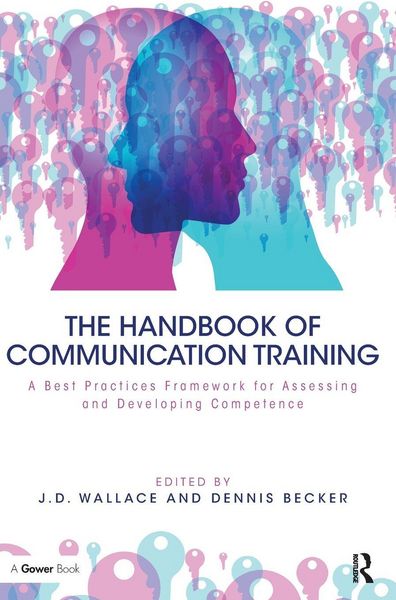
  • Produktbild: The Handbook of Communication Training
  • Produktbild: The Handbook of Communication Training

The Handbook of Communication Training A Best Practices Framework for Assessing and Developing Competence

108,99 €

inkl. gesetzl. MwSt., Versandkostenfrei


Beschreibung

Produktdetails

Einband

Gebundene Ausgabe

Erscheinungsdatum

08.08.2018

Herausgeber

J. Wallace + weitere

Verlag

Taylor and Francis

Seitenzahl

462

Maße (L/B/H)

25/17,5/2,9 cm

Gewicht

920 g

Sprache

Englisch

ISBN

978-1-138-73652-8

Beschreibung

Produktdetails

Einband

Gebundene Ausgabe

Erscheinungsdatum

08.08.2018

Herausgeber

Verlag

Taylor and Francis

Seitenzahl

462

Maße (L/B/H)

25/17,5/2,9 cm

Gewicht

920 g

Sprache

Englisch

ISBN

978-1-138-73652-8

Herstelleradresse

Libri GmbH
Europaallee 1
36244 Bad Hersfeld
DE

Email: gpsr@libri.de

Kundinnen und Kunden meinen

0 Bewertungen

Informationen zu Bewertungen

Zur Abgabe einer Bewertung ist eine Anmeldung im Konto notwendig. Die Authentizität der Bewertungen wird von uns nicht überprüft. Wir behalten uns vor, Bewertungstexte, die unseren Richtlinien widersprechen, entsprechend zu kürzen oder zu löschen.

Die Bewertungen sind nach Format, Anzahl Sterne und Datum sortiert.

Verfassen Sie die erste Bewertung zu diesem Artikel

Helfen Sie anderen Kund*innen durch Ihre Meinung

Kundinnen und Kunden meinen

0 Bewertungen filtern

Die Leseprobe wird geladen.
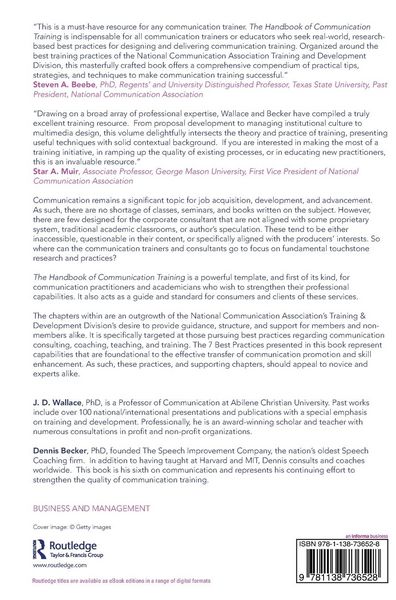
  • Produktbild: The Handbook of Communication Training
  • Produktbild: The Handbook of Communication Training
  • Acknowledgements, List of Contributors, Introduction, Best Practices for Communication Training, Best Practice 1 - Maintain Transparency to Clients and Trainees, Chapter 1 Mobilizing a Client for Change: Best Practices for Proposing Training, Jennifer H. Waldeck Phd, Chapter 2 Communication Training's Higher Calling: Using a Civic Frame to Promote Transparency and Elevate the Value of Services, Don Waisanen, PhD, Chapter 3 The F-word changes a circular message: Linking a profession's history to communication training's unique organizational role. Robin Smith Mathis PhD, Best Practice 2 - Use Assessable Methods, Chapter 4 Help, Communication Is Broken and We Need Training! How Diagnosing the Organizational Needs Leads to Better Interventions, Outcomes and Profit, Jeffrey L. Stafford, PhD, Michelle Hege, MA, Amber Barnes, MA, Greta R. Underhill, MA, Hannah R. Seagrave, MA, Chapter 5 Greater Alignment, Greater Success: Communication Needs Assessments and Training Program Assessments. Piyawan Charoensap-Kelly, , Chapter 6 Observational assessment at the core of your communication training program: Authentic design and use of observational survey instruments, Jessica Parker-Raley PhD, Amber N. Finn PhD, Best Practice 3 - Demonstrate Technology Proficiency, Chapter 7 Online Training Tools in an Interconnected World. Michael G. Strawser PhD, Marjorie M. Buckner PhD, Renee Kaufmann PhD, Chapter 8 Mobile Devices in Training: What are our Trainees Doing and What Can Trainers Do? Keri K. Stephens, Ph.D., Brett W. Robertson, M.A., Chapter 9 Best Practices in Slide Design. Lori B. Miraldi MA, Peter N. Miraldi PhD, Chapter 10 Training in a Flash: Considerations of Learning Outcomes and Storytelling in Building Webinar Training. Donna M. Elkins PhD, Robin Hinkle PhD, Hope Zoeller EdD, , Best Practice 4 - Demonstrate Professional Development., Chapter 11 Career and Professional Development as Levels of Engagement in the Communication Training and Development Field. Ross Brinkert, Chapter 12 The Communication Trainer as Bricoleur, Craig Engstrom, Ph.D., Michael Forst, M.A., Lacey Corey Brown, M.A., Chapter 13 Deliberate Practice Activities of Communication Professionals and Implications for Training and Consulting. Helen Lie, Ed.D., Chapter 14 Professional Development. Lisa Waite, MA, Best Practice 5 - Develop and Maintain Organizational Expertise, Chapter 15 From Training to Performance Improvement: Using a Holistic Approach to Demonstrate Organizational Expertise and Achieve. John E. Burk PhD, Thomas A. Birk PhD, Chapter 16 The Role of Communication Theory in Leadership Training and Development. Ralph A. Gigliotti, PhD, Brent D. Ruben, PhD, Best Practice 6 - Demonstrate Effective and Appropriate Instructional Design, Chapter 17 Best Practices of Training Instructional Design: The Needs-Centered Training Model, Steven A. Beebe, PhD, Chapter 18 Debriefing: Enhancing Skill Acquisition and Transfer of Learning during Training. Marjorie M. Buckner PhD, Amber N. Finn PhD, Chapter 19 Instructional Design Training as Instruction: Delivering Instruction for the Adult Learner. Robert J. Sidelinger PhD , Chapter 20 Training Trainers Growth Mindset Messaging: The Role of Implicit Person Theory on Training. Elissa A. Adame, Ph.D., Chapter 21 Belbin Team Roles: Assessing Behavioral Interaction to Improve Communication. DeeDee Smartt Lynch, President, Smartt Strategies, Mike Lynch, Chief Operations Officer, Smartt Strategies, Cody M. Clemens, M.A., Chapter 22 Operationalizing Kolb's Experiential Learning Cycle: A User-friendly Template for Instructional Design and Self-Assessment. Kristen A. McIntyre, PhD, Belynda Dix, MA, Marian L. Ward, MA., Best Practice 7 - Demonstrate Communication Proficiency, Chapter 23 The Communication Skills of an Effective Trainer. Seth S. Frei, MA, Steven A. Beebe, PhD, Chapter 24 Re-Motivating Monroe, Click-Whirr: Social Suasion and the Motivated Sequence. Jay Baldwin, Chapter 25 The Use of Humor and Storytelling Skills as a Best Practice in Demonstrating Communication Proficiency. Dakota C. Horn, Robin Golinski, Chapter 26 Effectively Integrating Group Techniques to Develop Communication Proficiency. Kristine M. Nicolini, PhD, DeAnne Priddis, PhD, Chapter 27 Incorporating Cosmopolitan Communication into Diverse Teaching and Training Contexts: Considerations from Our Work with Military Students and Veterans. Susan Steen, PhD, Lauren Mackenzie, PhD, Barton Buechner, PhD, Chapter 28 Social and Cultural Diversity in Training and Group Facilitation. Sara DeTurk PhD, Index.