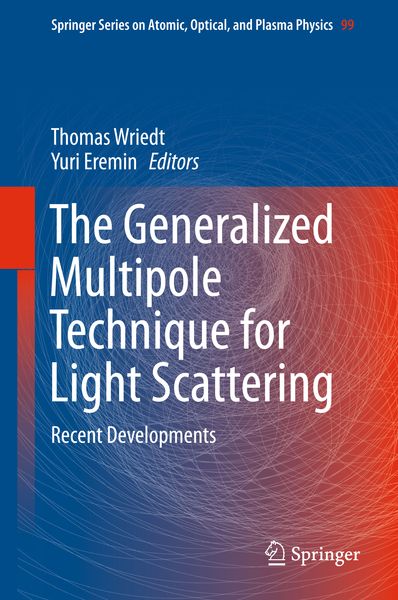
The Generalized Multipole Technique for Light Scattering Recent Developments
-
- Hardcover ausgewählt
- Taschenbuch
- eBook
-
Sprache:Englisch
129,99 €
inkl. gesetzl. MwSt.,
Beschreibung
Produktdetails
Einband
Gebundene Ausgabe
Erscheinungsdatum
19.03.2018
Abbildungen
XVI, 103 illus., 41 illus. in color., farbige Illustrationen, schwarz-weiss Illustrationen
Herausgeber
Thomas Wriedt + weitereVerlag
SpringerSeitenzahl
249
Maße (L/B/H)
24,1/16/2,1 cm
Gewicht
571 g
Auflage
1st ed. 2018
Sprache
Englisch
ISBN
978-3-319-74889-4
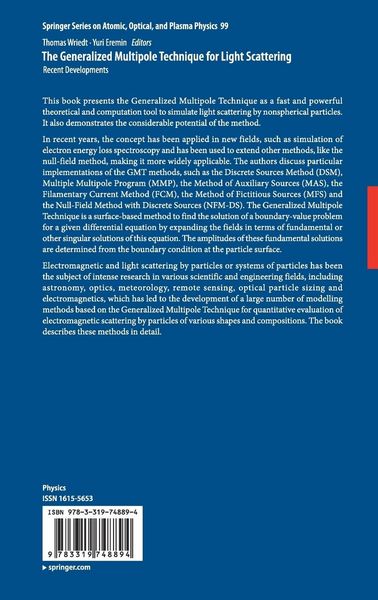
This book presents the Generalized Multipole Technique as a fast and powerful theoretical and computation tool to simulate light scattering by nonspherical particles. It also demonstrates the considerable potential of the method.
In recent years, the concept has been applied in new fields, such as simulation of electron energy loss spectroscopy and has been used to extend other methods, like the null-field method, making it more widely applicable. The authors discuss particular implementations of the GMT methods, such as the Discrete Sources Method (DSM), Multiple Multipole Program (MMP), the Method of Auxiliary Sources (MAS), the Filamentary Current Method (FCM), the Method of Fictitious Sources (MFS) and the Null-Field Method with Discrete Sources (NFM-DS). The Generalized Multipole Technique is a surface-based method to find the solution of a boundary-value problem for a given differential equation by expanding the fields in terms of fundamental or other singular solutions of this equation. The amplitudes of these fundamental solutions are determined from the boundary condition at the particle surface.Electromagnetic and light scattering by particles or systems of particles has been the subject of intense research in various scientific and engineering fields, including astronomy, optics, meteorology, remote sensing, optical particle sizing and electromagnetics, which has led to the development of a large number of modelling methods based on the Generalized Multipole Technique for quantitative evaluation of electromagnetic scattering by particles of various shapes and compositions. The book describes these methods in detail.
Noch keine Bewertungen vorhanden
Verfassen Sie die erste Bewertung zu diesem Artikel
Helfen Sie anderen Kundinnen und Kunden durch Ihre Meinung.
Kurze Frage zu unserer Seite
Vielen Dank für Ihr Feedback
Wir nutzen Ihr Feedback, um unsere Produktseiten zu verbessern. Bitte haben Sie Verständnis, dass wir Ihnen keine Rückmeldung geben können. Falls Sie Kontakt mit uns aufnehmen möchten, können Sie sich aber gerne an unseren Kund*innenservice wenden.
zum Kundenservice