
Magnetohydrodynamics and Fluid Dynamics: Action Principles and Conservation Laws Action Principles and Conservation Laws
-
- Taschenbuch ausgewählt
- eBook
-
Sprache:Englisch
56,99 €
inkl. gesetzl. MwSt.,
Beschreibung
Produktdetails
Einband
Taschenbuch
Erscheinungsdatum
06.02.2018
Abbildungen
XIV, 22 illus., 16 illus. in color., schwarz-weiss Illustrationen, farbige Illustrationen
Verlag
SpringerSeitenzahl
301
Maße (L/B/H)
23,5/15,5/1,8 cm
Gewicht
482 g
Auflage
1st edition 2018
Sprache
Englisch
ISBN
978-3-319-72510-9
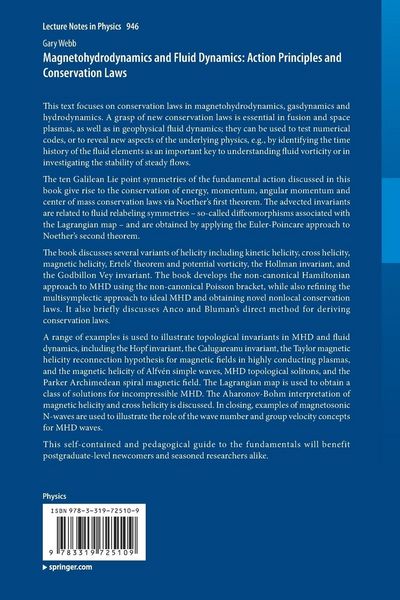
The ten Galilean Lie point symmetries of the fundamental action discussed in this book give rise to the conservation of energy, momentum, angular momentum and center of mass conservation laws via Noether’s first theorem. The advected invariants are related to fluid relabeling symmetries – so-called diffeomorphisms associated with the Lagrangian map – and are obtained by applying the Euler-Poincare approach to Noether’s second theorem.
The book discusses several variants of helicity including kinetic helicity, crosshelicity, magnetic helicity, Ertels’ theorem and potential vorticity, the Hollman invariant, and the Godbillon Vey invariant. The book develops the non-canonical Hamiltonian approach to MHD using the non-canonical Poisson bracket, while also refining the multisymplectic approach to ideal MHD and obtaining novel nonlocal conservation laws. It also briefly discusses Anco and Bluman’s direct method for deriving conservation laws.
A range of examples is used to illustrate topological invariants in MHD and fluid dynamics, including the Hopf invariant, the Calugareanu invariant, the Taylor magnetic helicity reconnection hypothesis for magnetic fields in highly conducting plasmas, and the magnetic helicity of Alfvén simple waves, MHD topological solitons, and the Parker Archimedean spiral magnetic field. The Lagrangian map is used to obtain a class of solutions for incompressible MHD. The Aharonov-Bohm interpretation of magnetic helicity and cross helicity is discussed. In closing, examples of magnetosonic N-waves are used to illustrate the role of the wave number and group velocity concepts for MHD waves.
This self-contained and pedagogical guide to the fundamentals will benefit postgraduate-level newcomers and seasoned researchers alike.
Noch keine Bewertungen vorhanden
Verfassen Sie die erste Bewertung zu diesem Artikel
Helfen Sie anderen Kundinnen und Kunden durch Ihre Meinung.
Kurze Frage zu unserer Seite
Vielen Dank für Ihr Feedback
Wir nutzen Ihr Feedback, um unsere Produktseiten zu verbessern. Bitte haben Sie Verständnis, dass wir Ihnen keine Rückmeldung geben können. Falls Sie Kontakt mit uns aufnehmen möchten, können Sie sich aber gerne an unseren Kund*innenservice wenden.
zum Kundenservice