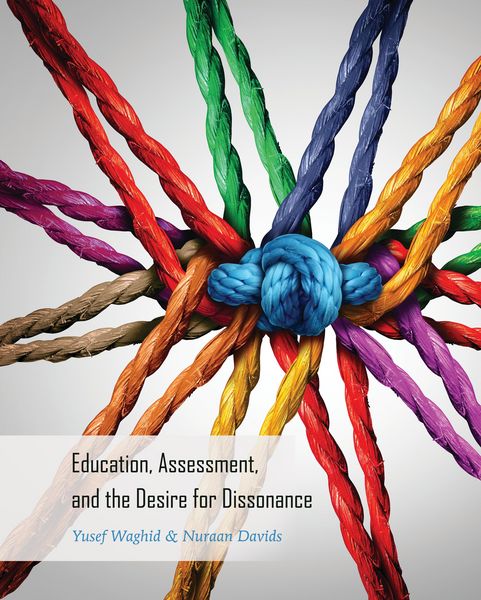
Education, Assessment, and the Desire for Dissonance
-
- Hardcover
- Taschenbuch
- eBook ausgewählt
-
Form:Einzelkauf Download
-
Sprache:Englisch
-
eBook Format:ePUB
- PDF 52,00 €
- ePUB 50,90 € ausgewählt
50,90 €
inkl. gesetzl. MwSt.Beschreibung
Produktdetails
Format
ePUB
Kopierschutz
Ja
Family Sharing
Nein
Text-to-Speech
Ja
Erscheinungsdatum
24.05.2017
Verlag
Peter Lang Inc., International Academic PublishersSeitenzahl
186 (Printausgabe)
Dateigröße
2343 KB
Auflage
1. Auflage
Sprache
Englisch
EAN
9781433140464
Education, Assessment, and the Desire for Dissonance aims to address the contentious practice of assessment in schools and universities within a poststructuralist educational paradigm. Within the theoretical paradigm of Foucault's (1994) notions of governmentality, subjectification and dissonance, the book examines why, through which and in which ways (how) educational assessment should unfold considering the challenges of globalized and cosmopolitan dimensions of educational change that have beset educational institutions. Waghid and Davids show how conceptual derivatives of Foucauldian governmentality, in particular the notions of power, panopticon and surveillance, dispositive, freedom and resistance-as relational concepts-affect assessment in universities and schools. The authors argue why universities and schools cannot be complacent or non-responsive to current understandings and practices of assessment. In the main, the authors contend that a Foucauldian notion of powerful, subjectified and dissonant assessment can, firstly, be extended to an Agambenian (2011) notion of a profane, denudified and rhythmic form of assessment; and secondly, be enhanced by a Derridian (1997) idea of friendship that bridges a Foucauldian view of governmental assessment with an Agambenian view of ethical assessment. Friendship allows people to act responsibly towards one another-that is, teachers and students acting responsibility towards one another-and resonates with an ongoing pursuit of rhythmic assessment practices. Such a form of assessment opens up an attentiveness to the incalculable and unexpected encounters that bear the responsibility of acting with one another. The authors conclude that an assessment with teaching and learning can transcend the limitations of an assessment of learning and an assessment for learning.
Noch keine Bewertungen vorhanden
Verfassen Sie die erste Bewertung zu diesem Artikel
Helfen Sie anderen Kundinnen und Kunden durch Ihre Meinung.
Kurze Frage zu unserer Seite
Vielen Dank für Ihr Feedback
Wir nutzen Ihr Feedback, um unsere Produktseiten zu verbessern. Bitte haben Sie Verständnis, dass wir Ihnen keine Rückmeldung geben können. Falls Sie Kontakt mit uns aufnehmen möchten, können Sie sich aber gerne an unseren Kund*innenservice wenden.
zum Kundenservice