Gutscheinbedingungen

**Gültig bis 04.08.2026 ab einem Mindestbestellwert von 30€ auf Spielzeug, Schreibwaren, Filme, Geschenke & Trends, Musik, tolino eReader & Zubehör, Hörbücher und Hörbuch-Downloads (außer Abo), nicht preisgebundene Bücher und Kalender online auf thalia.at und in der Thalia App. Einzelne Artikel können ausgeschlossen sein. Aufgrund der Buchpreisbindung sind deutschsprachige Bücher und eBooks ausgenommen. Zusätzlich ausgenommen sind preisgebundene Artikel, Abos & Flatrates, eBooks, Games, Geschenkkarten/-boxen, Shelfies, Software, Zeitschriften sowie einzelne Artikel von tonies®. Pro Einkauf einmal einlösbar. Click & Collect nur bei Onlinevorabzahlung möglich. Keine Barauszahlung. Nicht kombinierbar mit anderen Aktionen und Gutscheinen. Gutschein wird auf max. 500€ Bestellwert angerechnet. Nicht gültig für Versandkosten und Services. Preisgebundene Artikel sind vom Mindestbestellwert ausgeschlossen.

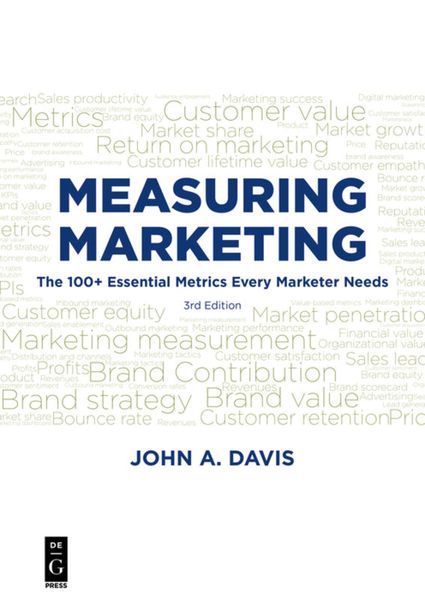
Produktbild: Measuring Marketing

Measuring Marketing The 100+ Essential Metrics Every Marketer Needs, Third Edition

53,99 €

inkl. gesetzl. MwSt., Versandkostenfrei


Beschreibung

Produktdetails

Einband

Taschenbuch

Erscheinungsdatum

19.12.2017

Abbildungen

mit 45 Illustrationen, mit 25 tblättern

Verlag

Walter de Gruyter

Seitenzahl

375

Maße (L/B/H)

24/17/2,2 cm

Gewicht

664 g

Auflage

3rd edition

Sprache

Englisch

ISBN

978-1-5015-1576-7

Beschreibung

Rezension

This book is a go-to resource for marketers looking to better measure the effectiveness of their efforts. The depth of information and approaches it provides helps professionals go beyond the 'usual suspects' we use for metrics, and challenges us to explore new methods for determining how well we're performing. Even better, many of the techniques shift our view of measurement from being a passive reporting tool to using it to be a more forward-looking tool for change.

-Lisa Bodell, CEO, futurethink; Author, Why Simple Wins

There is a quote, attributed to Albert Einstein: "Not everything that can be counted counts, and not everything that counts can be counted." In this book of marketing metrics, John Davis provides a brilliant insight into the metrics that do count in marketing. Each metric is explained succinctly so that marketing managers can understand and apply them to their business in a practical way. In a world of disruptive technology and fast changing consumer preferences, knowing what should be measured and how it should be measured is critical. This book should be compulsory reading for all marketing managers who want to stay ahead of the competition.

-Professor Mark Farrell, Head, Graduate School of Business and Law, RMIT University, Australia

Creating sustainable value is crucial for today's companies, and marketing plays a central role in this effort. With so many tools available, from traditional to digital and social media, as well as sophisticated sales organizations and new distribution channels, measuring performance can get quite complicated. John Davis's book, Measuring Marketing, is the perfect solution, offering clear descriptions and examples of how to measure the value contributed by the various marketing investments. Measuring Marketing is an excellent resource that every marketer and CMO should use.

-Hari Nair, Group Chief Strategy & Innovation Officer, Sime Darby, Kuala Lumpur Malaysia

John has delivered a comprehensive, end-to-end view of how to measure and create value. His expertise and approach are increasingly critical for any business to remain competitive.

-Thomas McCabe, Chief Country Officer, USA, DBS Bank

John Davis is a recognized expert in the field of marketing science. Measuring Marketing combines advances in the academic analysis of quantifying marketing impact together with deep industry insights to ensure...application to today's marketing organisations and companies.

-Steve Leonard, CEO, SGInnovate, Singapore

One variation of a managerial maxim goes that you can't manage what you can't count. John Davis has provided a cartograph of just how to do this. This book sits as comfortably on the aisle of financial analysis books as it does on the aisle of marketing books.

-Pakpoom Vallisuta, Chairman of The Quant Group; Board member of The Board of Visitors, Fuqua School of Business, Duke University

Produktdetails

Einband

Taschenbuch

Erscheinungsdatum

19.12.2017

Abbildungen

mit 45 Illustrationen, mit 25 tblättern

Verlag

Walter de Gruyter

Seitenzahl

375

Maße (L/B/H)

24/17/2,2 cm

Gewicht

664 g

Auflage

3rd edition

Sprache

Englisch

ISBN

978-1-5015-1576-7

Herstelleradresse

deGruyter Boston
Genthiner Straße 13
10785 Berlin
DE

Email: GPSR Kontakt

Noch keine Bewertungen vorhanden

Verfassen Sie die erste Bewertung zu diesem Artikel

Helfen Sie anderen Kundinnen und Kunden durch Ihre Meinung.

Kundinnen und Kunden meinen

Bewertungen (0)

Die Leseprobe wird geladen.
  • Produktbild: Measuring Marketing
  • Part 1: Corporate Financial Metrics ¿ 1

    Chapter 1: Revenue ¿ 3

    Chapter 2: Gross Profit ¿ 7

    Chapter 3: Value-to-Volume Ratio ¿ 9

    Chapter 4: Net Profit ¿ 13

    Chapter 5: Earnings-Based Value ¿ 17

    Chapter 6: Return on Sales ¿ 23

    Chapter 7: Return on Assets ¿ 25

    Chapter 8: Return on Equity ¿ 27

    Part 2: Marketing Planning Measures ¿ 31

    Chapter 9: Market Share ¿ 33

    Chapter 10: Relative Market Share ¿ 35

    Chapter 11: Market Growth ¿ 37

    Chapter 12: Market Demand ¿ 39

    Chapter 13: Market Penetration ¿ 41

    Chapter 14: Program/Nonprogram Ratio ¿ 47

    Chapter 15: Program/Payroll Ratio ¿ 49

    Chapter 16: Causal Forecast ¿ 51

    Chapter 17: Time Series Analysis ¿ 57

    Part 3: Brand Metrics ¿ 63

    Chapter 18: Brand Equity ¿ 65

    Chapter 19: Brand Scorecards ¿ 71

    Chapter 20: Brand Premium ¿ 75

    Chapter 21: Brand Contribution and Review Analysis ¿ 81

    Part 4: Customers Metrics ¿ 85

    Chapter 22: Net Sales Contribution ¿ 91

    Chapter 23: Time-Driven Activity-Based Costing ¿ 93

    Chapter 24: Segment Profitability ¿ 95

    Chapter 25: Customer Profitability ¿ 99

    Chapter 26: Share of Customer ¿ 101

    Chapter 27: Return on CustomerSM ¿ 105

    Chapter 28: New Customer Gains ¿ 109

    Chapter 29: Customer Acquisition Costs ¿ 113

    Chapter 30: Cost Per Lead ¿ 117

    Chapter 31: Retention Rate ¿ 121

    Chapter 32: Churn Rate ¿ 125

    Chapter 33: Consumer Franchise ¿ 129

    Chapter 34: Customer Equity and Customer Lifetime Value ¿ 133

    Chapter 35: Customer Brand Value ¿ 137

    Chapter 36: Customer Losses ¿ 139

    Part 5: Product/Offering Metrics ¿ 143

    Chapter 37: Usage ¿ 145

    Chapter 38: New Product Purchase Rate ¿ 147

    Chapter 39: Marketing Cost Per Unit ¿ 151

    Part 6: Price Matrics ¿ 153

    Chapter 40: Price ¿ 155

    Chapter 41: Mark-Up Pricing ¿ 159

    Chapter 42: Target Return Pricing ¿ 163

    Chapter 43: Sales Price Variance ¿ 165

    Chapter 44: Markdown Goods Percentage ¿ 169

    Chapter 45: Profit Impact ¿ 171

    Part 7: Advertising/Promotion Metrics ¿ 175

    Chapter 46: Share of Voice ¿ 177

    Chapter 47: Recall ¿ 179

    Chapter 48: Recognition ¿ 183

    Chapter 49: Reach ¿ 185

    Chapter 50: Frequency ¿ 187

    Chapter 51: Gross Rating Points ¿ 189

    Chapter 52: Cost Per Gross Rating Point ¿ 193

    Chapter 53: Response Rate ¿ 195

    Chapter 54: Conversion Rate ¿ 199

    Chapter 55: Advertising-To-Sales Ratio ¿ 201

    Chapter 56: Promotion Profit ¿ 203

    Part 8: Direct Marketing Metrics ¿ 207

    Chapter 57: Direct Marketing Revenue Goals ¿ 209

    Chapter 58: Direct Marketing Profit Goals ¿ 213

    Chapter 59: Direct Marketing Gross Profit ¿ 215

    Chapter 60: Direct Marketing Net Profit ¿ 217

    Chapter 61: Direct Marketing Return On Investment ¿ 219

    Part 9: Digital/Social Metrics ¿ 221

    Chapter 62: Gross Page Impressions (Or Gross Page Requests) ¿ 223

    Chapter 63: Word of Mouth ¿ 225

    Chapter 64: Total Clicks ¿ 1

    Chapter 65: Click Through Rate ¿ 229

    Chapter 66: Cost Per Click ¿ 231

    Chapter 67: Cost Per Action ¿ 235

    Chapter 68: Pay Per Lead ¿ 237

    Chapter 69: Activity Ratio for Social Media ¿ 239

    Chapter 70: Deductive Social Media Return on Investment ¿ 241

    Chapter 71: Resolution Time ¿ 243

    Chapter 72: Social Media Profitability ¿ 245

    Chapter 73: Bounce Rate ¿ 247

    Chapter 74: Return On Advertising Spend ¿ 249

    Part 10: Place/Distribution Metrics ¿ 251

    Chapter 75: Cost Per Sales Dollar ¿ 253

    Chapter 76: Transactions Per Customer ¿ 255

    Chapter 77: Transactions Per Hour ¿ 257

    Chapter 78: Average Transaction Size ¿ 259

    Chapter 79: Avergage Items Per Transaction ¿ 261

    Chapter 80: Hourly Customer Traffic ¿ 265

    Chapter 81: Returns to Net Sales ¿ 267

    Chapter 82: Inventory Turnover ¿ 269

    Chapter 83: Percent Inventory Carrying Costs ¿ 271

    Chapter 84: Gross Margin Return on Inventory Investment ¿ 273

    Chapter 85: Sales Per Square Foot ¿ 277

    Chapter 86: Sales/Profits Per Employee ¿ 279

    Chapter 87: Retail Close Ratio ¿ 281

    Chapter 88: Retail Margin Percentage ¿ 285

    Chapter 89: Percent Utilization of Discounts ¿ 287

    Chapter 90: Shrinkage to Net Sales ¿ 289

    Part 11: Sales Metrics

    Chapter 91: Net Sales Contribution ¿ 297

    Chapter 92: Absolute Index ¿ 299

    Chapter 93: Relative Index ¿ 303

    Chapter 94: Percent of Sales ¿ 305

    Chapter 95: Independent Sales Representative Analysis ¿ 309

    Chapter 96: Turnover Rate ¿ 311

    Chapter 97: Recruiting ¿ 315

    Chapter 98: Breakdown Approach ¿ 317

    Chapter 99: Workload Approach ¿ 321

    Chapter 100: Sales Performance Quotas ¿ 327

    Chapter 101: Average Sales Per Call ¿ 335

    Chapter 102: Close Process and Close Ratio ¿ 337

    Chapter 103: Cost Per Call ¿ 341

    Chapter 104: Break-Even Sales Volume ¿ 343

    Chapter 105: Sales Productivity ¿ 347

    Chapter 106: Four Factor Model ¿ 351

    Chapter 107: Sales Variance Analysis ¿ 355

    Chapter 108: Sales Volume Variance ¿ 361

    Chapter 109: Sales Enablement ¿ 365

    Chapter 110: Net Promoter ScoreR ¿ 367

    Index