KI-Beratung Beta

Gutscheinbedingungen

**Gültig bis 18.11.2026 auf englischsprachige Klassiker (klassiker-32728) online auf thalia.at und in der Thalia App. Einzelne Artikel können ausgeschlossen sein. Ausgenommen sind preisgebundene Artikel & eBooks. Pro Einkauf einmal einlösbar. Click & Collect nur bei Onlinevorabzahlung möglich. Keine Barauszahlung. Nicht kombinierbar mit anderen Aktionen und Gutscheinen. Gutschein wird auf max. 500€ Bestellwert angerechnet. Nicht gültig für Geschenkkarten, Versandkosten und Services.

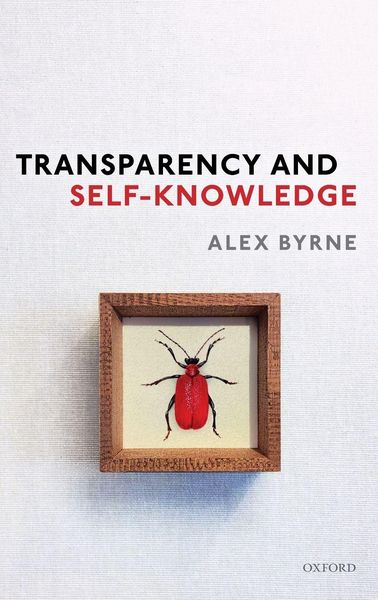
Produktbild: Transparency and Self-Knowledge

Transparency and Self-Knowledge

42,99 €

inkl. gesetzl. MwSt., Versandkostenfrei


Beschreibung

Alex Byrne sets out and defends a theory of self-knowledge-knowledge of one's mental states. Inspired by Gareth Evans' discussion of self-knowledge in his The Varieties of Reference, the basic idea is that one comes to know that one is in a mental state M by an inference from a worldly or environmental...

Beschreibung

Alex Byrne sets out and defends a theory of self-knowledge-knowledge of one's mental states. Inspired by Gareth Evans' discussion of self-knowledge in his The Varieties of Reference, the basic idea is that one comes to know that one is in a mental state M by an inference from a worldly or environmental premise to the conclusion that one is in M. (Typically the worldly premise will not be about anything mental.) The mind, on this account, is 'transparent': self-knowledge is achieved by an 'outward glance' at the corresponding tract of the world, not by an 'inward glance' at one's own mind. Belief is the clearest case, with the inference being from 'p' to 'I believe that p'. One serious problem with this idea is that the inference seems terrible, because 'p' is at best very weak evidence that one believes that p. Another is that the idea seems not to generalize. For example, what is the worldly premise corresponding to 'I intend to do this', or 'I feel a pain'? Byrne argues that both problems can be solved, and explains how the account covers perception, sensation, desire, intention, emotion, memory, imagination, and thought. The result is a unified theory of self-knowledge that explains the epistemic security of beliefs about one's mental states (privileged access), as well as the fact that one has a special first-person way of knowing about one's mental states (peculiar access).

Rezension

Byrne glides easily through the historical and contemporary literature on self-knowledge, and he culminates in an account of self-knowledge that is "uniformly detectivist, inferential, and economical, and the direction of inference is always from world to mind" (from the preview). The bibliography is impressive. Summing up: Highly recommended CHOICE

Produktdetails

Einband

Gebundene Ausgabe

Erscheinungsdatum

01.06.2018

Verlag Oxford University Press
Seitenzahl

240

Produktdetails

Einband

Gebundene Ausgabe

Erscheinungsdatum

01.06.2018

Verlag Oxford University Press
Seitenzahl

240

Maße (L/B/H)

24/16,1/1,8 cm

Gewicht

478 g

Sprache

Englisch

ISBN

978-0-19-882161-8

Herstelleradresse

Libri GmbH
Europaallee 1
36244 Bad Hersfeld
DE

Email: gpsr@libri.de

Noch keine Bewertungen vorhanden

Verfassen Sie die erste Bewertung zu diesem Artikel

Helfen Sie anderen Kundinnen und Kunden durch Ihre Meinung.

Kundinnen und Kunden meinen

Bewertungen (0)

Die Leseprobe wird geladen.
  • Produktbild: Transparency and Self-Knowledge
    • 1: Problems of Self-Knowledge

    • 2: Inner Sense

    • 3: Some Recent Approaches

    • 4: The Puzzle of Transparency

    • 5: Belief

    • 6: Perception and Sensation

    • 7: Desire, Intention, and Emotion

    • 8: Memory, Imagination, and Thought