KI-Beratung Beta

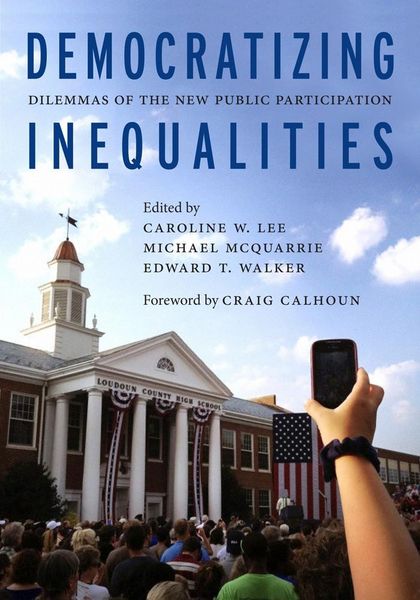
Produktbild: Democratizing Inequalities

Democratizing Inequalities Dilemmas of the New Public Participation

32,90 €

inkl. gesetzl. MwSt.

Beschreibung

Opportunities to "have your say," "get involved," and "join the conversation" are everywhere in public life. From crowdsourcing and town hall meetings to government experiments with social media, participatory politics increasingly seem like a revolutionary antidote to the decline of civic engagement and...

Beschreibung

Opportunities to "have your say," "get involved," and "join the
conversation" are everywhere in public life. From crowdsourcing and town hall
meetings to government experiments with social media, participatory politics increasingly
seem like a revolutionary antidote to the decline of civic engagement and the
thinning of the contemporary public sphere. Many argue that, with new
technologies, flexible organizational cultures, and a supportive policymaking
context, we now hold the keys to large-scale democratic revitalization.
Democratizing Inequalities shows that the equation may not be so
simple. Modern societies face a variety of structural problems that limit
potentials for true democratization, as well as vast inequalities in political
action and voice that are not easily resolved by participatory solutions. Popular
participation may even reinforce elite power in unexpected ways. Resisting an
oversimplified account of participation as empowerment, this collection of
essays brings together a diverse range of leading scholars to reveal surprising
insights into how dilemmas of the new public participation play out in politics
and organizations. Through investigations including fights over the
authenticity of business-sponsored public participation, the surge of the Tea
Party, the role of corporations in electoral campaigns, and participatory
budgeting practices in Brazil, Democratizing
Inequalities seeks to refresh our understanding of public participation and
trace the reshaping of authority in today's political environment.

Produktdetails

Format

ePUB

Kopierschutz

Nein

Family Sharing

Nein

Text-to-Speech

Ja

Produktdetails

Format

ePUB

Format

eBooks im ePUB-Format erlauben eine dynamische Anpassung des Inhalts an die jeweilige Display-Größe des Lesegeräts. Das Format eignet sich daher besonders für das Lesen auf mobilen Geräten, wie z.B. Ihrem tolino, Tablets oder Smartphones.

Kopierschutz

Nein

Kopierschutz

Dieses eBook können Sie uneingeschränkt auf allen Geräten der tolino Familie, allen sonstigen eReadern und am PC lesen. Das eBook ist nicht kopiergeschützt und kann ein personalisiertes Wasserzeichen enthalten. Weitere Hinweise zum Lesen von eBooks mit einem personalisierten Wasserzeichen finden Sie unter Hilfe/Downloads.

Family Sharing

Nein

Family Sharing

Mit Family Sharing können Sie eBooks innerhalb Ihrer Familie (max. sechs Mitglieder im gleichen Haushalt) teilen. Sie entscheiden selbst, welches Buch Sie mit welchem Familienmitglied teilen möchten. Auch das parallele Lesen durch verschiedene Familienmitglieder ist durch Family Sharing möglich. Um eBooks zu teilen oder geteilt zu bekommen, muss jedes Familienmitglied ein Konto bei Thalia oder einem anderen tolino-Buchhändler haben. Weitere Informationen finden Sie unter Hilfe/Family-Sharing.

Text-to-Speech

Ja

Text-to-Speech

Bedeutet Ihnen Stimme mehr als Text? Mit der Funktion Text-to-Speech können Sie sich im tolino webReader und in der aktuellen Thalia – Lesen & Hören App das eBook vorlesen lassen. Weitere Informationen finden Sie unter Hilfe/Text-to-Speech.

Erscheinungsdatum

30.01.2015

Herausgeber
Verlag The American University in Cairo Press
Seitenzahl

(Printausgabe)

Dateigröße

3410 KB

Sprache

Englisch

EAN

9781479880607

Barrierefreiheit
  • nicht oder eingeschränkt barrierefrei

Noch keine Bewertungen vorhanden

Verfassen Sie die erste Bewertung zu diesem Artikel

Helfen Sie anderen Kundinnen und Kunden durch Ihre Meinung.

Kundinnen und Kunden meinen

Bewertungen (0)

Weitere Artikel finden Sie in

Die Leseprobe wird geladen.
  • Produktbild: Democratizing Inequalities