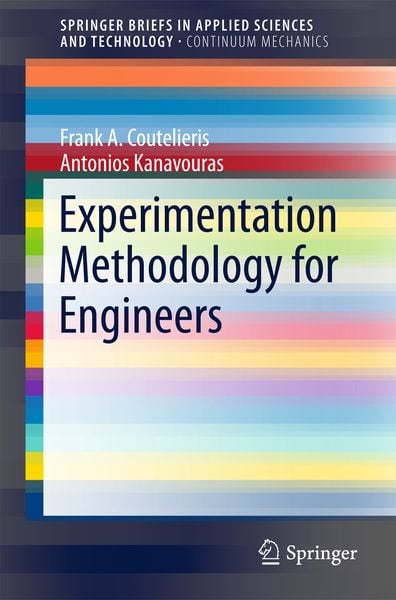
Experimentation Methodology for Engineers
-
- Taschenbuch ausgewählt
- eBook
-
Sprache:Englisch
51,99 €
inkl. gesetzl. MwSt.,
Beschreibung
Produktdetails
Einband
Taschenbuch
Erscheinungsdatum
01.03.2018
Abbildungen
XII, 6 illus., schwarz-weiss Illustrationen
Verlag
SpringerSeitenzahl
115
Maße (L/B/H)
23,6/15,6/1,2 cm
Gewicht
222 g
Auflage
1st ed. 2018
Sprache
Englisch
ISBN
978-3-319-72190-3
This book delivers a methodological approach on the experimentation and/or simulation processes from the disclaiming hypothesis on a physical phenomenon to the validation of the results. The main benefit of the book is that it discusses all the topics related to experimentation and validation of the outcome including state-of-the-art applications and presents important theoretical, mathematical and experimental developments, providing a self-contained major reference that is appealing to both the scientists and the engineers. At the same time, these topics are encountered in a variety of scientific and engineering disciplines.
As a first step, it presents the theoretical and practical implications on the formation of a hypothesis, considering the existing knowledge collection, classification and validation of the particular areas of experimenting interest. Afterwards, the transition from the knowledge classes to the experimentation parameters according to the phenomena evolution contributors and the systemic properties of the descriptors are discussed. The major experimenting requirements focus on the conditions to satisfy a potential disclaim of the initial hypothesis as conditions. Furthermore, the experimentation outcome, as derived via the previous experimentation process set-up, would be validate for the similarities among the existing knowledge and derived new one. The whole methodology offers a powerful tool towards the minimization of research effort wastes, as far as it can identify the lacks of knowledge, thus the areas of interest where the current research has to work on.
The special features of this book are (a) the use of state-of-the-art techniques for the classification of knowledge, (b) the consideration of a realistic systemic world of engineering approached phenomena, (c) the application of advanced mathematical techniques for identifying, describing and testing the similarities in the research results and conclusions, and (d) the experimental investigation of relevant phenomena.
Noch keine Bewertungen vorhanden
Verfassen Sie die erste Bewertung zu diesem Artikel
Helfen Sie anderen Kundinnen und Kunden durch Ihre Meinung.
Kurze Frage zu unserer Seite
Vielen Dank für Ihr Feedback
Wir nutzen Ihr Feedback, um unsere Produktseiten zu verbessern. Bitte haben Sie Verständnis, dass wir Ihnen keine Rückmeldung geben können. Falls Sie Kontakt mit uns aufnehmen möchten, können Sie sich aber gerne an unseren Kund*innenservice wenden.
zum Kundenservice