
Strategies of Genius Volume I
-
- Taschenbuch ausgewählt
- eBook
-
Sprache:Englisch
-
Verlag:Dilts Strategy Group
31,99 €
inkl. gesetzl. MwSt.,
Beschreibung
Produktdetails
Einband
Taschenbuch
Erscheinungsdatum
19.10.2017
Verlag
Dilts Strategy GroupSeitenzahl
342
Maße (L/B/H)
22,9/15,2/1,9 cm
Gewicht
496 g
Sprache
Englisch
ISBN
978-1-947629-07-3
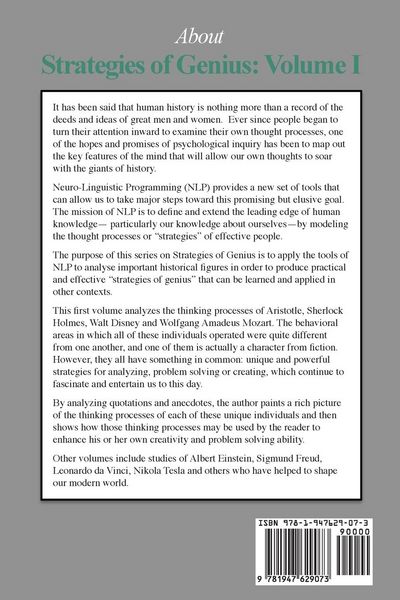
It has been said that human history is nothing more than a record of the deeds and ideas of great men and women. Ever since people began to turn their attention inward to examine their own thought processes, one of the hopes and promises of psychological inquiry has been to map out the key features of the mind that will allow our own thoughts to soar with the giants of history. Neuro-Linguistic Programming (NLP) provides a new set of tools that can allow us to take major steps toward this promising but elusive goal. The mission of NLP is to define and extend the leading edge of human knowledge— particularly our knowledge about ourselves—by modeling the thought processes or "strategies" of effective people. The purpose of this series on Strategies of Genius is to apply the tools of NLP to analyse important historical figures in order to produce practical and effective "strategies of genius" that can be learned and applied in other contexts. This first volume analyzes the thinking processes of Aristotle, Sherlock Holmes, Walt Disney and Wolfgang Amadeus Mozart. The behavioral areas in which all of these individuals operated were quite different from one another, and one of them is actually a character from fiction. However, they all have something in common: unique and powerful strategies for analyzing, problem solving or creating, which continue to fascinate and entertain us to this day. By analyzing quotations and anecdotes, the author paints a rich picture of the thinking processes of each of these unique individuals and then shows how those thinking processes may be used by the reader to enhance his or her own creativity and problem solving ability. Other volumes include studies of Albert Einstein, Sigmund Freud, Leonardo da Vinci, Nikola Tesla and others who have helped to shape our modern world.
Noch keine Bewertungen vorhanden
Verfassen Sie die erste Bewertung zu diesem Artikel
Helfen Sie anderen Kundinnen und Kunden durch Ihre Meinung.
Kurze Frage zu unserer Seite
Vielen Dank für Ihr Feedback
Wir nutzen Ihr Feedback, um unsere Produktseiten zu verbessern. Bitte haben Sie Verständnis, dass wir Ihnen keine Rückmeldung geben können. Falls Sie Kontakt mit uns aufnehmen möchten, können Sie sich aber gerne an unseren Kund*innenservice wenden.
zum Kundenservice