Gutscheinbedingungen

**Gültig bis 02.09.2026 auf fremdsprachige Bücher in der Thalia App. Einzelne Artikel können ausgeschlossen sein. Ausgenommen sind preisgebundene Artikel & eBooks. Pro Einkauf einmal einlösbar. Click & Collect nur bei Onlinevorabzahlung möglich. Keine Barauszahlung. Nicht kombinierbar mit anderen Aktionen und Gutscheinen. Gutschein wird auf max. 500€ Bestellwert angerechnet. Nicht gültig für Geschenkkarten, Versandkosten und Services.

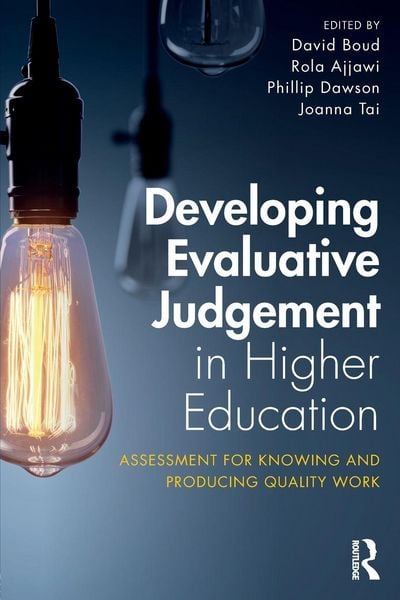
  • Produktbild: Developing Evaluative Judgement in Higher Education
  • Produktbild: Developing Evaluative Judgement in Higher Education

Developing Evaluative Judgement in Higher Education Assessment for Knowing and Producing Quality Work

55,99 €

inkl. gesetzl. MwSt., Versandkostenfrei


Beschreibung

Produktdetails

Einband

Taschenbuch

Erscheinungsdatum

12.04.2018

Abbildungen

4 SW-Zeichn., 4 Tabellen

Herausgeber

Boud David + weitere

Verlag

Taylor & Francis

Seitenzahl

220

Maße (L/B/H)

23,4/15,6/1,2 cm

Gewicht

342 g

Sprache

Englisch

ISBN

978-1-138-08935-8

Beschreibung

Rezension

Effective evaluative judgment is essential for effective 21st century learning, employment and active citizenship, but traditional assessment practices are not always effective in constructing and further developing such capabilities among students. This comprehensive and thoughtful edited collection, authored by a stellar cast of Australasian contributors provides an original and pragmatic guide to using practices including self- and peer-assessment, rubrics and exemplars, and dialogic feedback to enhance learning in a digitally enabled world.

Sally Brown, Chair of the Association of National Teaching Fellows, Emerita Professor, Leeds Beckett University

This edited collection challenges and assists us to design assessments which systematically reduce student dependence on their teachers as they learn to accurately judge and thereby improve the quality of their work in academic and professional settings. It pins down in practical terms how familiar practices such as feedback, rubrics, peer assessment and working with exemplars can be effectively employed to help graduates succeed once the scaffolding of criteria, marks and tutors have been left behind at university. By adopting a refreshingly new perspective on assessment purposes as well as encompassing small and large scale approaches, this book is at the cutting edge of assessment theory and practice.

Sue Bloxham, Emeritus professor of Academic Practice, University of Cumbria

Books with a long taxi-rank of contributors all too often underwhelm: what follows can be a bumpy ride with too many stop-offs and no clear destination. Not so this sparkling newcomer to the field of assessment in higher education. Happily, there's a compelling unifying theme in David Boud's seedcorn notion of evaluative judgment, and an impressive line-up of authors, each with insights that light up fresh pathways to understanding. Necessary intersections are explored with issues of standards and quality, but good use is also made of vantage-points that extend from the disciplines of the academy into the graduate workplace. The resulting journey is a delight to the mind's-eye.

Dai Hounsell, Emeritus Professor of Higher Education, University of Edinburgh, Fellow of the Society for Research into Higher Education

The book provides educators with a toolbox of practice strategies, illustrating how common pedagogical activities (for example, rubrics, exemplars and feedback) can be adapted to enhance students' ability to evaluate what constitutes "good work" in their disciplines. These strategies will be useful for educators who wish to reframe their assessment designs for better development of students' evaluative judgements.

Jiahui Luo, Educational Review

Produktdetails

Einband

Taschenbuch

Erscheinungsdatum

12.04.2018

Abbildungen

4 SW-Zeichn., 4 Tabellen

Herausgeber

Verlag

Taylor & Francis

Seitenzahl

220

Maße (L/B/H)

23,4/15,6/1,2 cm

Gewicht

342 g

Sprache

Englisch

ISBN

978-1-138-08935-8

Herstelleradresse

Libri GmbH
Europaallee 1
36244 Bad Hersfeld
DE

Email: gpsr@libri.de

Noch keine Bewertungen vorhanden

Verfassen Sie die erste Bewertung zu diesem Artikel

Helfen Sie anderen Kundinnen und Kunden durch Ihre Meinung.

Kundinnen und Kunden meinen

Bewertungen (0)

Die Leseprobe wird geladen.
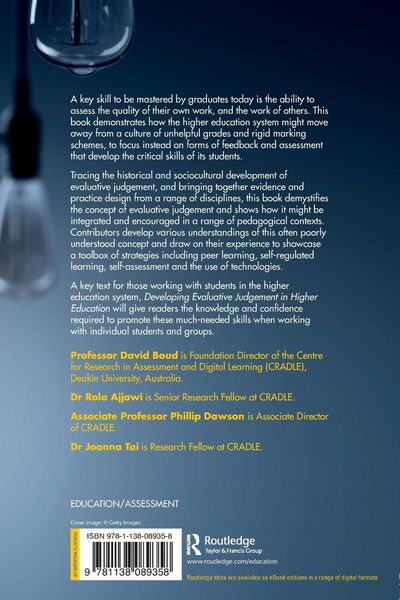
  • Produktbild: Developing Evaluative Judgement in Higher Education
  • Produktbild: Developing Evaluative Judgement in Higher Education
  •  List of figures and tables Acknowledgements List of Contributors Chapter 0: Introduction: what is evaluative judgement? Section 1: Conceptualising Evaluative Judgement Chapter 1: Conceptualising evaluative judgement for sustainable assessment in higher education Chapter 2: Evaluative judgement for learning to be in a digital world Chapter 3: Epistemic resourcefulness and the development of evaluative judgement Section 2: Alternative Theoretical Perspectives on Evaluative Judgement Chapter 4: Problematising standards: representation or performance? Chapter 5: Barriers to the cultivation of evaluative judgement: a critical and historical perspective Chapter 6: Limits to evaluative judgement Chapter 7: Understanding, assessing and enhancing student evaluative judgement in digital environments Section 3: Approaches to Developing Evaluative Judgement Chapter 8: Developing evaluative judgement: a self-regulated learning perspective Chapter 9: Understanding self-regulated learning in open-ended online assignment tasks  Chapter 10: Exemplars, feedback and bias: how do computers make evaluative judgements?  Chapter 11: Developing students' capacities for evaluative judgment through analysing exemplars Chapter 12: Designing for technology-enabled dialogic feedback Chapter 13: The practicalities of using assessment management to develop evaluative judgement Chapter 14: Strategies for fostering the development of evaluative judgement Section 4: Evaluative Judgement for Practice and Work  Chapter 15: Prefigurement, identities and agency: the disciplinary nature of evaluative judgement Chapter 16: The role of peers in developing evaluative judgement Chapter 17: Building evaluative judgement through the process of feedback Chapter 18: Using workplace-learning narratives to explore evaluative judgment in action Chapter 19: Creating an agenda for developing students' evaluative judgement