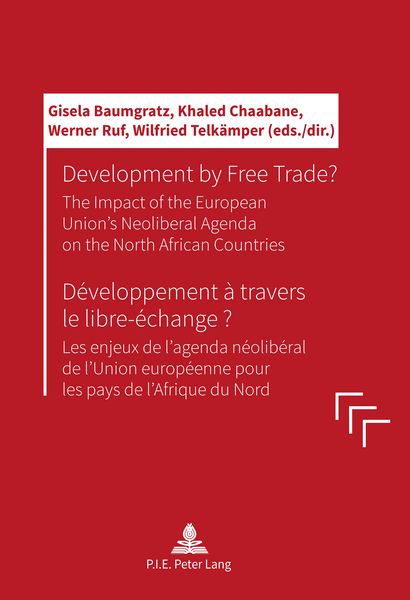
Development by Free Trade? Développement à travers le libre-échange? The Impact of the European Unions' Neoliberal Agenda on the North African Countries Les enjeux de l'agenda néolibéral de l'Union européenne pour les pays de l'Afrique du Nord
-
- Einzelkauf Download ausgewählt
-
Sprache:Englisch
54,00 €
inkl. gesetzl. MwSt.Beschreibung
Produktdetails
Format
ePUB
Kopierschutz
Ja
Family Sharing
Nein
Text-to-Speech
Ja
Erscheinungsdatum
30.01.2017
Herausgeber
Khaled Chaabane + weitereVerlag
P.I.E-Peter Lang S.A., Éditions Scientifiques InternationalesSeitenzahl
288 (Printausgabe)
Dateigröße
1866 KB
Auflage
1. Auflage
Sprache
Englisch
EAN
9782807602557
One year ago the negotiations between Tunisia and the European Union about a deep and comprehensive free trade agreement (DCFTA) had started in Tunis. Experts from both sides of the Mediterranean accepted to contribute to this book in order to foster the public debate in the North-African countries by informing actors of the civil society about the risks of this new generation of free trade agreements of the EU for the respective countries and their population. In fact, by analyzing the impact of the structural adjustment programs of the World Bank and the International Monetary Fund in Tunisia, Morocco and Algeria since the late 1980s followed up by the EU's free trade policy, the authors seriously doubt about the positive effects on development and prosperity promised by the promotors of free trade. They underline, on the contrary, that it is the EU which profits from the asymmetric power-relations in order to pursue its economic and especially its security interests related to "illegal migration".
Publié un an après le début des négociations sur l'Accord de libre échange complet et approfondi (ALECA) entre la Tunisie et l'Union européenne, cet ouvrage veut contribuer au débat public dans les pays concernés et alerter les acteurs de la société civile sur les risques que comporte cette nouvelle génération des accords de libre-échange de l'UE. Les experts nord-africains et européens réunis pour débattre des enjeux de la politique économique de l'UE vis-à-vis des pays de l'Afrique du Nord mettent sérieusement en cause la promesse de développement et de prospérité du libre-échange. Analysant l'impact de cette politique entamée par la Banque mondiale et le FMI depuis les années 1980 en Tunisie, en Algérie et au Maroc et poursuivie par l'UE, ils soulignent au contraire que l'UE profite de l'asymétrie des relations de pouvoir pour poursuivre ses intérêts économiques et sécuritaires liés à la « migration illégale ».
Kundinnen und Kunden meinen
Verfassen Sie die erste Bewertung zu diesem Artikel
Helfen Sie anderen Kund*innen durch Ihre Meinung
Kurze Frage zu unserer Seite
Vielen Dank für Ihr Feedback
Wir nutzen Ihr Feedback, um unsere Produktseiten zu verbessern. Bitte haben Sie Verständnis, dass wir Ihnen keine Rückmeldung geben können. Falls Sie Kontakt mit uns aufnehmen möchten, können Sie sich aber gerne an unseren Kund*innenservice wenden.
zum Kundenservice