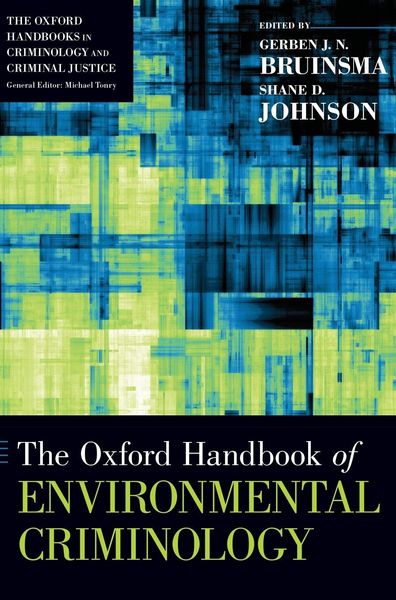
Produktbild: Oxford Handbook of Environmental Criminology

Oxford Handbook of Environmental Criminology

Aus der Reihe Oxford Handbooks

279,99 €

inkl. gesetzl. MwSt., Versandkostenfrei


Beschreibung

Produktdetails

Einband

Gebundene Ausgabe

Erscheinungsdatum

08.03.2018

Abbildungen

99 illustrations

Herausgeber

Gerben J.N. Bruinsma + weitere

Verlag

Oxford Academic

Seitenzahl

964

Maße (L/B/H)

25/17,5/5,6 cm

Gewicht

1807 g

Sprache

Englisch

ISBN

978-0-19-027970-7

Beschreibung

Produktdetails

Einband

Gebundene Ausgabe

Erscheinungsdatum

08.03.2018

Abbildungen

99 illustrations

Herausgeber

Verlag

Oxford Academic

Seitenzahl

964

Maße (L/B/H)

25/17,5/5,6 cm

Gewicht

1807 g

Sprache

Englisch

ISBN

978-0-19-027970-7

Herstelleradresse

Libri GmbH
Europaallee 1
36244 Bad Hersfeld
DE

Email: gpsr@libri.de

Noch keine Bewertungen vorhanden

Verfassen Sie die erste Bewertung zu diesem Artikel

Helfen Sie anderen Kundinnen und Kunden durch Ihre Meinung.

Kundinnen und Kunden meinen

Bewertungen (0)

Die Leseprobe wird geladen.
  • Produktbild: Oxford Handbook of Environmental Criminology
    • Foreword

    • Michael Tonry

    • 1 Environmental Criminology: History, Scope and State of the Art

    • Gerben J.N. Bruinsma and Shane D. Johnson

    • SECTION I - Reflections on Theoretical Issues

    • 2 Social Spatial Influences

    • Pamela Wilcox and Kristin Swartz

    • 3 How Do We Get to Causal Clarity on Physical Environment-Crime Dynamics?

    • Ralph B. Taylor

    • 4 The Individual Perspective

    • Lucia Summers and Rob T. Guerette

    • 5 Do We Really Need Collective Social Process to Understand Why Crime Occurs and Offenders Commit Crime?

    • Elizabeth R. Groff

    • 6 The Importance of High Offender Neighborhoods within Environmental Criminology

    • Anthony Bottoms

    • 7 Four Images of the Delinquent Area

    • Marcus Felson

    • 8 Evaluating Theories of Environmental Criminology: Strengths and Weaknesses

    • Francis T. Cullen and Teresa C. Kulig

    • SECTION II - Methods of Research in Environmental Criminology

    • 9 Deciding on the 'Appropriate' Unit of Analysis: Practical Considerations in Environmental Criminology

    • Brian Lawton

    • 10 GIS and Spatial Analysis

    • Martin Andresen

    • 11 The Role of Innovative Data Collection Methods in Advancing Criminological Understanding

    • Reka Solymosi and Kate Bowers

    • 12 New Steps in Visualization for Research in Environmental Criminology

    • Patricia L. Brantingham, Paul J. Brantingham, Justin Song, and Valerie Spicer

    • 13 Victimization Surveys in Environmental Criminology

    • Andromachi Tseloni, Nick Tilley, and Graham Farrell

    • 14 Systematic Observation

    • Ian Brunton-Smith

    • 15 Computer Simulations. Agent-Based Environmental Criminology

    • Daniel Birks

    • SECTION III -Everyday Urban Crime: Empirical Examples and Reviews of Research

    • Neighborhoods and Communities

    • 16 Research on Neighborhoods in European Cities

    • Lieven Pauwelst, Gerben Bruinsma, Frank Weerman, and Wim Hardyns

    • 17 Testing Theories of Social Disorganization in Nigeria

    • Faisal Umar, Ahmadu Bello, Shane D. Johnson, and James A. Cheshire

    • 18 Gated Communities and Crime in the United States

    • Nicholas Branic and Charis E. Kubrin

    • 19 Egohoods: Capturing Change in Spatial Crime Patterns

    • John R. Hipp and Christopher J. Bates

    • 20 Signal Crimes: How the Harms of Crime and Disorder Travel across Social Space-Time

    • Martin Innes and Helen Innes

    • Built Environment

    • 21 Built Environment, Land Use and Crime

    • Kathryn Wuschke and J. Bryan Kinney

    • 22 Macro Level Generators and Crime (Parks, Stadiums, and Transit Stations)

    • Andrew Newton

    • 23 Does Crime Impact Real Estate Prices? An Assessment of Accessibility and Location

    • Vania Ceccato and Mats Wilhelmsson

    • 24 Street Networks and Crime

    • Toby Davies and Kate Bowers

    • Places

    • 25 The Criminology of Places

    • Cody W. Telep, David Weisburd, and George Mason

    • 26 Studying Situational Effects of Setting Characteristics: Examples from the Study of Peers, Activities and Neighbourhoods

    • Frank Weerman, Evelien Hoeben, Wim Bernasco, Lieven Pauwels, and Gerben J.N. Bruinsma

    • 27 Place Management

    • John Eck and Tamara D. Madensen

    • 28 Crime Concentrations: Hot Dots, Hot Spots and Hot Flushes

    • Dainis Ignatans and Ken Pease

    • Routine Activity Convergence

    • 29 Time and Opportunity

    • Lisa Tompson and Timothy Coupe

    • 30 Guardianship

    • Danielle Reynald

    • 31 Mobility and Location Choice of Offenders

    • Wim Bernasco

    • Crime Prevention

    • 32 What have we Learned from Environmental Criminology for the Prevention of Crime?

    • Brandon Welsh and Sema A. Taheri

    • SECTION IV - Special Crimes and Circumstances

    • 33 Riots, Space and Place

    • Peter Baudains and Shane D. Johnson

    • 34 Geoprofiling Terrorism

    • Kim Rossmo

    • 35 Child Sexual Abuse and Opportunity

    • Richard Wortley

    • 36 (Juvenile) Gangs and Space

    • Matthew Valasik and George Tita

    • 37 Organized Crime and Places

    • Edward Kleemans

    • 38 Cybercrime and Place: Applying Environmental Criminology to Crimes in Cyberspace

    • Fernando Miro Llinares and Shane D. Johnson

    • 39 Maritime Piracy

    • Michael Townsley