Beschreibung
Photovoltaic (PV) is attracting increasing interest as an important contribution to renewable energy supply. Organic photovoltaic (OPV) is a comparable young PV technology with a great potential towards low cost solar power. This is due to the intrinsic advantage of the incorporated organic semiconductors which are soluble. Solution processing allows high throughput coating and printing processes. Hence, energy intensive high temperature and vacuum steps can be avoided which reduces the fabrication costs and keeps energy payback times low. The performance of organic solar cells strongly depends on the structure of the solution cast photoactive layer which comprises a polymer-fullerene blend. The blend structure evolves during the film drying step which has been studied in this thesis.
Starting point of this work was the hypothesis that drying process parameters are suitable for systematically tuning the structure formation during drying of solution cast polymer-fullerene films in order to generate optimized structures with improved photovoltaic performance. For the evaluation of this hypothesis the structure formation of the polymer-fullerene system Poly(3-hexylthiophene-2,5-diyl):[6,6]-Phenyl C61-butyric acid methyl ester (P3HT:PCBM) was investigated incorporating i) thin film drying kinetics, ii) phase behavior of polymer-fullerene solutions, iii) structure formation and iv) the drying process-structure-property relationship of solar cells. The generality of the obtained results has been studied in comparison with the behavior of Poly{[4,40-bis(2-ethylhexyl)dithieno(3,2-b;20,30-d)silole]-2,6-diyl-alt-(2,1,3-benzothidiazole)-4,7-diyl} (PSBTBT).
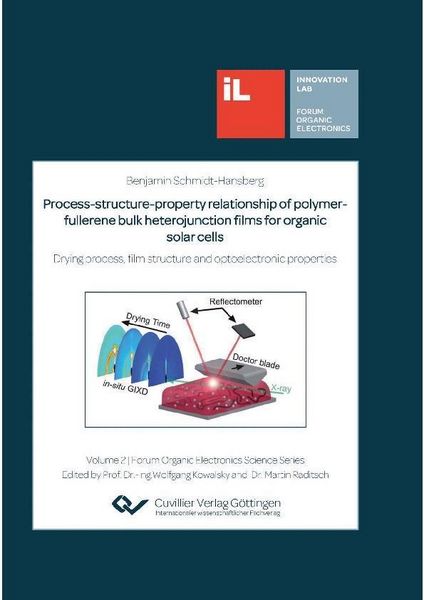
i) Within this thesis a dedicated coating and drying setup was developed which afforded precisely defined coating and drying process conditions as prerequisite for all obtained results. For the first time, the drying behavior of finally a few hundred nanometer thin films could be investigated at five measurement positions with laser reflectometry simultaneously. This allowed the elaboration of a spatially resolved numerical thin film drying model.
ii) In conjunction with the measurement and simulation of the evolution of film composition it was required to determine important instants of phase transitions such as solubility limits. Therefore the binodal region of P3HT solutions has been determined in the temperature range of 0°C-60°C. Within the unstable region P3HT solutions phase separate into a sol and a gel phase. The fullerene PCBM exhibits only a single solubility limit.
iii) In order to correlate the expected phase transitions according to the phase diagrams with the real structure formation, the above mentioned coating and drying setup was combined with synchrotron based in situ grazing incidence X-ray diffraction (GIXD) measurements. This gave unique insights into the mechanisms and dynamics of polymer-fullerene blend crystallization. After reaching P3HT solubility the crystallization proceeded with well-oriented interface-induced P3HT nucleation followed by P3HT crystal growth with increasing orientation distribution of the crystallites and PCBM aggregation in the final drying period. Furthermore strong polymer-fullerene interaction forces could be derived. By increasing the PCBM fraction it could be shown for the 1:2 P3HT:PCBM ratio that PCBM molecules brake the (020) π-π-stacking of P3HT lamellae which signifies a dramatic loss of hole mobility and consequently reduced device performance. It is further notable that increasing drying temperatures reduce the amount of (020) π-π-stacked P3HT molecules but lead to an increased amount of P3HT (100) crystallinity. Hence, drying temperature determines the preferred direction of crystal growth.
iv) Besides a finer degree of phase separation, reduced drying temperatures also cause a higher amount of π-π-stacked polymers, longer effective polymer conjugation length, increased amount of vertical charge transport pathways and an increasingly rough topography due to larger polymer aggregates. Jointly this leads to improved power conversion efficiency at lower drying temperatures. Based on the elaborated knowledge a strategy for a 40% reduction of drying time with only small drawbacks in solar cell performance could be developed.
Finally it was important to investigate the transferability of the obtained knowledge to other material systems. PSBTBT:PC71BM blends show similarities to that of P3HT:PCBM with partly interface induced polymer nucleation and subsequent fullerene aggregation in the final drying stage. The kinetics of molecular ordering however proceed fast enough such that the drying process under the investigated conditions cannot limit the structure formation. Hence, P3HT:PCBM is a suitable model system due to its sensitivity to many process parameters. According to the process influence on novel materials the results of this thesis can serve as a source for appropriate process strategies.