KI-Beratung Beta

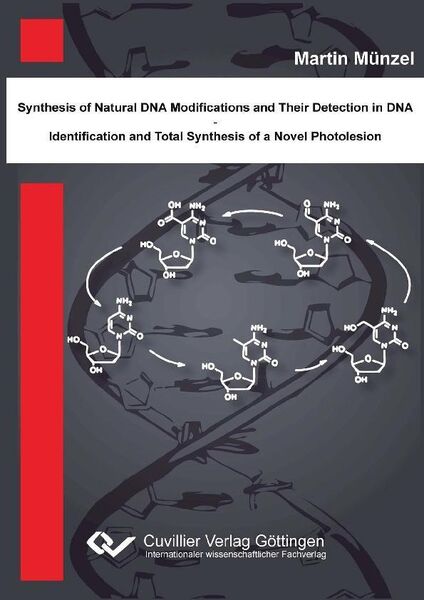
Produktbild: Synthese natürlicher DNA Modifikationen und deren Detektion in DNA - Identifikation und Totalsynthese eines neuartigen DNA Photoschadens

Synthese natürlicher DNA Modifikationen und deren Detektion in DNA - Identifikation und Totalsynthese eines neuartigen DNA Photoschadens

  • Form:Einzelkauf Download
  • Sprache:Englisch

30,30 €

inkl. gesetzl. MwSt.

Beschreibung

In the human body almost all cells contain the same genetic material; however, individual cells can perform vastly different functions. This is only possible, if different genes are active in different cell types. Furthermore, every cell stems from the same zygote; Hence the genetic information in cells...

Beschreibung

In the human body almost all cells contain the same genetic material; however, individual cells can perform vastly different functions. This is only possible, if different genes are active in different cell types. Furthermore, every cell stems from the same zygote; Hence the genetic information in cells needs to undergo reprogramming during differentiation. These processes require precise time dependent and robust control of gene expression, i.e. both stable and dynamic gene activation and silencing. The 'ATCG' DNA base sequence alone cannot control these processes. To enable the regulation of gene activity, cytosine bases in DNA can be further modified. The presence of methylated cytosines is long known to silence genes and aberrant methylation is the reason for many diseases including cancer. Thus, DNA modification is one of the most fundamental events in epigenetics.
To be able to detect methylated cytosines a methodology was developed that allows the efficient discrimination of cytosine and methylcytosine in DNA. The technique relies on different reaction products of the nucleosides with O-Allylhydroxylamine. These products exhibit different base pairing properties which can be readily detected by pyrosequencing.
As a further DNA modification, methylcytosine can be oxidized to hydroxymethylcytosine. By using a stable isotope dilution LC-MS approach the exact distribution of hydroxymethylcytosine in the mammalian body was determined for the first time. Especially high amounts of the nucleoside are present in the central nervous system. The hydroxymethylcytosine levels increase during brain development and are strongly reduced in cancerous tissue. It was furthermore investigated, if hydroxymethylcytosine was subject to further oxidation to formylcytosine and carboxylcytosine which - after final decarboxylation or excision by a glycosylase - would be an attractive mechanism for active DNA demethylation. This study ultimately led to the identification of formylcytosine and carboxylcytosine as constituents of mammalian DNA in our laboratory and by collaboration partners.
To enable the studies, natural and isotope labeled versions of the nucleosides were synthesized using Pd(0) catalyzed carbonylative couplings. This also allowed the design and synthesis of new phosphoramidite building blocks for the incorporation of hydroxymethylcytosine, formylcytosine and carboxylcytosine into DNA. Here, a cyclic carbamate was used as a protecting group in solid phase DNA synthesis for the first time.
DNA is not only subject to natural modifications, but can also be damaged by exogenous factors, of which UV light is one of the most prominent. The influence of UV light on CpG dinucleotides - the site of epigenetic modification - was investigated and new UV light induced DNA photolesions (the C(4-8)G and G(8-4)C photolesions) were identified. The photoproducts feature a bond between the exocyclic amino group of cytosine and a carbon atom on the 5 membered ring of guanine. The structures were proven by a total synthesis which featured a challenging Buchwald-Hartwig coupling as a key step. The identification of the DNA lesions shows that UV light does not only harm the genome but that it also disturbs the epigenetic information.

Produktdetails

Format

PDF

Kopierschutz

Nein

Family Sharing

Ja

Text-to-Speech

Nein

Produktdetails

Format

PDF

Format

eBooks im PDF-Format haben eine festgelegte Seitengröße und eignen sich daher nur bedingt zum Lesen auf einem tolino eReader oder Smartphone. Für den vollen Lesegenuss empfehlen wir Ihnen bei PDF-eBooks die Verwendung eines Tablets oder Computers.

Kopierschutz

Nein

Kopierschutz

Dieses eBook können Sie uneingeschränkt auf allen Geräten der tolino Familie, allen sonstigen eReadern und am PC lesen. Das eBook ist nicht kopiergeschützt und kann ein personalisiertes Wasserzeichen enthalten. Weitere Hinweise zum Lesen von eBooks mit einem personalisierten Wasserzeichen finden Sie unter Hilfe/Downloads.

Family Sharing

Ja

Family Sharing

Mit Family Sharing können Sie eBooks innerhalb Ihrer Familie (max. sechs Mitglieder im gleichen Haushalt) teilen. Sie entscheiden selbst, welches Buch Sie mit welchem Familienmitglied teilen möchten. Auch das parallele Lesen durch verschiedene Familienmitglieder ist durch Family Sharing möglich. Um eBooks zu teilen oder geteilt zu bekommen, muss jedes Familienmitglied ein Konto bei Thalia oder einem anderen tolino-Buchhändler haben. Weitere Informationen finden Sie unter Hilfe/Family-Sharing.

Text-to-Speech

Nein

Text-to-Speech

Bedeutet Ihnen Stimme mehr als Text? Mit der Funktion Text-to-Speech können Sie sich im tolino webReader und in der aktuellen Thalia – Lesen & Hören App das eBook vorlesen lassen. Weitere Informationen finden Sie unter Hilfe/Text-to-Speech.

Erscheinungsdatum

21.09.2011

Verlag Cuvillier Verlag eBooks
Seitenzahl

250 (Printausgabe)

Dateigröße

6301 KB

Sprache

Englisch

EAN

9783736938823

Barrierefreiheit
  • keine Information zur Barrierefreiheit bekannt

Noch keine Bewertungen vorhanden

Verfassen Sie die erste Bewertung zu diesem Artikel

Helfen Sie anderen Kundinnen und Kunden durch Ihre Meinung.

Kundinnen und Kunden meinen

Bewertungen (0)

Weitere Artikel finden Sie in

Die Leseprobe wird geladen.
  • Produktbild: Synthese natürlicher DNA Modifikationen und deren Detektion in DNA - Identifikation und Totalsynthese eines neuartigen DNA Photoschadens