Beschreibung
Produktdetails
Einband
Gebundene Ausgabe
Erscheinungsdatum
17.05.2018
Verlag
Oxford University PressSeitenzahl
376
Maße (L/B/H)
22,2/14,5/2,4 cm
Gewicht
604 g
Sprache
Englisch
ISBN
978-0-19-882127-4
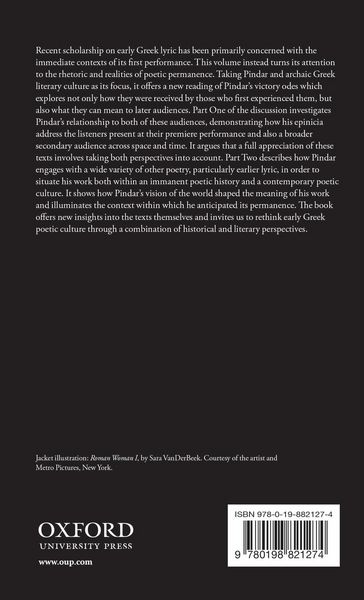
Recent scholarship on early Greek lyric has been primarily concerned with the immediate contexts of its first performance. This volume instead turns its attention to the rhetoric and realities of poetic permanence. Taking Pindar and archaic Greek literary culture as its focus, it offers a new reading of Pindar's victory odes which explores not only how they were received by those who first experienced them, but also what they can mean to later audiences. Part One of
the discussion investigates Pindar's relationship to both of these audiences, demonstrating how his epinicia address the listeners present at their premiere performance and also a broader secondary audience across space and time. It argues that a full appreciation of these texts involves taking both
perspectives into account. Part Two describes how Pindar engages with a wide variety of other poetry, particularly earlier lyric, in order to situate his work both within an immanent poetic history and a contemporary poetic culture. It shows how Pindar's vision of the world shaped the meaning of his work and illuminates the context within which he anticipated its permanence. The book offers new insights into the texts themselves and invites us to rethink early Greek poetic culture through a
combination of historical and literary perspectives.
the discussion investigates Pindar's relationship to both of these audiences, demonstrating how his epinicia address the listeners present at their premiere performance and also a broader secondary audience across space and time. It argues that a full appreciation of these texts involves taking both
perspectives into account. Part Two describes how Pindar engages with a wide variety of other poetry, particularly earlier lyric, in order to situate his work both within an immanent poetic history and a contemporary poetic culture. It shows how Pindar's vision of the world shaped the meaning of his work and illuminates the context within which he anticipated its permanence. The book offers new insights into the texts themselves and invites us to rethink early Greek poetic culture through a
combination of historical and literary perspectives.
Noch keine Bewertungen vorhanden
Verfassen Sie die erste Bewertung zu diesem Artikel
Helfen Sie anderen Kundinnen und Kunden durch Ihre Meinung.
Kurze Frage zu unserer Seite
Vielen Dank für Ihr Feedback
Wir nutzen Ihr Feedback, um unsere Produktseiten zu verbessern. Bitte haben Sie Verständnis, dass wir Ihnen keine Rückmeldung geben können. Falls Sie Kontakt mit uns aufnehmen möchten, können Sie sich aber gerne an unseren Kund*innenservice wenden.
zum Kundenservice