Gutscheinbedingungen

**Gültig am 28.06.2026 auf Spielzeug, Schreibwaren, Filme, Geschenke & Trends, Musik, tolino eReader & Zubehör, Hörbücher und Hörbuch-Downloads (außer Abo), nicht preisgebundene Bücher und Kalender online auf thalia.at und in der Thalia App. Einzelne Artikel können ausgeschlossen sein. Aufgrund der Buchpreisbindung sind deutschsprachige Bücher und eBooks ausgenommen. Zusätzlich ausgenommen sind preisgebundene Artikel, Abos & Flatrates, eBooks, Games, Geschenkkarten/-boxen, Shelfies, Software, Zeitschriften sowie einzelne Artikel von tonies®. Pro Einkauf einmal einlösbar. Click & Collect nur bei Onlinevorabzahlung möglich. Keine Barauszahlung. Nicht kombinierbar mit anderen Aktionen und Gutscheinen. Gutschein wird auf max. 500€ Bestellwert angerechnet. Nicht gültig für Versandkosten und Services.

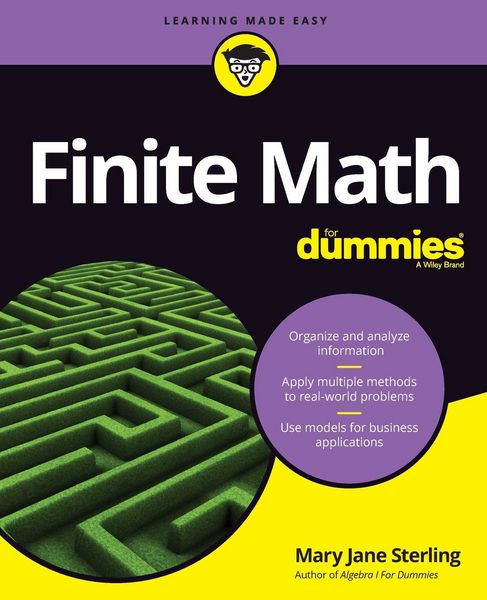
Produktbild: Finite Math for Dummies

Finite Math for Dummies

24,99 €

inkl. gesetzl. MwSt., zzgl. Versandkosten


  • Kostenlose Lieferung ab 30 € Einkaufswert
  • Versandkostenfrei für Bonuscard-Kund*innen

Beschreibung

Produktdetails

Einband

Taschenbuch

Erscheinungsdatum

15.05.2018

Verlag

John Wiley & Sons

Seitenzahl

336

Maße (L/B/H)

23,5/19,1/1,8 cm

Gewicht

633 g

Auflage

1. Auflage

Sprache

Englisch

ISBN

978-1-119-47636-8

Beschreibung

Produktdetails

Einband

Taschenbuch

Erscheinungsdatum

15.05.2018

Verlag

John Wiley & Sons

Seitenzahl

336

Maße (L/B/H)

23,5/19,1/1,8 cm

Gewicht

633 g

Auflage

1. Auflage

Sprache

Englisch

ISBN

978-1-119-47636-8

Herstelleradresse

Libri GmbH
Europaallee 1
36244 Bad Hersfeld
DE

Email: gpsr@libri.de

Kundinnen und Kunden meinen

0 Bewertungen

Informationen zu Bewertungen

Zur Abgabe einer Bewertung ist eine Anmeldung im Konto notwendig. Die Authentizität der Bewertungen wird von uns nicht überprüft. Wir behalten uns vor, Bewertungstexte, die unseren Richtlinien widersprechen, entsprechend zu kürzen oder zu löschen.

Die Bewertungen sind nach Format, Anzahl Sterne und Datum sortiert.

Verfassen Sie die erste Bewertung zu diesem Artikel

Helfen Sie anderen Kund*innen durch Ihre Meinung

Kundinnen und Kunden meinen

0 Bewertungen filtern

Die Leseprobe wird geladen.
  • Produktbild: Finite Math for Dummies
  • Introduction 1

    About This Book 1

    Foolish Assumptions 2

    Icons Used in This Book 2

    Beyond the Book 3

    Where to Go from Here 3

    Part 1: Getting Started with Finite Math 5

    Chapter 1: Feeling Fine with Finite Math 7

    Getting in Line with Linear Statements 8

    Making the Most with Matrices 8

    Staying with the Program 9

    Getting Set with Sets 10

    Posing the Probability 11

    Figuring in Financial Factors 13

    Finding Statistical Satisfaction 14

    Considering the Logical Side of Mathematics 15

    Unlocking the Chains 16

    Getting into Gaming 18

    Chapter 2: Lining Up Linear Functions 19

    Recognizing Equations of Lines 20

    Identifying slope and its scope 20

    Creating different forms of the equation 21

    Writing the equation of a line 21

    Graphing Lines on the Coordinate Plane 22

    Graphing a line using two points 23

    Using the slope and y-intercept to graph a line 24

    Graphing special lines 25

    Determining Relationships between Lines 27

    Parallel and perpendicular lines 27

    Intersecting versus coincidental lines 29

    Solving for a Variable 30

    Chapter 3: Solving Systems of Linear Equations 33

    Solving Systems Using Elimination 34

    Solving a system of two linear equations using elimination 34

    Using elimination to solve a system of three linear equations 36

    Solving Systems Using Substitution 38

    Solving a system of two linear equations using substitution 38

    Taking on a system of three linear equations using substitution 39

    Dealing with Too Many or No Solutions 41

    Too many solutions 41

    No solution at all 42

    Making Linear Equations Work for You 43

    Determining the profit 44

    Mixing it up with a solution 44

    Counting on change 46

    Chapter 4: Taking on Systems of Inequalities 49

    Ruling with Inequalities 49

    Graphing Linear Inequalities 51

    Creating graphs of systems 53

    Making graphs work for you 56

    Part 2: Making Use of Available Methods 63

    Chapter 5: Making Way for Matrices 65

    Squaring Off with Matrix Basics 65

    Identifying matrices and their components 66

    Equalizing and transposing matrices 67

    Performing matrix operations and processes 68

    Investigating Row Operations 75

    Performing the row operations 75

    Creating inverses 77

    Applying Matrices and Their Operations 80

    Matrices and motorcycles 81

    Taking matrices to the zoo 84

    Chapter 6: Making Matrices Work for You 87

    Solving Systems of Equations Using Matrices 88

    Solving a linear system in two variables 89

    Forging ahead with four variables 90

    Stopping up short 92

    Multiplying by the inverse 94

    Discovering Multiple Solutions 97

    Applying Matrices to Tasks 99

    Considering input and output 99

    Distributing temperatures 103

    Taking Advantage of Special Formulas 105

    Inverses of 2 × 2 matrices 105

    Inverses of 3 × 3 matrices 107

    Chapter 7: Getting Lined Up with Linear Programming 109

    Setting Up Linear Programming Problems 110

    Making the problem structure work 110

    Solving a maximization problem 112

    Going for a minimum 115

    Going Three-Dimensional 118

    Maximizing in three dimensions 119

    Going for the minimum 122

    Chapter 8: Simply the Simplex Method 125

    Delineating Simplex Method Steps for Maximization 126

    Setting up for the simplex method 126

    Solving a maximization application 131

    Making the Most of Minimization 135

    Spelling out the format 135

    Stepping through minimization 136

    Giving minimization meaning 140

    Part 3: Using Finite Math to Tackle World Situations 145

    Chapter 9: Setting Up Sets 147

    Introducing Set Notation 147

    Describing large and small sets 148

    Special types of sets 149

    Performing Basic Operations 151

    Using Venn Diagrams for Better Views 152

    Elements shown 152

    The number of elements shown 156

    Chapter 10: Processing the Probability 161

    Introducing Counting Methods 161

    Multiplication method of counting 162

    Using permutations for counting 163

    Counting with combinations 165

    Determining the Probability of an Event 167

    Binomial distributions 169

    Using probability trees 171

    Applying Probability Techniques 174

    Games of chance 174

    Probability of being chosen 177

    Chapter 11: Counting on the Mathematics of Finance 181

    Considering Simple Interest 181

    Compounding Things with Compound Interest 182

    Continuous compounding 184

    Effective interest rate 185

    Presenting present value 185

    Analyzing Annuities 188

    Future value of an annuity 188

    Present value of an annuity 189

    Sinking funds 190

    Amortization 191

    Creating an amortization schedule 191

    Accelerating to payoff 193

    Chapter 12: Telling the Truth with Statistics 195

    Presenting Data Graphically 195

    Barring none with a bar graph 196

    Histograms 197

    Baking up a pie chart 198

    Stem-and-leaf graphs 199

    Measures of Central Tendency 200

    Meaning it with the mean 200

    Riding down the middle with the median 202

    Making the most of the mode 202

    Recognizing the geometric mean 203

    Comparing measures of central tendency 203

    Box-and-whisker plots 207

    Variance and Standard Deviation 208

    Variance 208

    Standard deviation 209

    Investigating the Normal Distribution 210

    Chapter 13: Logic 213

    Logically Presenting the Vocabulary 213

    Finding the Truth with Truth Tables 215

    Considering the conjunction 215

    Displaying the disjunction 216

    Looking into negativity 217

    Conditionally making statements 217

    Analyzing compound statements 218

    Equivalent Statements 219

    Studying the Conditional 221

    Analyzing Arguments 222

    Applying Logic to Circuits 225

    Part 4: Employing the Tools of Finite Math to Expand and Investigate 229

    Chapter 14: Markov Chains 231

    Recognizing a Markov Chain 231

    Coming to Terms with Markov Chains 232

    Working with Transition Matrices 233

    Using charts and trees 233

    Dealing with diagrams 236

    Probability Vectors 239

    Absorbing Chains 242

    Making Long-Term Predictions 244

    Avoiding ruin 244

    Alternating even and odd 246

    Chapter 15: Playing Games with Game Theory 249

    Playing Fairly 249

    Playing by the Rules 252

    Matrix representation 252

    Vocabulary 252

    Vocabulary illustrated 253

    Getting Strategic 255

    Yielding to Domination 258

    Determining the Moves 259

    Finding no saddle point 259

    Getting down to business 263

    Chapter 16: Applications of Matrices and Game Theory 267

    Traffic Flow 267

    Battle of the Bismarck Sea 270

    The Game of Chicken 271

    The Prisoner's Dilemma 272

    The Traveler's Dilemma 273

    Blotto's Rules 274

    Jack Be Nimble 275

    Nim with two heaps 275

    Upping the Nim stacks to three 277

    Part 5: the Part of Tens 279

    Chapter 17: Ten Financial Formulas 281

    The Rule of 72 281

    Leverage Ratio 282

    Gains and Losses 282

    Determining Depreciation 283

    Total Return on Investments 283

    Expected Return 284

    Inflation-Adjusted Return 284

    Remaining Balance 285

    Future Value of Annuity Due 286

    Bond Pricing Formula 286

    Chapter 18: Ten Important Graphing Calculator Functions 289

    Graphing Lines for Intersections 289

    Adjusting the Window 290

    Entering Matrices 291

    Adding, Subtracting, and Multiplying Matrices 292

    Powering Up Matrices 293

    Finding Matrix Inverses 294

    Solving Systems of Equations Using Matrices 295

    Decimals to Fractions 296

    Counting with Permutations and Combinations 296

    Making Statistical Statements 298

    Glossary 301

    Index 305