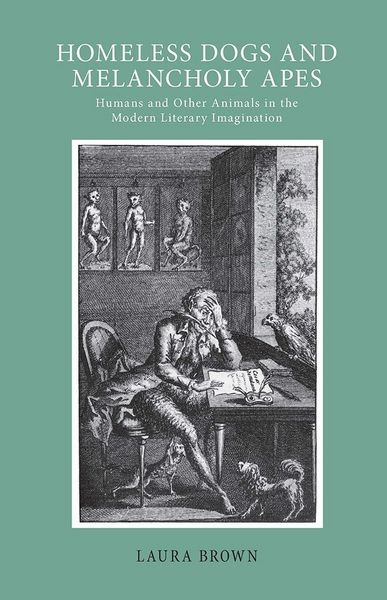
Homeless Dogs and Melancholy Apes Humans and Other Animals in the Modern Literary Imagination
-
- Einzelkauf Download ausgewählt
-
Sprache:Englisch
-
eBook Format:ePUB
- PDF 165,95 €
- ePUB 23,09 € ausgewählt
23,09 €
inkl. gesetzl. MwSt.Beschreibung
Produktdetails
Format
ePUB
Kopierschutz
Nein
Family Sharing
Nein
Text-to-Speech
Ja
Altersempfehlung
ab 18 Jahr(e)
Erscheinungsdatum
31.01.2017
Verlag
Cornell University PressSeitenzahl
176 (Printausgabe)
Dateigröße
1436 KB
Sprache
Englisch
EAN
9781501716621
In eighteenth-century England, the encounter between humans and other animals took a singular turn with the discovery of the great apes and the rise of bourgeois pet keeping. These historical changes created a new cultural and intellectual context for the understanding and representation of animal-kind, and the nonhuman animal has thus played a significant role in imaginative literature from that period to the present day.
In Homeless Dogs and Melancholy Apes, Laura Brown shows how the literary works of the eighteenth century use animal-kind to bring abstract philosophical, ontological, and metaphysical questions into the realm of everyday experience, affording a uniquely flexible perspective on difference, hierarchy, intimacy, diversity, and transcendence. Writers of this first age of the rise of the animal in the modern literary imagination used their nonhuman characters-from the lapdogs of Alexander Pope and his contemporaries to the ill-mannered monkey of Frances Burney's Evelina or the ape-like Yahoos of Jonathan Swift-to explore questions of human identity and self-definition, human love and the experience of intimacy, and human diversity and the boundaries of convention. Later literary works continued to use imaginary animals to question human conventions of form and thought.
Brown pursues this engagement with animal-kind into the nineteenth century-through works by Mary Shelley, Charles Dickens, and Elizabeth Barrett Browning-and into the twentieth, with a concluding account of Paul Auster's dog-novel, Timbuktu. Auster's work suggests that-today as in the eighteenth century-imagining other animals opens up a potential for dissonance that creates distinctive opportunities for human creativity.
Noch keine Bewertungen vorhanden
Verfassen Sie die erste Bewertung zu diesem Artikel
Helfen Sie anderen Kundinnen und Kunden durch Ihre Meinung.
Kurze Frage zu unserer Seite
Vielen Dank für Ihr Feedback
Wir nutzen Ihr Feedback, um unsere Produktseiten zu verbessern. Bitte haben Sie Verständnis, dass wir Ihnen keine Rückmeldung geben können. Falls Sie Kontakt mit uns aufnehmen möchten, können Sie sich aber gerne an unseren Kund*innenservice wenden.
zum Kundenservice