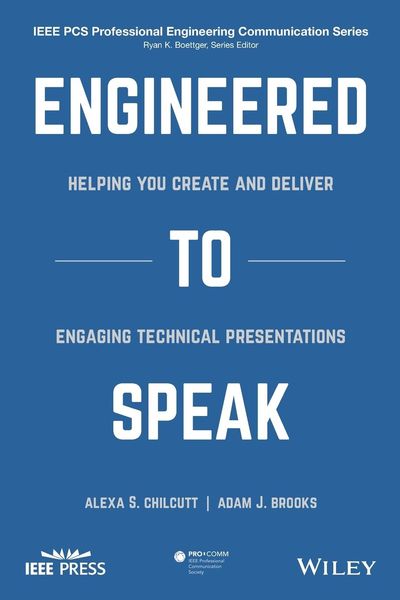
Produktbild: Engineered to Speak

Engineered to Speak Helping You Create and Deliver Engaging Technical Presentations

89,99 €

inkl. gesetzl. MwSt., Versandkostenfrei


Beschreibung

Produktdetails

Einband

Taschenbuch

Erscheinungsdatum

20.08.2019

Verlag

Wiley

Seitenzahl

190

Maße (L/B/H)

22,9/15,2/1,1 cm

Gewicht

287 g

Sprache

Englisch

ISBN

978-1-119-47496-8

Beschreibung

Produktdetails

Einband

Taschenbuch

Erscheinungsdatum

20.08.2019

Verlag

Wiley

Seitenzahl

190

Maße (L/B/H)

22,9/15,2/1,1 cm

Gewicht

287 g

Sprache

Englisch

ISBN

978-1-119-47496-8

Herstelleradresse

Libri GmbH
Europaallee 1
36244 Bad Hersfeld
DE

Email: gpsr@libri.de

Noch keine Bewertungen vorhanden

Verfassen Sie die erste Bewertung zu diesem Artikel

Helfen Sie anderen Kundinnen und Kunden durch Ihre Meinung.

Kundinnen und Kunden meinen

Bewertungen (0)

Die Leseprobe wird geladen.
  • Produktbild: Engineered to Speak
  • A Note From Series Editor xi

    About the Authors xiii

    Acknowledgments xv

    PART I: RECOGNIZE COMMUNICATION OPPORTUNITIES

    1 WHY THIS BOOK? 3

    1.1 Why Now? 5

    1.2 Managers 6

    1.3 Engineers and Technical Professionals 6

    1.4 Students 7

    1.5 Embracing Your Power as a Presenter 7

    1.6 How to Use this Book 8

    1.7 Calls to Action 9

    2 DEMYSTIFYING COMMUNICATION AND ENGINEERING 11

    2.1 The Place to Start 12

    2.2 Rejecting Stereotypes 13

    2.3 Debunking the Myths 14

    2.3.1 Myth 1: Good Communicators Are Not Anxious 14

    2.3.2 Myth 2: Some People Are Naturally Great Speakers 15

    2.3.3 Myth 3: Winging it Works 16

    2.3.4 Myth 4: Need to Be the "Sage on Stage" 16

    2.3.5 Myth 5: Data Is Supreme 17

    2.3.6 Myth 6: Time - I Must Fill It 17

    2.3.7 Myth 7: Extroverts Make Better Speakers 18

    2.4 Calls to Action 18

    2.4.1 Communication Assessment Questions 18

    2.4.2 Level of Anxiety in Public Speaking Situations 19

    2.4.3 Putting Knowledge into Practice 20

    3 RECOGNIZING COMMUNICATION OPPORTUNITIES 23

    3.1 The Sphere of Influence Model 24

    3.1.1 Internal Interactions Quadrant 25

    3.1.2 Leadership Interactions Quadrant 26

    3.1.3 External Interactions Quadrant 27

    3.1.4 Personal Interactions Quadrant 28

    3.2 Communicating to Connect 28

    3.3 Listening Hang?]Ups 29

    3.4 Active Listening Tactics 31

    3.4.1 Paraphrasing 31

    3.4.2 Priming 31

    3.4.3 Expressing Understanding 31

    3.4.4 Use of Nonverbal Body Language 32

    3.5 Putting it into Practice 32

    3.6 Calls to Action 34

    4 ASKING THE QUESTIONS 37

    4.1 Asking the Questions 38

    4.1.1 Who Am I Speaking to? 39

    4.1.2 What Is the Purpose of My Presentation? 39

    4.1.3 What Is the Desired Outcome? 39

    4.1.4 What Information Matters Most? 40

    4.1.5 Why Should they Care? 40

    4.1.6 When Am I Speaking? 41

    4.1.7 Where Am I Speaking? 41

    4.1.8 How Should I Present? 41

    4.2 Analyzing your Audience 42

    4.2.1 Captive Verses Voluntary Audiences 42

    4.2.2 Knowledge 43

    4.2.3 Technical and Nontechnical Audiences 43

    4.2.4 The Jargon Barrier 44

    4.3 Competing for Attention 45

    4.4 Opposing Viewpoints 46

    4.5 Calls to Action 47

    PART II: APPLY THE PROCESS

    5 ORGANIZING AND OUTLINING YOUR PRESENTATION 51

    5.1 Benefits of Organization - Decreasing Uncertainty 52

    5.2 Engineering the Outline 52

    5.2.1 Informational Organizational Pattern 53

    5.2.2 Put it into Practice 54

    5.2.3 Persuasive Organizational Patterns 56

    5.2.4 Transitions 57

    5.3 How to Begin your Presentation 57

    5.4 How to Close your Presentation 59

    5.5 Preparation Outline 60

    5.6 Calls to Action 60

    6 PERFECTING YOUR PITCH 63

    6.1 Lead with Meaning 64

    6.2 Start with an Essential Truth 64

    6.3 Use Evidence to Tell your Story 65

    6.3.1 Building Compelling Narratives 66

    6.3.2 Applying the STAR Method 66

    6.4 End with the Call to Action 68

    6.5 Calls to Action 69

    7 VISUALIZING YOUR MESSAGE 71

    7.1 Understanding why Visuals Work 73

    7.2 Designing your Slides 75

    7.2.1 Storyboard Design 76

    7.2.2 Keep it Simple 77

    7.3 Handling Handouts 79

    7.4 Physical Objects/Demonstrations 81

    7.5 Real?]time Writing and Drawing 82

    7.5.1 The White Board 82

    7.5.2 The Flip Chart 83

    7.6 Calls to Action 85

    8 CREATING CHARISMA 87

    8.1 Dynamic Delivery 88

    8.2 The Voice 88

    8.2.1 Tone 89

    8.2.2 Volume 90

    8.2.3 Rate 91

    8.2.4 Pausing 91

    8.2.5 Articulation 92

    8.3 Body Language 94

    8.3.1 Eye Contact 94

    8.3.2 Gestures 95

    8.3.3 Stance 96

    8.3.4 Using the Space 97

    8.4 Calls to Action 98

    PART III: COMMIT TO IMPROVEMENT

    9 PRACTICE, FEEDBACK, AND ANXIETY REDUCTION TECHNIQUES 103

    9.1 Practice Makes Better, not Perfect 104

    9.2 Giving and Receiving Feedback 107

    9.2.1 Requesting Real Feedback 108

    9.2.2 Providing Feedback to Others 110

    9.3 Managing Anxiety Through Uncertainty Reduction Tactics 112

    9.3.1 Get Outside of Yourself 112

    9.3.2 The Audience Is There for You 113

    9.4 Fielding Questions 114

    9.4.1 Addressing Opposing Viewpoints 115

    9.4.2 Stumped? 115

    9.5 Calls to Action 116

    10 PROFESSIONALLY SPEAKING 119

    10.1 Embracing your Influence 120

    10.2 Taking the Lead 121

    10.3 Being Part of the Strategy 122

    10.4 Breaking out of Bad 123

    10.5 Reading the Signs 124

    10.6 Listening 126

    10.7 Finishing Strong 127

    APPENDICES 129

    Appendix A: Self-Assessments from Chapter 1 130

    Appendix B: Sphere of Influence/Active listening from Chapter 3 132

    Appendix C: Asking the Questions from Chapter 4 135

    Appendix D: Organizing and Outline Your Presentation from Chapter 5 136

    Appendix E: Perfecting Your Pitch from Chapter 6 141

    Appendix F: Visualizing Your Message from Chapter 7 144

    Appendix G: Creating Charisma from Chapter 8 147

    Appendix H: Practice, Feedback, and Anxiety Reduction Techniques from Chapter 9 150

    Appendix I: Ten Session Communication Curriculum 153

    Index 169