KI-Beratung Beta

Gutscheinbedingungen

**Gültig bis 18.11.2026 auf englischsprachige Klassiker (klassiker-32728) online auf thalia.at und in der Thalia App. Einzelne Artikel können ausgeschlossen sein. Ausgenommen sind preisgebundene Artikel & eBooks. Pro Einkauf einmal einlösbar. Click & Collect nur bei Onlinevorabzahlung möglich. Keine Barauszahlung. Nicht kombinierbar mit anderen Aktionen und Gutscheinen. Gutschein wird auf max. 500€ Bestellwert angerechnet. Nicht gültig für Geschenkkarten, Versandkosten und Services.

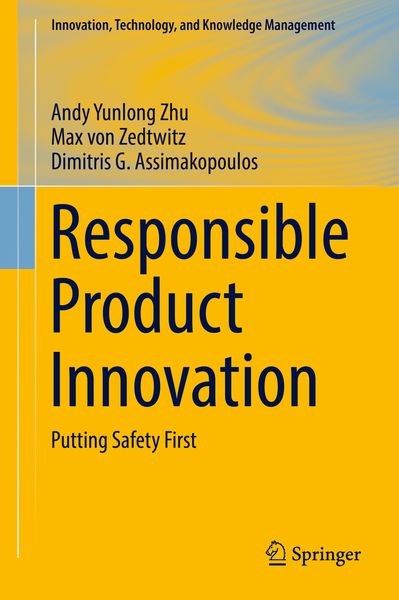
Produktbild: Responsible Product Innovation
- 10%

Responsible Product Innovation Putting Safety First

10% sparen

147,99 € UVP 164,99 €

inkl. gesetzl. MwSt., Versandkostenfrei


Beschreibung

This book analyses the relationships among product safety strategy and culture, concurrent engineering, new product development (NPD) processes and product safety performance. Product safety is a matter of enormous economic and societal concern, given the safety risks to consumers and the financial risks...

Beschreibung

This book analyses the relationships among product safety strategy and culture, concurrent engineering, new product development (NPD) processes and product safety performance. Product safety is a matter of enormous economic and societal concern, given the safety risks to consumers and the financial risks to producers. Nevertheless, a thorough conceptual understanding of the effects of NPD policies and practices is still largely missing, as several large-scale trends have made clarifying the role of product safety in its socio-economic context difficult, including: the rise of consumerism and the shift in the balance of power from manufacturers to customers and regulators; the internationalization of value chains and the fragmentation of markets worldwide; and technological change leading to a sophistication of products that rendered average consumers increasingly unaware of risk and potential accidents.     

This volume sets out to close the gaps among research, practice and policy, with an emphasis on advocating responsible product innovation. Through an in-depth study of the durable juvenile products industry, the authors discover important relationships, for example that top management involvement, safety-first culture and robust NPD processes are paramount in increasing product safety and decreasing product recalls in firms.  On the other end of the spectrum, concurrent engineering does not automatically lead to product safety, they found no “magic bullet” through which product safety can be tied to the use of a particular tool, skill, or practice. Offering a dynamic framework for aligning the interests of multiple stakeholders, including manufacturers, regulators, and consumers, the authors provide a clearer understanding of product safety and its implications for scholars, students, policy makers, and practitioners in the areas of innovation management, product management, R&D management, and responsible research and innovation.

Produktdetails

Einband

Gebundene Ausgabe

Erscheinungsdatum

21.11.2017

Abbildungen

XXXI, 150 p. 21 illus., 19 illus. in color.

Verlag Springer

Produktdetails

Einband

Gebundene Ausgabe

Erscheinungsdatum

21.11.2017

Abbildungen

XXXI, 150 p. 21 illus., 19 illus. in color.

Verlag Springer
Seitenzahl

150

Maße (L/B/H)

24,1/16/1,6 cm

Gewicht

395 g

Auflage

1st ed. 2018

Sprache

Englisch

ISBN

978-3-319-68450-5

Herstelleradresse

Springer-Verlag GmbH
Europaplatz 3
69115 Heidelberg
DE

Email: ProductSafety@springernature.com

Noch keine Bewertungen vorhanden

Verfassen Sie die erste Bewertung zu diesem Artikel

Helfen Sie anderen Kundinnen und Kunden durch Ihre Meinung.

Kundinnen und Kunden meinen

Bewertungen (0)

Weitere Artikel finden Sie in

  • Produktbild: Responsible Product Innovation
  • Chapter 1: INTRODUCTION: BETTER SAFE THAN SORRY.- Chapter 2: LITERATURE REVIEW.- Chapter 3: CONCEPTUAL MODEL AND HYPOTHESES.- Chapter 4: METHODOLOGY.- Chapter 5: QUANTITATIVE RESULTS.- Chapter 6: QUALITATIVE RESULTS.- Chapter 7: DISCUSSION.- Chapter 8: IMPLICATIONS AND RECOMMENDATIONS.- Chapter 9: CONCLUSIONS AND LIMITATIONS.-