KI-Beratung Beta

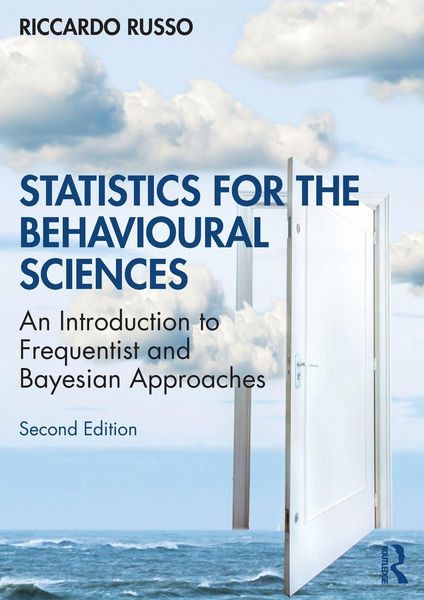
  • Produktbild: Statistics for the Behavioural Sciences
  • Produktbild: Statistics for the Behavioural Sciences

Statistics for the Behavioural Sciences An Introduction to Frequentist and Bayesian Approaches

56,99 €

inkl. gesetzl. MwSt., Versandkostenfrei


Beschreibung

This accessible textbook is for those without a mathematical background (just some notions of basic algebra are sufficient) and provides a comprehensive introduction to all topics covered in introductory behavioural science statistics courses. It includes plenty of real examples to demonstrate approaches...

Beschreibung

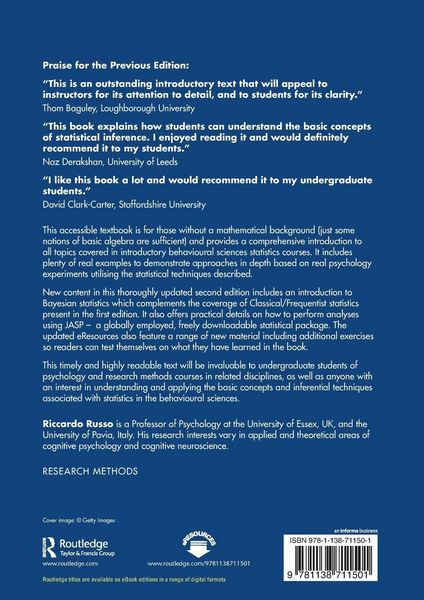
This accessible textbook is for those without a mathematical background (just some notions of basic algebra are sufficient) and provides a comprehensive introduction to all topics covered in introductory behavioural science statistics courses. It includes plenty of real examples to demonstrate approaches in depth based on real psychology experiments utilizing the statistical techniques described.

New content in this thoroughly updated second edition includes an introduction to Bayesian statistics which complements the coverage of Classical/Frequentist statistics present in the first edition. It also offers practical details on how to perform analyses using JASP - a globally employed, freely downloadable statistical package. The updated eResources also feature a range of new material including additional exercises so readers can test themselves on what they have learned in the book.

This timely and highly readable text will be invaluable to undergraduate students of psychology and research methods courses in related disciplines, as well as anyone with an interest in understanding and applying the basic concepts and inferential techniques associated with statistics in the behavioural sciences.

Rezension

Praise from the Previous Edition:

"This is an outstanding introductory text that will appeal to instructors for its attention to detail, and to students for its clarity." - Thom Baguley, Loughborough University
"This book explains how students can understand the basic concepts of statistical inference. I enjoyed reading it and would definitely recommend it to my students." - Naz Derakshan, University of Leeds
"I like this book a lot and would recommend it to my undergraduate students." - David Clark-Carter, Staffordshire University

Produktdetails

Einband

Taschenbuch

Erscheinungsdatum

30.11.2020

Abbildungen

109 SW-Abb., 60 SW-Fotos, 49 SW-Zeichn., 51 Tabellen

Verlag Taylor & Francis

Produktdetails

Einband

Taschenbuch

Erscheinungsdatum

30.11.2020

Abbildungen

109 SW-Abb., 60 SW-Fotos, 49 SW-Zeichn., 51 Tabellen

Verlag Taylor & Francis
Seitenzahl

332

Maße (L/B/H)

24,6/17,4/1,9 cm

Gewicht

593 g

Auflage

2. Auflage

Sprache

Englisch

ISBN

978-1-138-71150-1

Herstelleradresse

Libri GmbH
Europaallee 1
36244 Bad Hersfeld
DE

Email: gpsr@libri.de

Noch keine Bewertungen vorhanden

Verfassen Sie die erste Bewertung zu diesem Artikel

Helfen Sie anderen Kundinnen und Kunden durch Ihre Meinung.

Kundinnen und Kunden meinen

Bewertungen (0)

Die Leseprobe wird geladen.
  • Produktbild: Statistics for the Behavioural Sciences
  • Produktbild: Statistics for the Behavioural Sciences
  • Preface edition 1

    Acknowledgements edition I

    Preface edition II

    Acknowledgements edition II

    0. Mathematics and Algebra: A Rapid-Mini Review

    0.1. Operators and symbols

    0.2. Orders of operations

    0.3. Dealing with fractions

    0.4. Variables, constants and equations

    0.5. Graphs and equations

    0.6. How to solve an equation with one unknown

    1. Introduction and basic concepts

    1.1. Why is statistics useful in the behavioural sciences?

    1.2. Simple example of statistical teseting

    1.3. Descriptive and inferential statistics

    1.4. Descriptive and inferential statistics

    1.5 What is an experiment?

    1.6 Correlational studies

    1.7 Irrelevant variables

    2. Descriptive statistics

    2.1. Organising raw data

    2.2. Frequency distributions and histograms

    2.3. Grouped data

    2.4. Stem-and-leaf diagrams

    2.5. Summarising data

    2.6. Measures of central tendency: Mode, median, and mean

    2.7. Advantages and disadvantages of mode, median, and mean

    2.8. A useful digression on the Sigma notation

    2.9. Measures of dispersion (or variability)

    2.10. Further on the mean, variance, and standard deviation of frequency distributions

    2.11. How to calculate the combined mean and the combined variance of several samples (Web only content)

    2.12. Properties of estimators

    2.13. Mean and variance of linearly transformed data

    2.14 Using JASP for data analysis: Descriptive statistics

    3. Introduction to probability

    3.1. Why are some notions of probability useful?

    3.2. Some preliminary definitions and the concept of probability

    3.3. Venn diagrams and probability

    3.4. The addition rule and the multiplication rule of probability

    3.5. Probability trees

    3.6. Conditional probability

    3.7. Independence and conditional probability

    3.8. Bayes's Theorem

    4. Introduction to inferential statistics

    4.1. Inferential statistics and probability

    4.2. The Classical/Frequentist approach to inferential statistics

    4.3. How the inferential statistic process operates in frequentist statistics

    4.4. Reducing the risk of false positives

    4.5. The risk of making false negative errors

    4.6. Estimating the magnitude of the size of the parameter associated to the theory

    4.7. Confidence intervals and inferential statistics.

    4.8. The Bayesian approach to inferential statistics

    4.9. Odds, probabilities and how to update probabilities

    4.10. Chickenpox or Smallpox? This is the dilemma. Bayesian inference in practice.

    4.11. The Bayes Factor: The Bayesian equivalent of significance testing

    4.12. The Bayes Factor in practice

    4.13. Computing the BF and interpreting its function in statistical inference

    4.14. Estimating the magnitude of the size of the parameter associated to the theory: Credible intervals

    4.15. Frequentist and Bayesian approaches to statistical inference: A rough comparison

    5. Probability distributions and the binomial distribution

    5.1. Introduction

    5.2. Probability distributions

    5.