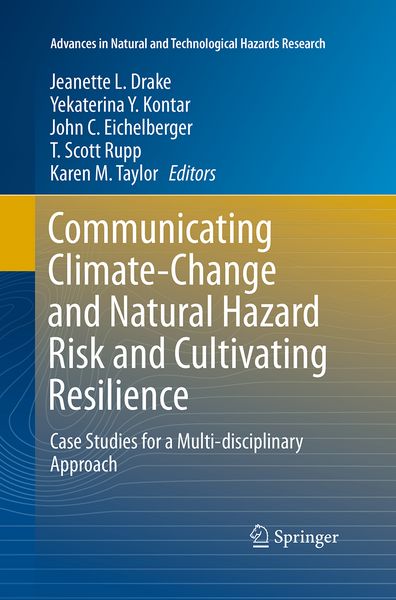
Communicating Climate-Change and Natural Hazard Risk and Cultivating Resilience Case Studies for a Multi-disciplinary Approach
-
- Hardcover
- Taschenbuch ausgewählt
- eBook
-
Sprache:Englisch
99,99 €
inkl. gesetzl. MwSt.,
Beschreibung
Produktdetails
Einband
Taschenbuch
Erscheinungsdatum
23.08.2016
Abbildungen
XXXII, 311 p.
Herausgeber
Jeanette L. Drake + weitereVerlag
SpringerSeitenzahl
311
Maße (L/B/H)
23,5/15,5/1,9 cm
Gewicht
522 g
Auflage
Softcover reprint of the original 1st ed. 2016
Sprache
Englisch
ISBN
978-3-319-37280-8
This edited volume emphasizes risk and crisis communication principles and practices within the up-to the minute context of new technologies, a new focus on resiliency, and global environmental change. It includes contributions from experts from around the globe whose research, advocacy, teaching, work, or service in the natural or social sciences deals with risk communication and/or management surrounding natural and technological disasters, with a particular focus on climate change-related phenomena. Resilience and good communication are intimately linked and with climate change precipitating more numerous and onerous weather-related catastrophes, a conversation on resilience is timely and necessary. The goal is robust communities that are able to withstand the shock of disaster. Communicating well under ordinary circumstances is challenging; communicating during a crisis is extraordinarily difficult.
This book is dedicated to all those who have directly or indirectly suffered the effects of climate change end extreme events with the hope that the advance of knowledge, implementation of sound science and appropriate policies and use of effective communication will help in reducing their vulnerability while also improving resilience in the face of often devastating natural and technological disasters.
Noch keine Bewertungen vorhanden
Verfassen Sie die erste Bewertung zu diesem Artikel
Helfen Sie anderen Kundinnen und Kunden durch Ihre Meinung.
Kurze Frage zu unserer Seite
Vielen Dank für Ihr Feedback
Wir nutzen Ihr Feedback, um unsere Produktseiten zu verbessern. Bitte haben Sie Verständnis, dass wir Ihnen keine Rückmeldung geben können. Falls Sie Kontakt mit uns aufnehmen möchten, können Sie sich aber gerne an unseren Kund*innenservice wenden.
zum Kundenservice