Gutscheinbedingungen

**Gültig bis 06.07.2026 auf fremdsprachige Bücher online auf thalia.at, in der Thalia App ab einem Mindestbestellwert von 30€ und in allen Thalia Buchhandlungen in Österreich. In den Buchhandlungen nur gültig auf lagernde Ware. Einzelne Artikel können ausgeschlossen sein. Ausgenommen sind preisgebundene Artikel & eBooks. Pro Einkauf einmal einlösbar. Nur gültig gegen Vorlage oder im Onlineshop hinterlegter Bonuscard. Infos zur Einlösung in der Buchhandlung sind auf der Bonuscard-Vorteilspreisseite zu finden. Click & Collect nur bei Onlinevorabzahlung möglich. Keine Einlösung bei Scan & Go-Bezahlung. Keine Barauszahlung. Nicht kombinierbar mit anderen Aktionen und Gutscheinen. Gutschein wird auf max. 500€ Bestellwert angerechnet. Nicht gültig für Versandkosten und Services.

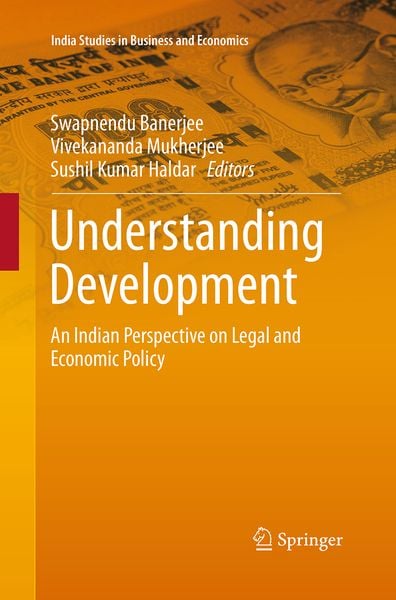
  • Produktbild: Understanding Development
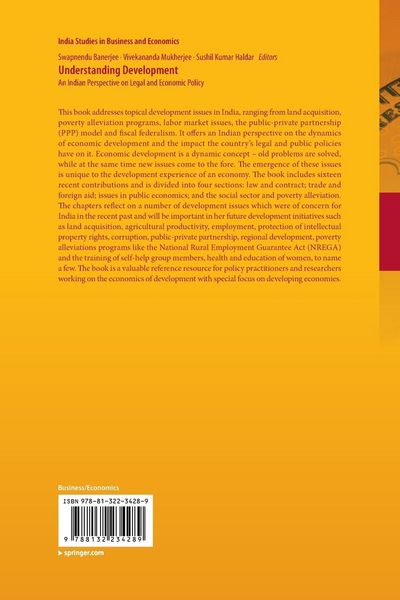
  • Produktbild: Understanding Development

Understanding Development An Indian Perspective on Legal and Economic Policy

49,99 €

inkl. gesetzl. MwSt., Versandkostenfrei


Beschreibung

Produktdetails

Einband

Taschenbuch

Erscheinungsdatum

23.08.2016

Abbildungen

X, 26 illus., 23 illus. in color., farbige Illustrationen, schwarz-weiss Illustrationen

Herausgeber

Swapnendu Banerjee + weitere

Verlag

Springer India

Seitenzahl

272

Maße (L/B/H)

23,5/15,5/1,6 cm

Gewicht

435 g

Auflage

Softcover reprint of the original 1st edition 2016

Sprache

Englisch

ISBN

978-81-322-3428-9

Beschreibung

Portrait

Swapnendu Banerjee is an associate professor at the Department of Economics, Jadavpur University, Kolkata, India. His areas of interest are microeconomic theory, game theory and economics of contracts. He completed his Ph.D. from Jadavpur University and subsequently did his postdoctoral research from the National University of Singapore (2004-2005). He has published extensively in reputed international journals and has given presentations and invited lectures at places like Cornell University (NY, USA), National University of Singapore, Indian Statistical Institute, Delhi School of Economics, Indian Institute of Management Calcutta and Indira Gandhi Institute of Development Research (India), among others.

Vivekananda Mukherjee is an associate professor at the Department of Economics, Jadavpur University, Kolkata, India. His areas of teaching and research interest are applied microeconomics, public economics, environment and natural resource economics. He has published in journals such as European Journal of Political Economy, Journal of Institutional and Theoretical Economics, Environment and Development Economics, Theory and Decision, Ecological Economics, to name a few.

Sushil Kumar Haldar is also an associate professor at the Department of Economics of Jadavpur University (JU). His areas of teaching and research interest are economics of social sector including economics of education, health, vulnerability and human poverty. His papers have been published in journals of national and international repute. He has completed many research projects on development issues funded by UNDP-Planning Commission-Govt. of India, European Union, UGC New Delhi, UPE JU (University with Potential for Excellence), CAS JU (Centre of Advanced Study), etc. Dr. Haldar has co-authored four books on development related issues from Indian perspectives.

Produktdetails

Einband

Taschenbuch

Erscheinungsdatum

23.08.2016

Abbildungen

X, 26 illus., 23 illus. in color., farbige Illustrationen, schwarz-weiss Illustrationen

Herausgeber

Verlag

Springer India

Seitenzahl

272

Maße (L/B/H)

23,5/15,5/1,6 cm

Gewicht

435 g

Auflage

Softcover reprint of the original 1st edition 2016

Sprache

Englisch

ISBN

978-81-322-3428-9

Herstelleradresse

Springer-Verlag KG
Sachsenplatz 4-6
1201 Wien
AT

Email: GPSR Kontakt

Noch keine Bewertungen vorhanden

Verfassen Sie die erste Bewertung zu diesem Artikel

Helfen Sie anderen Kundinnen und Kunden durch Ihre Meinung.

Kundinnen und Kunden meinen

Bewertungen (0)

  • Produktbild: Understanding Development
  • Produktbild: Understanding Development
  • 1. Introduction.- 2. Does an employment protection law matter? A panel data analysis of selected OECD countries, 1985-2012.- 3. Network of legal citations: an analysis of some supreme court decisions on land acquisition in India.- 4. Surrogacy Contracting and Intermediation.- 5. Sharecropping in theory and practice: a selective review.- 6. Trade in Intermediate Goods, Endogenous Growth and Intellectual Property Rights.- 7. Multi-market Firms and Export Quota: Effects of Withdrawal of the Multi-Fiber Arrangement.- 8. Does foreign aid corrupt? : A theoretical note.- 9. Public-private Partnerships and Governance.- 10. Principles of Allocating Development Grant at Sub-National Level in India: A Suggested Methodology.- 11. Fiscal rule and social sector spending: A study of north east India.- 12. An Analysis on Impact of Employment Generation Policies on Rural Women in West Bengal, India.- 13. Poverty in Best Bengal:  a review of recent performance and programmes.- 14. The Impact of MGNREGS on Rural Households: Evidence from a Quasi-Experiment.- 15. Does parental education have any role to play on female child disadvantage?. 16. School attendance and employment of youth in India: Convergence across caste and religious groups?.- 17. Adverse Effect of Bio-mass Fuel use on Pregnancy Outcome in Rural India.