KI-Beratung Beta

Gutscheinbedingungen

**Gültig am 27.11.2026 auf Spielzeug, Schreibwaren, Filme, Geschenke & Trends, Musik, tolino eReader & Zubehör, Hörbücher und Hörbuch-Downloads, nicht preisgebundene Bücher und Kalender online auf thalia.at und in der Thalia App. Einzelne Artikel können ausgeschlossen sein. Aufgrund der Buchpreisbindung sind deutschsprachige Bücher und eBooks ausgenommen. Zusätzlich ausgenommen sind Abos & Flatrates, Games, Geschenkkarten/-boxen, Shelfies, Software, Zeitschriften sowie einzelne Artikel von tonies®. Pro Einkauf einmal einlösbar. Click & Collect nur bei Onlinevorabzahlung möglich. Keine Barauszahlung. Nicht kombinierbar mit anderen Aktionen und Gutscheinen. Gutschein wird auf max. 500€ Bestellwert angerechnet. Nicht gültig für Versandkosten und Services.

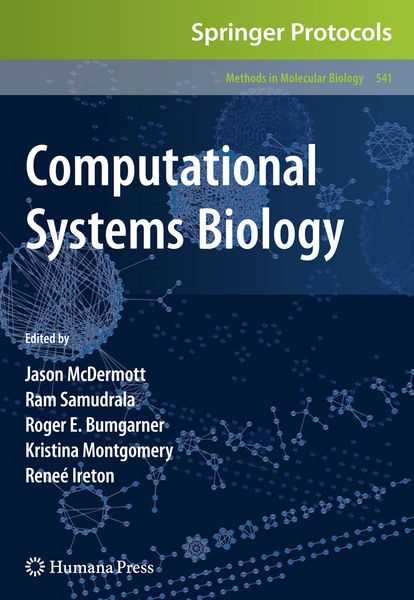
Produktbild: Computational Systems Biology
Band 541

Computational Systems Biology

119,99 €

inkl. gesetzl. MwSt., Versandkostenfrei


Beschreibung

Computational systems biology is the term that we use to describe computational methods to identify, infer, model, and store relationships between the molecules, pathways, and cells (‘‘systems’’) involved in a living organism. Based on this definition, the field of computational systems biology has been...

Beschreibung

Computational systems biology is the term that we use to describe computational methods to identify, infer, model, and store relationships between the molecules, pathways, and cells (‘‘systems’’) involved in a living organism. Based on this definition, the field of computational systems biology has been in existence for some time. However, the recent confluence of high-throughput methodology for biological data gathering,genome-scalesequencing,andcomputationalprocessingpowerhasdrivena reinvention and expansion of this field. The expansions include not only modeling of small metabolic (1–3) and signaling systems (2, 4) but also modeling of the relati- ships between biological components in very large systems, including whole cells and organisms (5–15). Generally, these models provide a general overview of one or more aspects of these systems and leave the determination of details to experimentalists focused on smaller subsystems. The promise of such approaches is that they will elucidate patterns, relationships, and general features, which are not evident from examining specific components or subsystems. These predictions are either interesting in and of themselves (e. g. , the identification of an evolutionary pattern) or interesting andvaluabletoresearchersworkingonaparticularproblem(e. g. ,highlightapreviously unknown functional pathway). Two events have occurred to bring the field of computational systems biology to theforefront. Oneistheadventofhigh-throughputmethodsthathavegeneratedlarge amounts of information about particular systems in the form of genetic studies, gene and protein expression analyses and metabolomics. With such tools, research to c- sidersystemsasawholearebeingconceived,planned,andimplementedexperimentally on an ever more frequent andwider scale.

Rezension

From the reviews:
“The new volume of the Humana Press ‘Methods in Molecular Biology’ series, entitled ‘Computational Systems Biology,’ consists of 25 chapters authored by 57 specialists in the field. … This book contains a wide collection of methods that … gives a broad review of this fascinating and quickly developing field. … for a computational biologist, it is a fascinating read, a broad and comprehensive resource on the current methods and approaches.” (Borys Wróbel, Acta Biochimica Polonica, Vol. 56, December, 2009)

Produktdetails

Einband

Taschenbuch

Erscheinungsdatum

23.08.2016

Abbildungen

XVIII, 592 p.

Herausgeber Jason McDermott + weitere

Produktdetails

Einband

Taschenbuch

Erscheinungsdatum

23.08.2016

Abbildungen

XVIII, 592 p.

Herausgeber
Verlag Humana Press
Seitenzahl

592

Maße (L/B/H)

26/19,3/3,3 cm

Gewicht

1258 g

Auflage

Softcover reprint of the original 1st ed. 2009

Sprache

Englisch

ISBN

978-1-4939-5644-9

Herstelleradresse

Springer-Verlag GmbH
Europaplatz 3
69115 Heidelberg
DE

Email: ProductSafety@springernature.com

Noch keine Bewertungen vorhanden

Verfassen Sie die erste Bewertung zu diesem Artikel

Helfen Sie anderen Kundinnen und Kunden durch Ihre Meinung.

Kundinnen und Kunden meinen

Bewertungen (0)

  • Produktbild: Computational Systems Biology
  • Network Components.- Identification of cis-Regulatory Elements in Gene Co-expression Networks Using A-GLAM.- Structure-Based Ab Initio Prediction of Transcription Factor–Binding Sites.- Inferring Protein–Protein Interactions from Multiple Protein Domain Combinations.- Prediction of Protein–Protein Interactions: A Study of the Co-evolution Model.- Computational Reconstruction of Protein–Protein Interaction Networks: Algorithms and Issues.- Prediction and Integration of Regulatory and Protein–Protein Interactions.- Detecting Hierarchical Modularity in Biological Networks.- Network Inference.- Methods to Reconstruct and Compare Transcriptional Regulatory Networks.- Learning Global Models of Transcriptional Regulatory Networks from Data.- Inferring Molecular Interactions Pathways from eQTL Data.- Methods for the Inference of Biological Pathways and Networks.- Network Dynamics.- Exploring Pathways from Gene Co-expression to Network Dynamics.- Network Dynamics.- Kinetic Modeling of Biological Systems.- Guidance for Data Collection and Computational Modelling of Regulatory Networks.- Function and Evolutionary Systems Biology.- A Maximum Likelihood Method for Reconstruction of the Evolution of Eukaryotic Gene Structure.- Enzyme Function Prediction with Interpretable Models.- Using Evolutionary Information to Find Specificity-Determining and Co-evolving Residues.- Connecting Protein Interaction Data, Mutations, and Disease Using Bioinformatics.- Effects of Functional Bias on Supervised Learning of a Gene Network Model.- Computational Infrastructure for Systems Biology.- Comparing Algorithms for Clustering of Expression Data: How to Assess Gene Clusters.- The Bioverse API and Web Application.- Computational Representation of Biological Systems.- Biological NetworkInference and Analysis Using SEBINI and CABIN.