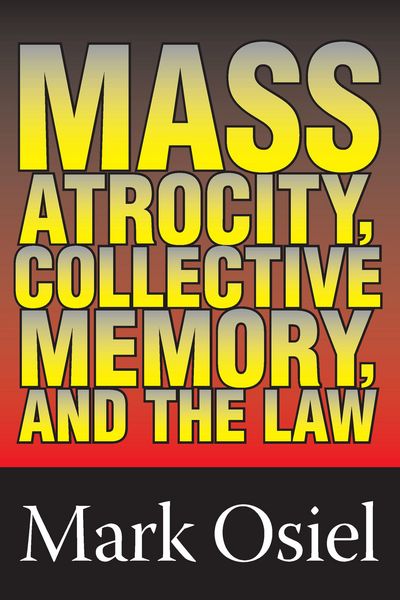
Mass Atrocity, Collective Memory, and the Law
-
- Hardcover
- Taschenbuch
- eBook ausgewählt
-
Form:Einzelkauf Download
-
Sprache:Englisch
-
eBook Format:PDF
- ePUB 3 69,40 €
- PDF 69,40 € ausgewählt
69,40 €
inkl. gesetzl. MwSt.Beschreibung
Produktdetails
Format
Kopierschutz
Ja
Family Sharing
Nein
Text-to-Speech
Nein
Erscheinungsdatum
12.07.2017
Herausgeber
Michael Curtis + weitereVerlag
Taylor & Francis eBooksSeitenzahl
317 (Printausgabe)
Dateigröße
18760 KB
Sprache
Englisch
EAN
9781351506687
Trials of those responsible for large-scale state brutality have captured public imagination in several countries. Prosecutors and judges in such cases, says Osiel, rightly aim to shape collective memory. They can do so hi ways successful as public spectacle and consistent with liberal legality. In defending this interpretation, he examines the Nuremburg and Tokyo trials, the Eicnmann prosecution, and more recent trials in Argentina and France. Such trials can never summon up a "collective conscience" of moral principles shared by all, he argues. But they can nonetheless contribute to a little-noticed kind of social solidarity.
To this end, writes Osiel, we should pay closer attention to the way an experience of administrative massacre is framed within the conventions of competing theatrical genres. Defense counsel will tell the story as a tragedy, while prosecutors will present it as a morality play. The judicial task at such moments is to employ the law to recast the courtroom drama in terms of a "theater of ideas," which engages large questions of collective memory and even national identity. Osiel asserts that principles of liberal morality can be most effectively inculcated in a society traumatized by fratricide when proceedings are conducted in this fashion.
The approach Osiel advocates requires courts to confront questions of historical interpretation and moral pedagogy generally regarded as beyond their professional competence. It also raises objections that defendants' rights will be sacrificed, historical understanding distorted, and that the law cannot willfully influence collective memory, at least not when lawyers acknowledge this aim. Osiel responds to all these objections, and others. Lawyers, judges, sociologists, historians, and political theorists will find this a compelling contribution to debates on the meaning and consequences of genocide.
Kundinnen und Kunden meinen
Verfassen Sie die erste Bewertung zu diesem Artikel
Helfen Sie anderen Kund*innen durch Ihre Meinung
Kurze Frage zu unserer Seite
Vielen Dank für Ihr Feedback
Wir nutzen Ihr Feedback, um unsere Produktseiten zu verbessern. Bitte haben Sie Verständnis, dass wir Ihnen keine Rückmeldung geben können. Falls Sie Kontakt mit uns aufnehmen möchten, können Sie sich aber gerne an unseren Kund*innenservice wenden.
zum Kundenservice