KI-Beratung Beta

Gutscheinbedingungen

**Gültig am 27.11.2026 auf Spielzeug, Schreibwaren, Filme, Geschenke & Trends, Musik, tolino eReader & Zubehör, Hörbücher und Hörbuch-Downloads, nicht preisgebundene Bücher und Kalender online auf thalia.at und in der Thalia App. Einzelne Artikel können ausgeschlossen sein. Aufgrund der Buchpreisbindung sind deutschsprachige Bücher und eBooks ausgenommen. Zusätzlich ausgenommen sind Abos & Flatrates, Games, Geschenkkarten/-boxen, Shelfies, Software, Zeitschriften sowie einzelne Artikel von tonies®. Pro Einkauf einmal einlösbar. Click & Collect nur bei Onlinevorabzahlung möglich. Keine Barauszahlung. Nicht kombinierbar mit anderen Aktionen und Gutscheinen. Gutschein wird auf max. 500€ Bestellwert angerechnet. Nicht gültig für Versandkosten und Services.

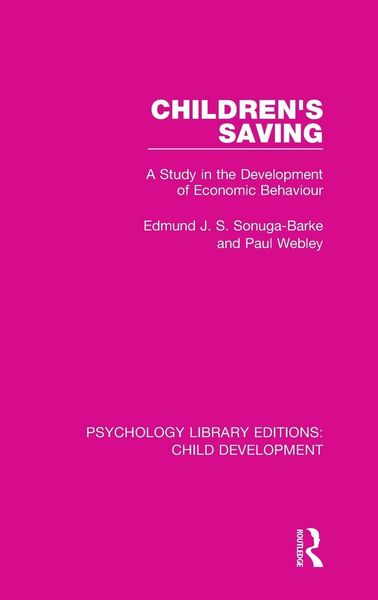
Produktbild: Children's Saving

Children's Saving A Study in the Development of Economic Behaviour

111,99 €

inkl. gesetzl. MwSt., Versandkostenfrei


Beschreibung

Originally published in 1993, this book presents an alternative approach to the study of the emergence of economic awareness during childhood: a new developmental economic psychology!

In the past, attempts to study the emergence of children's economic consciousness have failed to take account of the practical...

Beschreibung

Originally published in 1993, this book presents an alternative approach to the study of the emergence of economic awareness during childhood: a new developmental economic psychology!

In the past, attempts to study the emergence of children's economic consciousness have failed to take account of the practical nature of the "economic" in the history of western cultures. Economic socialisation has been seen as the acquisition of abstract knowledge about the institutions of adult economic culture. The child has been seen as a spectator, acquiring knowledge of that culture, but never really a part of it.

However, economic actions, in essence, are directed not towards the attainment of knowledge, but rather towards the practical solution of problems of resource allocation imposed by constraint. Children, just like adults, are faced with practical problems of resource allocation. Their response to these problems may be different from those of adults but no less "economic" for that.

This realisation forms the heart of this book. In it children are seen as both inhabitants of their own "playground" economic subculture and actors in the wider economic world of adults, solving, or attempting to solve, practical economic problems.

In order to highlight this "child-centred" approach, the authors studied the way children tackle the particular problems posed by limitations of income. How do children learn (a) the relationship between choices available in the present and the future, (b) to spread their limited financial resources over time into the future and (c) about the strategies, such as banking, that allow them to protect those resources from threats and temptations? In short, how do children learn to save?

This volume goes some way to answering these and related questions and in so doing sets up an alternative framework for the study of the emergence of economic awareness.

Produktdetails

Einband

Gebundene Ausgabe

Erscheinungsdatum

07.12.2017

Verlag Taylor & Francis
Seitenzahl

168

Produktdetails

Einband

Gebundene Ausgabe

Erscheinungsdatum

07.12.2017

Verlag Taylor & Francis
Seitenzahl

168

Maße (L/B/H)

23,4/15,6/1,1 cm

Gewicht

413 g

Sprache

Englisch

ISBN

978-1-138-08849-8

Herstelleradresse

Libri GmbH
Europaallee 1
36244 Bad Hersfeld
DE

Email: gpsr@libri.de

Noch keine Bewertungen vorhanden

Verfassen Sie die erste Bewertung zu diesem Artikel

Helfen Sie anderen Kundinnen und Kunden durch Ihre Meinung.

Kundinnen und Kunden meinen

Bewertungen (0)

Die Leseprobe wird geladen.
  • Produktbild: Children's Saving
  • Acknowledgements. 1. A New Focus for the Study of Children's Economic Affairs 2. Children's Saving as an Example of Economic Development 3. The Development of Functional Saving in a Play Economy 4. Extending the Boundaries of the Play Economy 5. Social Influences on Children's Saving 6. Contrasting the Economic, Social and Developmental Significance of Young Children's Behaviour 7. First Commentary: Cognitive Approaches to Economic Development Revisited, by Anna Emilia Berti 8. Second Commentary: How and Why Children Save, by Sharone L. Maital and Shlomo Maital 9. An Epilogue: Towards and Integral Developmental Economic Psychology. A Reply by the Authors. References. Author Index. Subject Index.