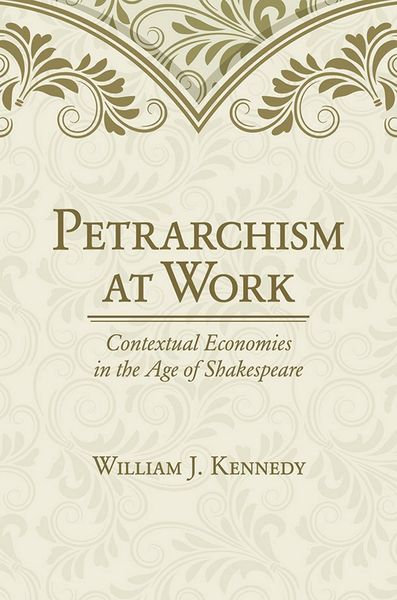
Petrarchism at Work Contextual Economies in the Age of Shakespeare
-
- Einzelkauf Download ausgewählt
-
Sprache:Englisch
43,99 €
inkl. gesetzl. MwSt.Beschreibung
Produktdetails
Format
ePUB
Kopierschutz
Nein
Family Sharing
Nein
Text-to-Speech
Ja
Erscheinungsdatum
19.04.2016
Verlag
Cornell University PressSeitenzahl
352 (Printausgabe)
Dateigröße
698 KB
Sprache
Englisch
EAN
9781501703805
The Italian scholar and poet Francesco Petrarch (1304-1374) is best remembered today for vibrant and impassioned love poetry that helped to establish Italian as a literary language. Petrarch inspired later Renaissance writers, who produced an extraordinary body of work regarded today as perhaps the high-water mark of poetic productivity in the European West. These "Petrarchan" poets were self-consciously aware of themselves as poets-as craftsmen, revisers, and professionals. As William J. Kennedy shows in Petrarchism at Work, this commitment to professionalism and the mastery of poetic craft is essential to understanding Petrarch's legacy.
Petrarchism at Work contributes to recent scholarship that explores relationships between poetics and economic history in early-modern European literature. Kennedy traces the development of a Renaissance aesthetics from one based upon Platonic intuition and visionary furor to one grounded in Aristotelian craftsmanship and technique. Their polarities harbor economic consequences, the first privileging the poet's divinely endowed talent, rewarded by the autocratic largess of patrons, the other emphasizing the poet's acquired skill and hard work. Petrarch was the first to exploit the tensions between these polarities, followed by his poetic successors. These include Gaspara Stampa in the emergent salon society of Venice, Michelangelo Buonarroti in the "gift" economy of Medici Florence and papal Rome, Pierre de Ronsard and the poets of his Pléiade brigade in the fluctuant Valois court, and William Shakespeare and his contemporaries in the commercial world of Elizabethan and early Stuart London. As Kennedy shows, the poetic practices of revision and redaction by Petrarch and his successors exemplify the transition from a premodern economy of patronage to an early modern economy dominated by unstable market forces.
Noch keine Bewertungen vorhanden
Verfassen Sie die erste Bewertung zu diesem Artikel
Helfen Sie anderen Kundinnen und Kunden durch Ihre Meinung.
Kurze Frage zu unserer Seite
Vielen Dank für Ihr Feedback
Wir nutzen Ihr Feedback, um unsere Produktseiten zu verbessern. Bitte haben Sie Verständnis, dass wir Ihnen keine Rückmeldung geben können. Falls Sie Kontakt mit uns aufnehmen möchten, können Sie sich aber gerne an unseren Kund*innenservice wenden.
zum Kundenservice