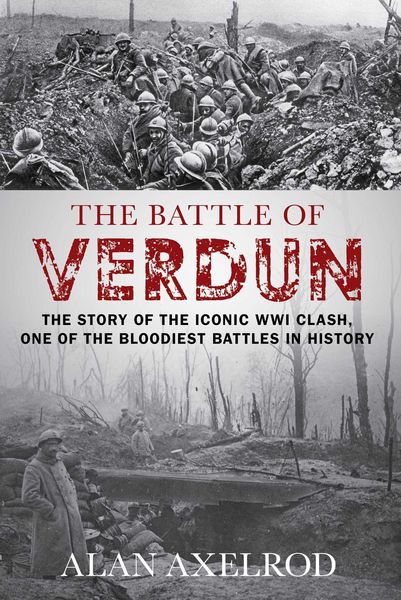
The Battle of Verdun
-
- Taschenbuch
- eBook ausgewählt
-
Form:Einzelkauf Download
-
Sprache:Englisch
16,26 €
inkl. gesetzl. MwSt.Beschreibung
Produktdetails
Format
ePUB
Kopierschutz
Ja
Family Sharing
Ja
Text-to-Speech
Ja
Erscheinungsdatum
01.04.2016
Verlag
Simon + Schuster LLCSeitenzahl
272 (Printausgabe)
Dateigröße
9184 KB
Sprache
Englisch
EAN
9781493022106
The Great War ate men, machines, and money without mercy or remission. At the end of 1915, the German army chief of staff, Erich von Falkenhayn, believed he knew how to finally kill the beast and win the war.
On Christmas day, 1915, Falkenhayn sent a letter to Kaiser Wilhelm II proposing a campaign to demoralize Britain, whose industrial might and maritime power were the foundation of the alliance against Germany, while also knocking France out of the war. He wrote that the "strain on France has reached breaking point …. If we succeed in opening the eyes of her people to the fact that in a military sense they have nothing more to hope for, that breaking point would be reached and England's best sword knocked out of her hand."
His plan was to attack a single point the French perceived as so vital that they would be compelled "to throw in every man they have." Falkenhayn concluded: "If they do so, the forces of France will bleed to death" or, as he put it later, the "French army would be bled white."
Falkenhayn's target of choice was Verdun, a place that, throughout virtually all of the history of Europe, had been a fortress. Located within a loop of the Meuse River, it occupied a strategic blocking position in the Meuse River valley. As recently as the Franco-Prussian War of 1871, Verdun had been the last of the French fortified cities to hold out against the German onslaught. After that war, it had been vastly augmented, so that it was now a circle of detached forts surrounding a central citadel. The town of Verdun itself, also fortified, was likewise encircled by forts distributed in a five-mile radius. The combined massive complex guarded not only passage through the river valley region, but also dominated a key railroad junction leading to points south, southwest, west, and north in France.
Along with the related, but separate, Battle of the Somme, Verdun was among the most deadly battles in history. To understand this struggle is to understand all of World War I, including the principal stated motive of Woodrow Wilson for bringing the United States into the "European War" in April 1917. For him, Verdun proved both France's determination to win at all costs and the likelihood that, without help, it would be defeated nevertheless. The unparalleled barbarity of Verdun, a product of the Old World, convinced the American president that only the principal nation of the New World could finally alter the grim course of human destiny. While many, both in 1916 and in the decades that followed, saw Verdun as a bloody monument to the inescapable futility of war, Wilson saw in it a hope for fighting what he would call a "war to end all wars."
On Christmas day, 1915, Falkenhayn sent a letter to Kaiser Wilhelm II proposing a campaign to demoralize Britain, whose industrial might and maritime power were the foundation of the alliance against Germany, while also knocking France out of the war. He wrote that the "strain on France has reached breaking point …. If we succeed in opening the eyes of her people to the fact that in a military sense they have nothing more to hope for, that breaking point would be reached and England's best sword knocked out of her hand."
His plan was to attack a single point the French perceived as so vital that they would be compelled "to throw in every man they have." Falkenhayn concluded: "If they do so, the forces of France will bleed to death" or, as he put it later, the "French army would be bled white."
Falkenhayn's target of choice was Verdun, a place that, throughout virtually all of the history of Europe, had been a fortress. Located within a loop of the Meuse River, it occupied a strategic blocking position in the Meuse River valley. As recently as the Franco-Prussian War of 1871, Verdun had been the last of the French fortified cities to hold out against the German onslaught. After that war, it had been vastly augmented, so that it was now a circle of detached forts surrounding a central citadel. The town of Verdun itself, also fortified, was likewise encircled by forts distributed in a five-mile radius. The combined massive complex guarded not only passage through the river valley region, but also dominated a key railroad junction leading to points south, southwest, west, and north in France.
Along with the related, but separate, Battle of the Somme, Verdun was among the most deadly battles in history. To understand this struggle is to understand all of World War I, including the principal stated motive of Woodrow Wilson for bringing the United States into the "European War" in April 1917. For him, Verdun proved both France's determination to win at all costs and the likelihood that, without help, it would be defeated nevertheless. The unparalleled barbarity of Verdun, a product of the Old World, convinced the American president that only the principal nation of the New World could finally alter the grim course of human destiny. While many, both in 1916 and in the decades that followed, saw Verdun as a bloody monument to the inescapable futility of war, Wilson saw in it a hope for fighting what he would call a "war to end all wars."
Noch keine Bewertungen vorhanden
Verfassen Sie die erste Bewertung zu diesem Artikel
Helfen Sie anderen Kundinnen und Kunden durch Ihre Meinung.
Kurze Frage zu unserer Seite
Vielen Dank für Ihr Feedback
Wir nutzen Ihr Feedback, um unsere Produktseiten zu verbessern. Bitte haben Sie Verständnis, dass wir Ihnen keine Rückmeldung geben können. Falls Sie Kontakt mit uns aufnehmen möchten, können Sie sich aber gerne an unseren Kund*innenservice wenden.
zum Kundenservice