KI-Beratung Beta

Gutscheinbedingungen

**Gültig am 27.11.2026 auf Spielzeug, Schreibwaren, Filme, Geschenke & Trends, Musik, tolino eReader & Zubehör, Hörbücher und Hörbuch-Downloads, nicht preisgebundene Bücher und Kalender online auf thalia.at und in der Thalia App. Einzelne Artikel können ausgeschlossen sein. Aufgrund der Buchpreisbindung sind deutschsprachige Bücher und eBooks ausgenommen. Zusätzlich ausgenommen sind Abos & Flatrates, Games, Geschenkkarten/-boxen, Shelfies, Software, Zeitschriften sowie einzelne Artikel von tonies®. Pro Einkauf einmal einlösbar. Click & Collect nur bei Onlinevorabzahlung möglich. Keine Barauszahlung. Nicht kombinierbar mit anderen Aktionen und Gutscheinen. Gutschein wird auf max. 500€ Bestellwert angerechnet. Nicht gültig für Versandkosten und Services.

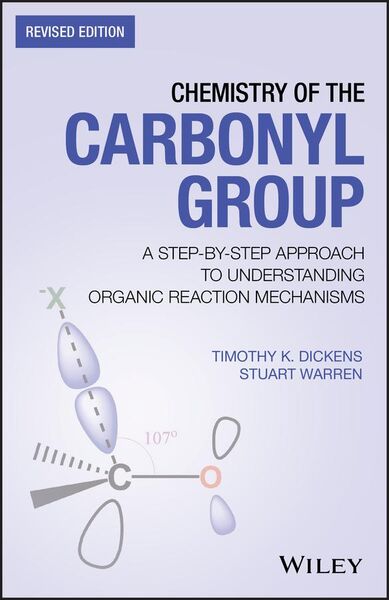
Produktbild: Chemistry of the Carbonyl Group

Chemistry of the Carbonyl Group A Step-by-Step Approach to Understanding Organic Reaction Mechanisms

57,99 €

inkl. gesetzl. MwSt., Versandkostenfrei


Beschreibung

Teaches and enables students to build confidence in drawing and manipulating curly arrows, a fundamental skill for all organic chemists   This book is an interactive approach to learning about chemistry of the carbonyl group--inviting students to work through its pages with pencil and paper in hand. It...

Beschreibung

Teaches and enables students to build confidence in drawing and manipulating curly arrows, a fundamental skill for all organic chemists
 
This book is an interactive approach to learning about chemistry of the carbonyl group--inviting students to work through its pages with pencil and paper in hand. It educates with the belief that the most effective way to learn is by practice and interaction. With this in mind, the reader is asked to predict what would happen under a specific set of reaction conditions. The book is divided into frames: each frame poses a question and invites the reader to predict what will happen. Subsequent frames give the solution but then pose more questions to develop a theme further.
 
Chemistry of the Carbonyl Group: A Programmed Approach to Organic Reaction Mechanisms, Revised Edition provides a solid grounding in the fundamental reactions of carbonyls. Presented in full colour to enhance the understanding of mechanisms within chemistry, the chapters of this step-by-step guide cover: nucleophilic addition to the carbonyl group; nucleophilic substitution; nucleophilic substitution at the carbonyl group with complete removal of carbonyl oxygen; carbanions and enolisation; and building organic molecules from carbonyl compounds.
* A must-have book for undergraduate chemists to emphasise understanding in carbonyl group chemistry
* Goes through all the stages of basic carbonyl chemistry, detailing even the simplest mechanisms
* A step-by-step learning guide to synthetic chemistry for the first year of a chemistry degree, with all the information needed for independent learning
* Provides a solid grounding in the fundamental reactions of carbonyls which will inform the understanding of many other organic chemistry reactions
 
Chemistry of the Carbonyl Group: A Programmed Approach to Organic Reaction Mechanisms - Revised Edition is packed with all the information on synthetic chemistry that every first-year student will need in order to learn independently.

Produktdetails

Einband

Taschenbuch

Erscheinungsdatum

10.07.2018

Verlag John Wiley & Sons Inc
Seitenzahl

192

Produktdetails

Einband

Taschenbuch

Erscheinungsdatum

10.07.2018

Verlag John Wiley & Sons Inc
Seitenzahl

192

Maße (L/B/H)

21,6/13,9/1,2 cm

Gewicht

268 g

Auflage

2nd Revised edition

Sprache

Englisch

ISBN

978-1-119-45956-9

Herstelleradresse

Libri GmbH
Europaallee 1
36244 Bad Hersfeld
DE

Email: gpsr@libri.de

Noch keine Bewertungen vorhanden

Verfassen Sie die erste Bewertung zu diesem Artikel

Helfen Sie anderen Kundinnen und Kunden durch Ihre Meinung.

Kundinnen und Kunden meinen

Bewertungen (0)

Die Leseprobe wird geladen.
  • Produktbild: Chemistry of the Carbonyl Group
  • Preface xi

    Acknowledgements xiii

    Some Help That You May Need xv

    What Do You Need to Know Before You Start? xvii

    Introduction xix

    1 Nucleophilic Addition to the Carbonyl Group 1

    Nucleophilic addition: what it is and how it happens 3

    Alcohols as nucleophiles: acetal formation 6

    Some carbon-carbon bond-forming reactions with carbon nucleophiles: cyanide ion, acetylide ion and Grignard reagents 10

    Hydride ion and its derivatives LiAlH4 and NaBH4 Reduction of aldehydes and ketones 17

    Meerwein-Ponndorf reduction and Oppenauer oxidation, with a branch program on how to draw transition states 19

    Two general revision problems 25

    2 Nucleophilic Substitution 29

    Substitution: how it happens 31

    LiAlH4 reduction of esters 33

    Reaction of Grignard reagents with esters 34

    Alkaline hydrolysis of esters 38

    Acid hydrolysis of amides 39

    Summary of acid and base catalysis 41

    Reaction between carboxylic acids and thionyl chloride 41

    Synthesis of esters and anhydrides from carboxylic acids 43

    Review questions 45

    3 Nucleophilic Subsitution at the Carbonyl Group with Complete Removal of Carbonyl Oxygen 49

    Imine formation from aldehydes and ketones 51

    Oxime formation and the structure of oximes 53

    Hydrazone and semicarbazone formation 54

    Reduction of C=O to CH2 56

    Conversion of C=O to CCl2 60

    DDT synthesis 64

    Chloromethylation of aromatic compounds 65

    Review questions 66

    4 Carbanions and Enolisation 69

    Carbanions 71

    Tautomerism 72

    Equilibration and racemisation of ketones by enolisation 73

    Halogenation of ketones 78

    Formation of bromo-acid derivatives 83

    Organo-zinc derivatives and their use in synthesis 85

    Review questions 87

    5 Building Organic Molecules from Carbonyl Compounds 89

    Using enols as nucleophiles to attack other carbonyl groups 92

    The aldol reaction 92

    The Claisen ester condensation 93

    Acid catalysed condensation of acetone 94

    Self-condensation reactions 96

    Elaboration of a skeleton in synthesis 97

    Cross-condensations with molecules which cannot enolise 98

    Mannich reaction 103

    Perkin reaction 105

    Stable enols from ß-dicarbonyl compounds 108

    Knoevenagel reaction 110

    Alkylation of ß-dicarbonyl compounds 113

    Michael reaction 116

    Decarboxylation 125

    Base cleavage of ß-dicarbonyl compounds 131

    Cyclisation reactions: the Dieckmann condensation 134

    Cyclisation of diketones 136

    The dimedone synthesis 137

    Ring opening by base cleavage of ß-dicarbonyl compounds 141

    Revision questions 142

    Examples of syntheses: two steroid syntheses 145

    Stork's cedrene synthesis 150

    Index 155