
KI-Beratung Beta

Gutscheinbedingungen

**Gültig bis 18.11.2026 auf englischsprachige Klassiker (klassiker-32728) online auf thalia.at und in der Thalia App. Einzelne Artikel können ausgeschlossen sein. Ausgenommen sind preisgebundene Artikel & eBooks. Pro Einkauf einmal einlösbar. Click & Collect nur bei Onlinevorabzahlung möglich. Keine Barauszahlung. Nicht kombinierbar mit anderen Aktionen und Gutscheinen. Gutschein wird auf max. 500€ Bestellwert angerechnet. Nicht gültig für Geschenkkarten, Versandkosten und Services.

  • Produktbild: The Worlds of Positivism
  • Produktbild: The Worlds of Positivism

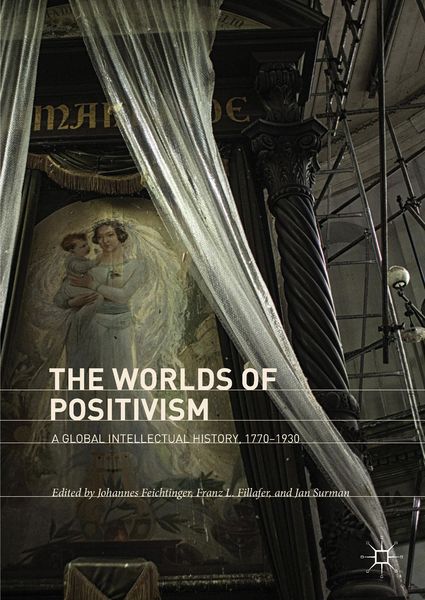
The Worlds of Positivism A Global Intellectual History, 1770–1930

128,99 €

inkl. gesetzl. MwSt., Versandkostenfrei


Beschreibung

This book is the first to trace the origins and significance of positivism on a global scale. Taking their cues from Auguste Comte and John Stuart Mill, positivists pioneered a universal, experience-based culture of scientific inquiry for studying nature and society—a new science that would enlighten...

Beschreibung

This book is the first to trace the origins and significance of positivism on a global scale. Taking their cues from Auguste Comte and John Stuart Mill, positivists pioneered a universal, experience-based culture of scientific inquiry for studying nature and society—a new science that would enlighten all of humankind. Positivists envisaged one world united by science, but their efforts spawned many. Uncovering these worlds of positivism, the volume ranges from India, the Ottoman Empire, and the Iberian Peninsula to Central Europe, Russia, and Brazil, examining positivism’s impact as one of the most far-reaching intellectual movements of the modern world. Positivists reinvented science, claiming it to be distinct from and superior to the humanities. They predicated political governance on their refashioned science of society, and as political activists, they sought and often failed to reconcile their universalism with the values of multiculturalism. Providing a genealogy of scientific governance that is sorely needed in an age of post-truth politics, this volume breaks new ground in the fields of intellectual and global history, the history of science, and philosophy.

Portrait


Johannes Feichtinger is Senior Research Associate at the Austrian Academy of Sciences and Visiting Professor for modern history and the philosophy of science at the University of Vienna, Austria.
Franz L. Fillafer is Lecturer in modern and contemporary history at the University of Konstanz, Germany.
Jan Surman is Visiting Scholar at the Max Web Centre for Advanced Cultural and Social Studies, University of Erfurt, Germany.

Produktdetails

Einband

Gebundene Ausgabe

Erscheinungsdatum

07.02.2018

Abbildungen

XX, 367 p. 6 illus., 1 illus. in color.

Herausgeber Johannes Feichtinger + weitere

Produktdetails

Einband

Gebundene Ausgabe

Erscheinungsdatum

07.02.2018

Abbildungen

XX, 367 p. 6 illus., 1 illus. in color.

Herausgeber
Verlag Springer
Seitenzahl

367

Maße (L/B/H)

21,6/15,3/2,6 cm

Gewicht

574 g

Sprache

Englisch

ISBN

978-3-319-65761-5

Herstelleradresse

Springer-Verlag GmbH
Europaplatz 3
69115 Heidelberg
DE

Email: ProductSafety@springernature.com

Noch keine Bewertungen vorhanden

Verfassen Sie die erste Bewertung zu diesem Artikel

Helfen Sie anderen Kundinnen und Kunden durch Ihre Meinung.

Kundinnen und Kunden meinen

Bewertungen (0)

  • Produktbild: The Worlds of Positivism
  • Produktbild: The Worlds of Positivism

  • 1. Introduction: Particularizing Positivism.- I. Empires of Positivism.- 2. Striking a Chord: The Reception of Comte's Positivism in Colonial India.- 3. Positivism, Revolution and History in Brazil.- 4. Positivism in the Late Ottoman Empire: The "Young Turks" as Mediators and Multipliers.- II. Positive Knowledge and the Making of Positivism.- 5. An Enlightened Path to Positivism? Reflections on the Institutionalization of Science in Bourbon Spain.- 6. Trading Epistemological Insults: "Positive Knowledge" and Natural Science in Germany, 1800–1850.- 7. The French Philosophical Crisis of the 1860s and the Invention of the "Positivist School".- III. The Liberal Politics of Science and Society.- 8. Habsburg Positivism: The Politics of Positive Knowledge in Imperial and Post-Imperial Austria, 1804–1938.- 9. The Contexts of Early Polish Positivisms, 1840s–1900s.- 10. Positivism in Late Tsarist Russia: Its Introduction, Penetration and Diffusion.- IV. Positivist Aftermath.- 11. Positivism in the Northern Peripheries: Generations of Positivist Philosophers in Sweden and Its Neighboring Countries.- 12. Dilthey and Carnap: The Feeling of Life, the Scientific Worldview, and the Elimination of Metaphysics.- 13. Epilogue: The Worlds of Positivism: An Analytical Synopsis.