KI-Beratung Beta

Gutscheinbedingungen

**Gültig bis 18.11.2026 auf englischsprachige Klassiker (klassiker-32728) online auf thalia.at und in der Thalia App. Einzelne Artikel können ausgeschlossen sein. Ausgenommen sind preisgebundene Artikel & eBooks. Pro Einkauf einmal einlösbar. Click & Collect nur bei Onlinevorabzahlung möglich. Keine Barauszahlung. Nicht kombinierbar mit anderen Aktionen und Gutscheinen. Gutschein wird auf max. 500€ Bestellwert angerechnet. Nicht gültig für Geschenkkarten, Versandkosten und Services.

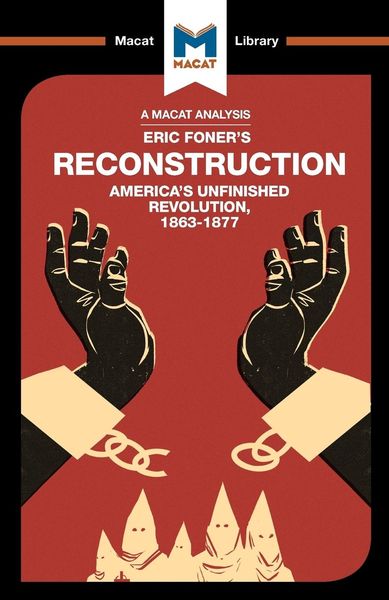
  • Produktbild: An Analysis of Eric Foner's Reconstruction
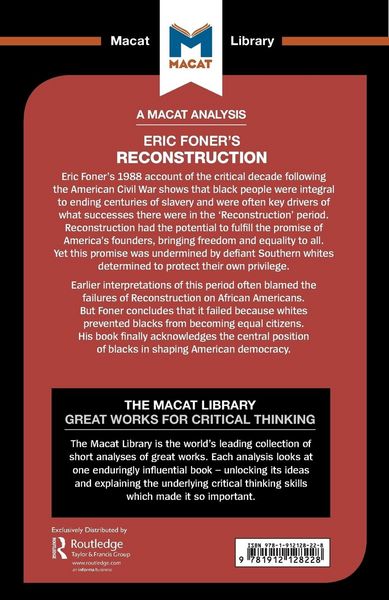
  • Produktbild: An Analysis of Eric Foner's Reconstruction

An Analysis of Eric Foner's Reconstruction America's Unfinished Revolution 1863-1877

Aus der Reihe The Macat Library

8,99 €

inkl. gesetzl. MwSt., zzgl. Versandkosten


  • Kostenlose Lieferung ab 30 € Einkaufswert
  • Versandkostenfrei für Bonuscard-Kund*innen

Beschreibung

'Reconstruction' is the name given to the period that, beginning shortly before the end of the American Civil War and running until 1877, saw the frustration of federal government's attempts to integrate the newly freed slaves into the American political and economic system. It ended in frustration,...

Beschreibung

'Reconstruction' is the name given to the period that, beginning shortly before the end of the American Civil War and running until 1877, saw the frustration of federal government's attempts to integrate the newly freed slaves into the American political and economic system. It ended in frustration, disillusionment and also violence, with individual southern states denying rights to freed slaves, preventing them from voting, and largely forcing them back into roles that exploited their labor and prevented them from gaining access to education.

For much of the 20th century, the predominant view of the Reconstruction period was that of the Dunning School, which argued that former slaves were unprepared for the responsibilities of voting and holding office, and that it was their incapability of handling such responsibilities - and not the racist actions of whites - that was largely responsible for the failures of the Reconstruction period. Eric Foner's great work reverses those judgements. Foner adopts a problem-solving approach, asking productive questions of state archives and generating and assessing alternative possibilities to assess the views of the Dunning School in a much wider context. His verdict - that slaves and freedmen were often key figures who shaped the eventual emergence of a more progressive American democracy - is backed up by persuasive reasoning which explains how these results came about and shows how the white establishment, led by President Andrew Johnson, was primarily responsible for the disasters of the Reconstruction era.

Produktdetails

Einband

Taschenbuch

Erscheinungsdatum

04.07.2017

Verlag Taylor & Francis
Seitenzahl

104

Produktdetails

Einband

Taschenbuch

Erscheinungsdatum

04.07.2017

Verlag Taylor & Francis
Seitenzahl

104

Maße (L/B/H)

19,8/12,9/0,6 cm

Gewicht

121 g

Sprache

Englisch

ISBN

978-1-912128-22-8

EU-Ansprechpartner

Taylor & Francis Verlag GmbH
Kaufingerstraße 24
80331 München
DE
GPSR@taylorandfrancis.com

Herstelleradresse

Taylor & Francis Group
5 Howick Place
SW1P 1WG London
UK
GPSR@taylorandfrancis.com

Noch keine Bewertungen vorhanden

Verfassen Sie die erste Bewertung zu diesem Artikel

Helfen Sie anderen Kundinnen und Kunden durch Ihre Meinung.

Kundinnen und Kunden meinen

Bewertungen (0)

Die Leseprobe wird geladen.
  • Produktbild: An Analysis of Eric Foner's Reconstruction
  • Produktbild: An Analysis of Eric Foner's Reconstruction
  • Ways in to the Text  Who was Eric Foner?  What does Reconstruction Say?  What does Reconstruction Matter?  Section 1: Influences  Module 1: The Author and the Historical Context  Module 2: Academic Context  Module 3: The Problem  Module 4: The Author's Contribution  Section 2: Ideas  Module 5: Main Ideas  Module 6: Secondary Ideas  Module 7: Achievement  Module 8: Place in the Author's Work  Section 3: Impact  Module 9: The First Responses  Module 10: The Evolving Debate  Module 11: Impact and Influence Today  Module 12: Where Next?  Glossary of Terms  People Mentioned in the Text  Works Cited