Gutscheinbedingungen

**Gültig bis 14.09.2026 auf Spielzeug, Schreibwaren, Filme, Geschenke & Trends, Musik, tolino eReader & Zubehör, Hörbücher, nicht preisgebundene Bücher und Kalender in der Thalia App. Einzelne Artikel können ausgeschlossen sein. Aufgrund der Buchpreisbindung sind deutschsprachige Bücher und eBooks ausgenommen. Zusätzlich ausgenommen sind Abos & Flatrates, Games, Geschenkkarten/-boxen, Shelfies, Software, Zeitschriften sowie einzelne Artikel von tonies®. Pro Einkauf einmal einlösbar. Nur gültig mit im Onlineshop hinterlegter Bonuscard. Click & Collect nur bei Onlinevorabzahlung möglich. Keine Barauszahlung. Nicht kombinierbar mit anderen Aktionen und Gutscheinen. Gutschein wird auf max. 500€ Bestellwert angerechnet. Nicht gültig für Versandkosten und Services.

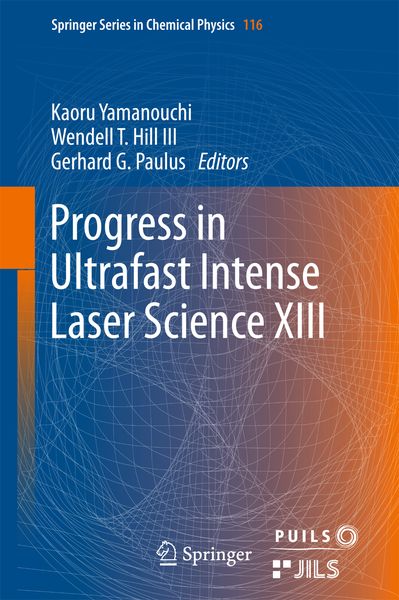
  • Produktbild: Progress in Ultrafast Intense Laser Science XIII
  • Produktbild: Progress in Ultrafast Intense Laser Science XIII
Band 116 - 10%

Progress in Ultrafast Intense Laser Science XIII

10% sparen

147,99 € UVP 164,99 €

inkl. gesetzl. MwSt., Versandkostenfrei


Beschreibung

Produktdetails

Einband

Gebundene Ausgabe

Erscheinungsdatum

11.01.2018

Abbildungen

XIII, 223 p. 99 illus., 83 illus. in color.

Herausgeber

Kaoru Yamanouchi + weitere

Verlag

Springer

Seitenzahl

223

Maße (L/B/H)

24,1/16/1,9 cm

Gewicht

530 g

Auflage

1st ed. 2017

Sprache

Englisch

ISBN

978-3-319-64839-2

Beschreibung

Portrait


Kaoru Yamanouchi has been Professor of Chemistry at The University of Tokyo since April 1997. His research fields are in physical chemistry and AMO physics, especially gas phase laser spectroscopy, chemical reaction dynamics, and intense laser science. In 1996, he launched a new research project to investigate how atoms, molecules, and clusters behave in an intense laser field whose magnitude is as large as that of a Coulomb field within atoms and molecules. By developing new experimental techniques such as mass-resolved momentum imaging, pulsed gas electron diffraction, and coincidence momentum imaging, he has continued a successful exploration of the new research field of ultrafast intense laser science. Among his discoveries, ultrafast structural deformation of molecules and ultrafast hydrogen atom migration within hydrocarbon molecules are particularly noteworthy. He has also demonstrated that the ultrafast structural changes of molecules can in principle be probed in real time with femtosecond temporal resolution using a method called laser-assisted electron diffraction.

Wendell T. Hill, III has held the rank of Professor since 1996 at the University of Maryland, College Park, with appointments in the Institute for Physical Science and Technology and the Department of Physics; he has been a fellow of the Joint Quantum Institute at the University of Maryland since 2006.  From high-energy particle physics to atomic, molecular and optical (AMO) physics to condensed matter physics, Hill’s publications span a broad range of physics subdisciplines.  His current investigations fall into three AMO areas:  ultrafast quantum dynamics; ultraintense laser-matter interactions; ultracold quantum atoms.  His group was one of the first to employ velocity-map imaging, coupled with optimal-control techniques, to control femtosecond molecular dynamics.  His most recent work finds him developing approaches to exploit phase-locked pairs of pulses, both to control dynamics and todecipher optimal control pulses. In addition to numerous journal manuscripts, he wrote the introductory chapter on electromagnetic radiation for the “Encyclopedia of Applied Spectroscopy,” published in 2009 by Wiley, co-author the physics text “Light-Matter Interaction: Atoms and Molecules in External Fields and Nonlinear Optics,” published in 2007 by Wiley and co-edited “Progress in Ultrafast Intense Laser Science VIII,” published in 2012 by Springer Science. 


Gerhard G. Paulus has been a Professor of Nonlinear Optics at Friedrich Schiller University since September 2007, after leaving Texas A&M University, where he was Associate Professor of Physics since 2003. Currently, he is the dean of the Faculty of Physics and Astronomy of his university. His research fields are strong-field and attosecond laser physics, high-precision X-ray polarimetry, and XUV nanoscale imaging. Key contributions are the discovery of the plateau in above-threshold ionization spectra and the measurement of the CE phase, the demonstration of X-ray polarimeters with an extinction ratio of 10 billion, and, most recently, the realization of optical coherence tomography in the extreme ultraviolet with nanometer resolution.

Produktdetails

Einband

Gebundene Ausgabe

Erscheinungsdatum

11.01.2018

Abbildungen

XIII, 223 p. 99 illus., 83 illus. in color.

Herausgeber

Verlag

Springer

Seitenzahl

223

Maße (L/B/H)

24,1/16/1,9 cm

Gewicht

530 g

Auflage

1st ed. 2017

Sprache

Englisch

ISBN

978-3-319-64839-2

Herstelleradresse

Springer-Verlag KG
Sachsenplatz 4-6
1201 Wien
AT

Email: ProductSafety@springernature.com

Noch keine Bewertungen vorhanden

Verfassen Sie die erste Bewertung zu diesem Artikel

Helfen Sie anderen Kundinnen und Kunden durch Ihre Meinung.

Kundinnen und Kunden meinen

Bewertungen (0)

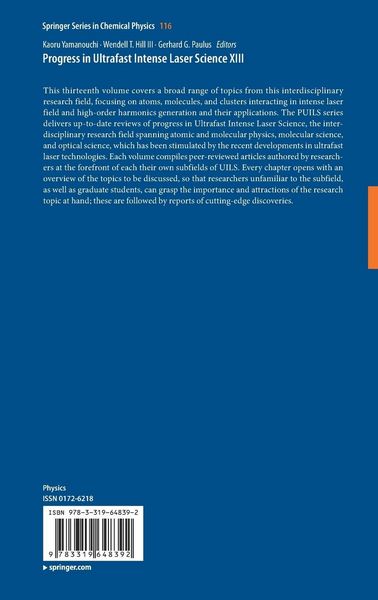
  • Produktbild: Progress in Ultrafast Intense Laser Science XIII
  • Produktbild: Progress in Ultrafast Intense Laser Science XIII

  • Strong-Feld S-Matrix Series with Coulomb Wave Final State.- Multiconfiguration Methods for Time-Dependent Many-Electron Dynamics.- Controlling Coherent Quantum Nuclear Dynamics in LiH by Ultra Short IR Atto Pulses.- Probing Multiple Molecular Orbitals in an Orthogonally Polarized Two-color Laser Field.- Tracing Nonlinear Cluster Dynamics Induced by Intense XUV, NIR and MIR Laser Pulses.- Molecules in Bichromatic Circularly Polarized Laser Pulses: Electron Recollision and Harmonic Generation.- High Harmonic Phase Spectroscopy Using Long Wavelengths.- Strong-Field-Assisted Measurement of Near-Fields and Coherent Control of Photoemission at Nanometric Metal Tips.- Advanced Laser Facilities and Scientific Applications.- The Extreme Light Infrastructure – Attosecond Light Pulse Source (ELI-ALPS) Project.