KI-Beratung Beta

Gutscheinbedingungen

**Gültig bis 30.11.2026 auf Spielzeug, Schreibwaren, Filme, Geschenke & Trends, Musik, tolino eReader & Zubehör, Hörbücher und Hörbuch-Downloads, nicht preisgebundene Bücher und Kalender online auf thalia.at und in der Thalia App. Einzelne Artikel können ausgeschlossen sein. Aufgrund der Buchpreisbindung sind deutschsprachige Bücher und eBooks ausgenommen. Zusätzlich ausgenommen sind Abos & Flatrates, Games, Geschenkkarten/-boxen, Shelfies, Software, Zeitschriften sowie einzelne Artikel von tonies®. Pro Einkauf einmal einlösbar. Nur gültig mit im Onlineshop hinterlegter Bonuscard. Click & Collect nur bei Onlinevorabzahlung möglich. Keine Barauszahlung. Nicht kombinierbar mit anderen Aktionen und Gutscheinen. Gutschein wird auf max. 500€ Bestellwert angerechnet. Nicht gültig für Versandkosten und Services.

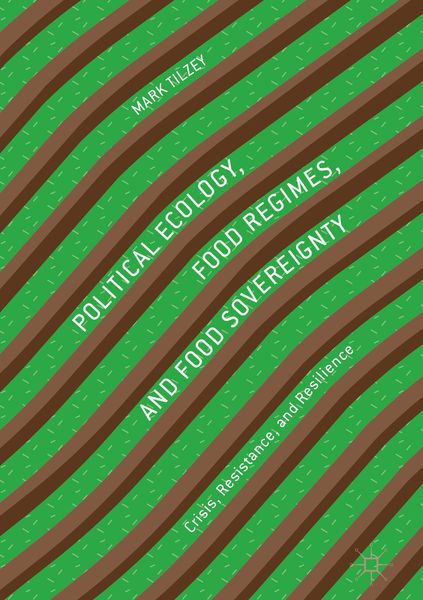
  • Produktbild: Political Ecology, Food Regimes, and Food Sovereignty
  • Produktbild: Political Ecology, Food Regimes, and Food Sovereignty

Political Ecology, Food Regimes, and Food Sovereignty Crisis, Resistance, and Resilience

108,99 €

inkl. gesetzl. MwSt., Versandkostenfrei


Beschreibung

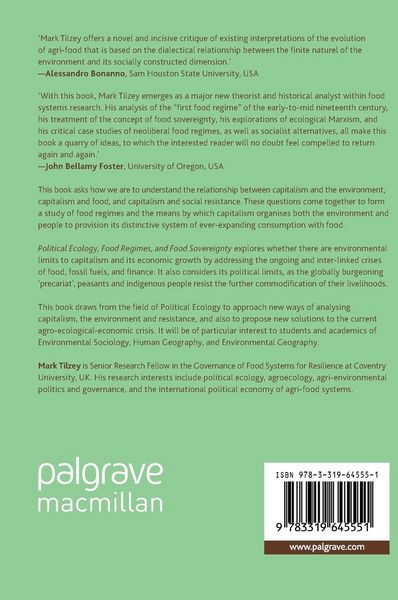
This book asks how we are to understand the relationship between capitalism and the environment, capitalism and food, and capitalism and social resistance. These questions come together to form a study of food regimes and the means by which capitalism organises both the environment and people to provision...

Beschreibung

This book asks how we are to understand the relationship between capitalism and the environment, capitalism and food, and capitalism and social resistance. These questions come together to form a study of food regimes and the means by which capitalism organises both the environment and people to provision its distinctive system of ever-expanding consumption with food.
Political Ecology, Food Regimes, and Food Sovereignty
explores whether there are environmental limits to capitalism and its economic growth by addressing the ongoing and inter-linked crises of food, fossil fuels, and finance. It also considers its political limits, as the globally burgeoning ‘precariat’, peasants and indigenous people resist the further commodification of their livelihoods.
This book draws from the field of Political Ecology to approach new ways of analysing capitalism, the environment and resistance, and also to propose new solutions to the current agro-ecological-economiccrisis.

It will be of particular interest to students and academics of Environmental Sociology, Human Geography, and Environmental Geography. 

Produktdetails

Einband

Gebundene Ausgabe

Erscheinungsdatum

13.11.2017

Abbildungen

VIII, 394 p.

Verlag Springer

Produktdetails

Einband

Gebundene Ausgabe

Erscheinungsdatum

13.11.2017

Abbildungen

VIII, 394 p.

Verlag Springer
Seitenzahl

394

Maße (L/B/H)

21,6/15,3/2,7 cm

Gewicht

594 g

Auflage

1st ed. 2018

Sprache

Englisch

ISBN

978-3-319-64555-1

Herstelleradresse

Springer-Verlag GmbH
Europaplatz 3
69115 Heidelberg
DE

Email: ProductSafety@springernature.com

Noch keine Bewertungen vorhanden

Verfassen Sie die erste Bewertung zu diesem Artikel

Helfen Sie anderen Kundinnen und Kunden durch Ihre Meinung.

Kundinnen und Kunden meinen

Bewertungen (0)

  • Produktbild: Political Ecology, Food Regimes, and Food Sovereignty
  • Produktbild: Political Ecology, Food Regimes, and Food Sovereignty
  • 1. Introduction .- Section 1: Political Ecology, Food Regimes, and Food Sovereignty .- 2. Political Ecology and Social Systems: An Integrated, but Differentiated, Theory of Socio-Natural Dynamics .- 3. Political Ecology, Capitalism, and Food Regimes .- 4.The ‘First’ or British ‘Liberal’ Food Regime 1840-1870; The ‘Second’ or ‘Imperial’ Food Regime 1870-1930 .- 5. The Rise and Demise of the ‘Third’ or ‘Political Productivist’ Food Regime 1930-1980 .- Section 2: Crisis and Resistance .- 7. The Neoliberal Food Regime in Crisis? .- 8. Crisis and Resistance: Reform or Revolution? .- Section 3: Country Case Studies .- 9. Prelude to the Country Case Studies: The Agrarian Question and Food Sovereignty Movements .- 10. Bolivia .- 11. Ecuador .- 12. Nepal .- 13. China .- Section 4: Resilience as Counter-Hegemony .- 14. ‘Understanding the World in Order to Change It’: What Might Food Sovereignty Look Like? Or a Normative Political Ecology as Livelihood Sovereignty.